“Cada cirujano lleva dentro de sí un pequeño cementerio, donde de vez en cuando va a orar. Un lugar de amargura y pesar, en el que debe buscar una explicación para sus fracasos”.
René Leriche. La filosofía de la cirugía (1951).
This study shows that higher post-procedural gradients after TAVI are associated with an increased risk of structural valve deterioration. This has practical implications, as gradients may be reduced through device and procedural strategies, including supra-annular valves in small annuli, more liberal post-dilation, and surgical valve fracturing in valve-in-valve procedures. https://t.co/op1bgNVmuh
📌Me gustaría saber la versión de @sanidadgob
🎯Pero pretender reducir la remuneración por pregunta, de los ya miserables 15€/preg, a 9€ (o 12 qué más da), es patético e insultante, y traduce perfectamente el valor que se asume tiene nuestro trabajo. Si es verdad claro
Rafa Nadal said beautiful words to Roger Federer, Novak Djokovic, and Andy Murray during his Roland Garros tribute:
“After all these years fighting for everything it’s unbelievable how the time changes perspective of everything. You don’t know yet Novak. Probably you know already Andy. With Roger we have talked about it a couple times. All of the nerves, pressure, strange feelings you feel when we see each other when we are rivals.. it’s completely different when you finish your career. At the end, now, it’s all about being happy about everything that we achieved. At the end, all of us achieved our dreams. We became tennis players. Played in the most important stages of our careers. I think we built amazing rivalries but at the same time in a good way. We showed the world that we can fight as hard as possible, but being good colleagues and respect each other very well. And for me, it means a lot that you are all here.. You gave me some hard times on court honestly 😂 but I really enjoyed pushing myself to the limit every single day to compete with all of you. At the end tennis is just a game. Sometimes we feel a bit more. But we understand at the end of the day, it’s really only a game. What it means for me that all of you are here is everything. It’s a great message to the world that we can be good friends even if we had the best rivalries. Thank you very very much for everything during all these years. I really hope and I’m sure we will continue doing positive things for our sport. Our legacy is there, but we need to keep building things that helps tennis keep growing. I’m sure we will make beautiful things together. Thank you very much for everything. And all the best.” 🥹
El hospital Quirónsalud Infanta Luisa implanta por primera vez en España una prótesis endovascular en el arco aórtico completamente percutánea.
@shci_sec @SECTCV https://t.co/vicM4s6Ne1
Presented at #ACC25:
Among older patients undergoing TAVI, dapagliflozin led to a lower incidence of a composite of death from any cause or worsening of heart failure than standard care at 1 year. Full DapaTAVI trial results: https://t.co/QgikchFPtJ
Editorial: Aortic Stenosis — When Valve Intervention Is Not Enough https://t.co/wLQEK04zwy
@ACCinTouch
The ESC has revised its historic Level of Evidence system, adopting a new four-category classification (A, B1, B2, C). While one can hope this brings more clarity than confusion (though I doubt it—there is never enough confusion in medicine), the real issue is not the grading itself but how it is performed.
Take, for example, the 2021 valvular heart disease guidelines, where the most challenging recommendations were essentially outsourced to four methodologists (two from ESC and two from EACTS). They conducted risk-of-bias assessments for all available TAVI and M-TEER trials at the time. This was a necessary and commendable approach, but can we realistically apply the same process to every recommendation in every guideline?
Having participated in guideline development on several occasions, I like to think of guidelines as a methodology that transcends the individuals in the task force—that is, different people applying the same methodology should reach the same recommendations. Yet, this is not the case. Human factors play a significant role, and strong opinions can indeed tip the scale.
How do we overcome this? For instance, the new classification introduces the concept of “adequately powered” trials—including even “adequately powered non-randomized trials.” But who actually verifies the 500+ references in a guideline, one by one, to ensure the methodology is applied correctly and that each trial is truly “adequately powered” according to inherently subjective criteria? (What does “adequately” even mean in a noninferiority trial, where elusive factors like the noninferiority margin and the actual event rate in the control group versus the expected rate come into play?)
I don’t know. Maybe it’s time to take a step further and acknowledge that, in some areas, AI is already doing this better than we are.
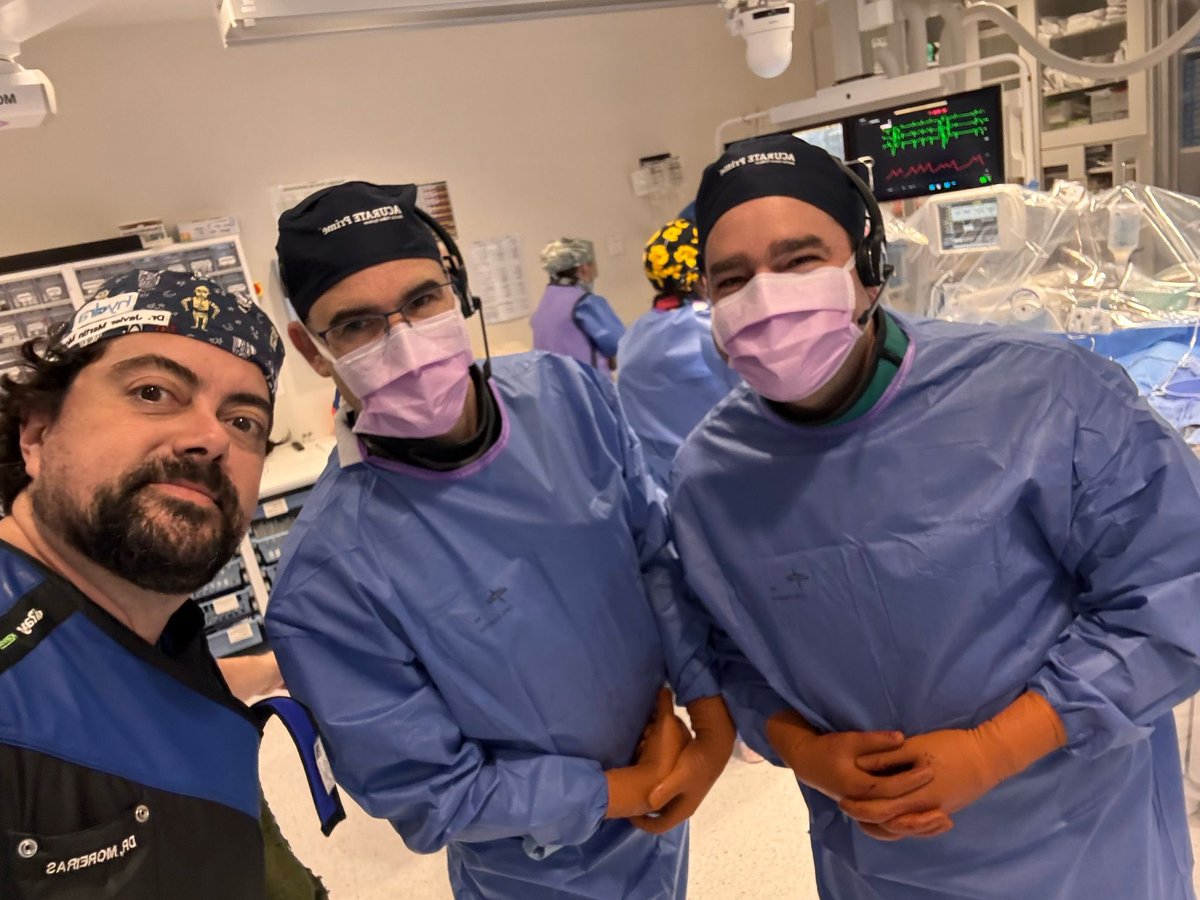
CSC estructural 2025. Implante de TAVI Acurate Prime desde el HU DE Salamanca. Amigos a un lado y a otro de la pantalla. Excelente resultado, gran equipo de hemodinámica, como en casa. @icruzgonzalez@jmmoreiras, @IHujrj@pepp183
Ayer se jubiló el Dr. Juan Carlos García Rubira. @grubira1
Sentimientos encontrados.
Felices porque se lo merece, y tristes porque no estará tanto como nos gusta que esté.
Feliz jubilación amigo, maestro y ejemplo
Alma del servicio de @CardiologiaHUVM en @HUVMacarena
Ayer se jubiló el Dr. Juan Carlos García Rubira. @grubira1
Sentimientos encontrados.
Felices porque se lo merece, y tristes porque no estará tanto como nos gusta que esté.
Feliz jubilación amigo, maestro y ejemplo
Alma del servicio de @CardiologiaHUVM en @HUVMacarena
🆕 1er EC importante para resolver la❔de qué hacer con la enfermedad coronaria que nos encontramos en los cateterismos pre-TAVI (aparentemente asinomática🤷♂️) 👉 NOTION-3
📌 Parece que la ICP en enfermedad "estable" puede incluso mejorar el Px 😏
Veamos 🧵 👇 #ESCCongress2024