Quick project of migrating my personal site off Ghost and to Cloudflare's EmDash went smoothly. Super friendly to work with and the AI integrations made it simple to change. Well done @Cloudflare 👏
It's already live after ~4 hours - https://t.co/02sO7cbGKl
@DanielLockyer I wonder in those cases whether it was attempted to contribute or not. An attempt and denial is one thing vs. no attempt at all. The latter points to a bigger problem imo
@thdxr Been working on this to have a place to celebrate wins personally and professionally. Started as a fun project and wanted to dive into how to integrate it with existing tools so I can add entries from a CLI or AI tool and reminisce through my phone
https://t.co/o7cV0KON1Y
The reply to the Bun rewrite in Rust by Andrew Kelley was disappointing to see. While, I understand the frustration and the want to give your side of the story, there is a better way to handle this. He made it a personal attack while stating it wasn't one and instead it could have very easily been more productive. If you saw issues with how Zig was utilized in Bun, share those thoughts and how it could have been written differently to solve problems that were listed in Jarred's post. To me, that would've been a productive way to demonstrate that Zig may not have been the issue here as Andrew alludes to in his blog post.
I had some interest in looking into Zig although this puts a damper on that. @mitchellh has had some of the most sound takes on language use and approaches that I've seen recently and his use of Zig is honestly what got me interested in looking into it in the first place.
To be clear, I'm not an open source maintainer of anything large and I don't understand the trials and tribulations that happen while building something as large as Zig although if you want to build a community and keep people interested, there's still good will to build. You can give your opinions and show people how to better use the software you're building. Just don't attack people in the process, that's just not necessary. Feedback is great, I think being kind in how you give it is important though.
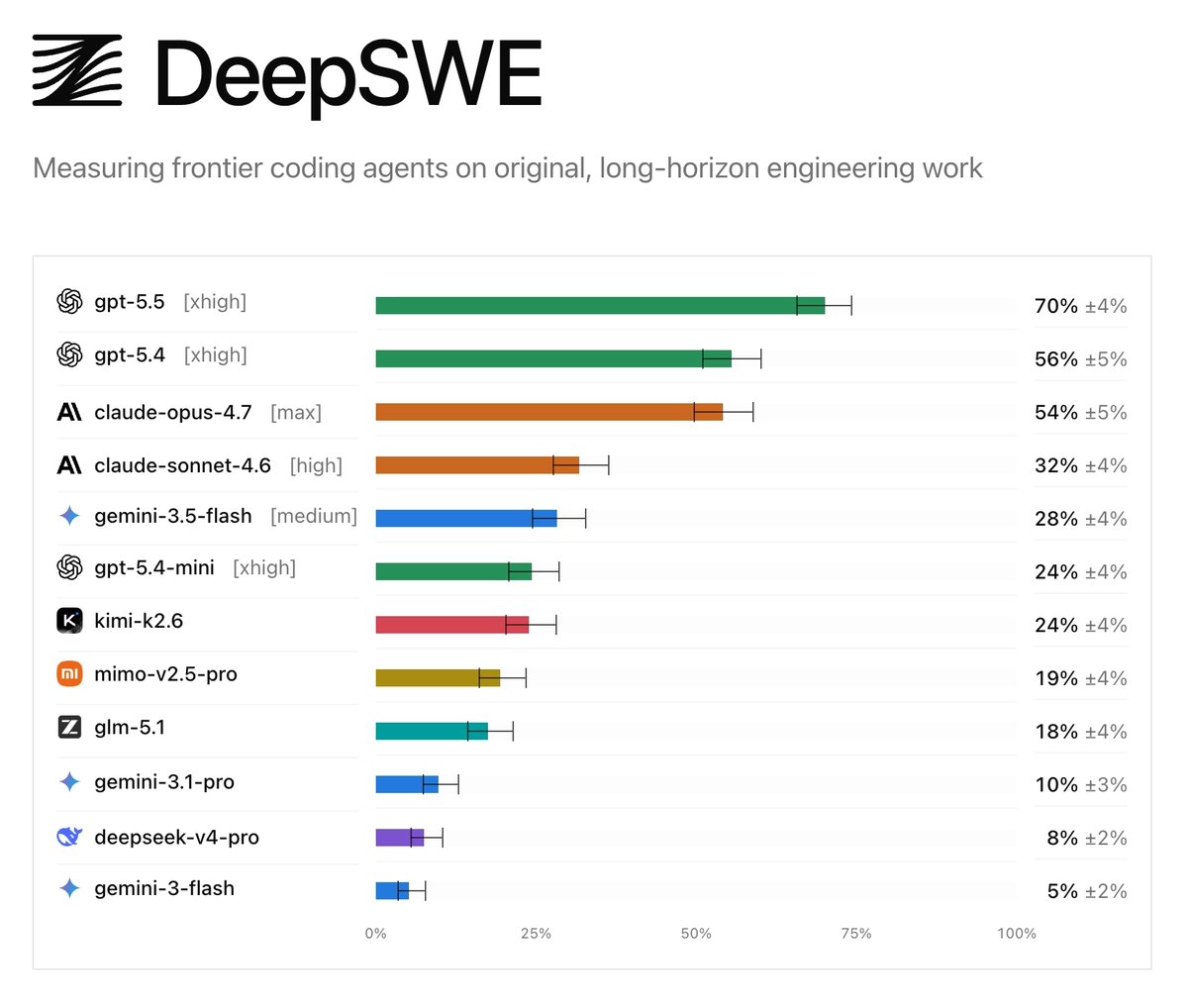
Today we’re releasing DeepSWE, a new standard for agentic coding benchmarks.
On public leaderboards, top models often look relatively close in capability. DeepSWE shows where they actually diverge, reflecting the realistic experience of developers in their day-to-day work.
One of the underrated reasons Linear is so popular with so many people is they have an internal target that nothing in their interface should take more than 300ms to render. They keep fixing regressions whenever it happens.
It’s very hard to retrofit this culture: look at JIRA…
@Markmanson I’ve noticed the same thing. I bring two books when I fly since I end up finishing an entire book each way (unless it’s a big book) 😅 I think it might be constraints of the airplane causing focus
Someone at work recently asked how to avoid burning out with all the new AI tools coming out.
My honest answer is that I don't chase them. 🙂
It takes me back to the debates people used to have about which editor was best. Vim, Emacs, VSCode, JetBrains. There are a lot of similarities between them and variations in the workflows people preferred, but ultimately the payoff came from the investment you made in one of them.
AI tools feel similar to me.
The overlap between them is bigger than the differences, and the real leverage comes from the workflow you build around the tool, not the tool itself.
That's why I've stayed with Claude Code and haven't deviated into Codex, Cursor, OpenCode, or whatever comes next. Not because those aren't good, but because constantly re-learning a workflow is its own form of burnout. It pulls focus away from the actual problems I'm trying to solve.
If a tool helps me solve problems more effectively, that's where I want to put my focus. Everything else is a distraction that adds to your cognitive load and fuels burnout.