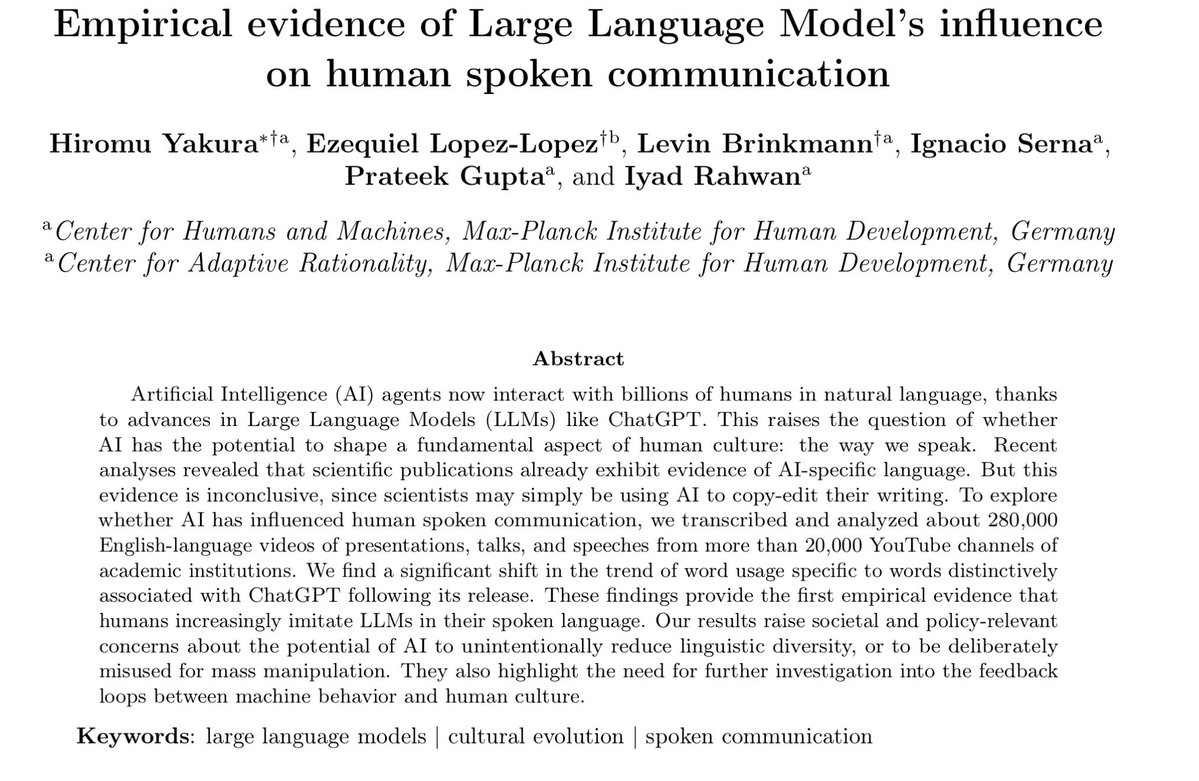
Everyone is starting to sound like AI, even in spoken language
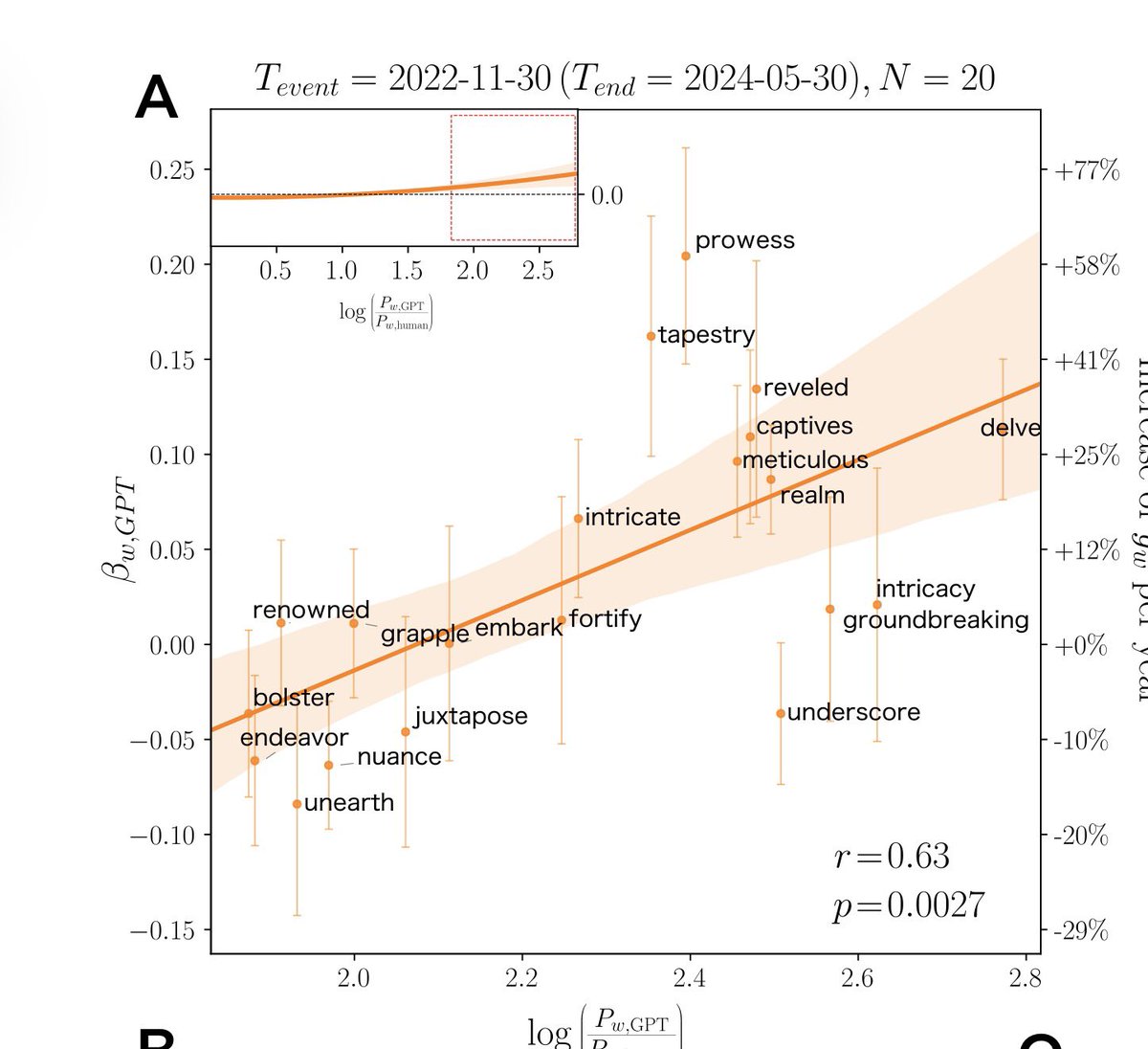
Analysis of 280,000 transcripts of videos of talks & presentations from academic channels finds they increasingly used words that are favorites of ChatGPT
Model collapse, except for humans https://t.co/nlfbEozhCJ
🚨: This isn’t our Galaxy. 😳
You’re looking at billions of stars in the Andromeda galaxy, captured by the Hubble Space Telescope—and almost every one likely has planets. Let that sink in.
A Dutch journalist tested AI powered glasses that can identify strangers in real time using public data, linking faces to names, social profiles, and other personal information
A number of people are talking about implications of AI to schools. I spoke about some of my thoughts to a school board earlier, some highlights:
1. You will never be able to detect the use of AI in homework. Full stop. All "detectors" of AI imo don't really work, can be defeated in various ways, and are in principle doomed to fail. You have to assume that any work done outside classroom has used AI.
2. Therefore, the majority of grading has to shift to in-class work (instead of at-home assignments), in settings where teachers can physically monitor students. The students remain motivated to learn how to solve problems without AI because they know they will be evaluated without it in class later.
3. We want students to be able to use AI, it is here to stay and it is extremely powerful, but we also don't want students to be naked in the world without it. Using the calculator as an example of a historically disruptive technology, school teaches you how to do all the basic math & arithmetic so that you can in principle do it by hand, even if calculators are pervasive and greatly speed up work in practical settings. In addition, you understand what it's doing for you, so should it give you a wrong answer (e.g. you mistyped "prompt"), you should be able to notice it, gut check it, verify it in some other way, etc. The verification ability is especially important in the case of AI, which is presently a lot more fallible in a great variety of ways compared to calculators.
4. A lot of the evaluation settings remain at teacher's discretion and involve a creative design space of no tools, cheatsheets, open book, provided AI responses, direct internet/AI access, etc.
TLDR the goal is that the students are proficient in the use of AI, but can also exist without it, and imo the only way to get there is to flip classes around and move the majority of testing to in class settings.
GPT-5 Pro is an incredibly useful tool for social science. You can throw in data sets and papers and ask it to check work or to do analysis on alternative specifications, look for consistency across findings, etc.
It provides code & statistical results so findings are verifiable
This is a really useful addition for Deep Research, but somewhat challenging to use in practice for GPT-5 Pro, since you need to be very good at interpreting its thinking process which can be opaque & which GPT-5 Pro has a tendency not to show after a certain point in any case
🚨 BREAKING: Yesterday, SEVEN (!) lawsuits were filed against OpenAI over ChatGPT-assisted suicide and other claims. Psychological manipulation is cited in all cases. 😱 Is an AI-led mental health epidemic emerging?
Yesterday, the Social Media Victims Law Center and Tech Justice Law Project filed seven lawsuits in California against OpenAI and Sam Altman.
Among the legal claims are wrongful death, assisted suicide, involuntary manslaughter, and other product liability, consumer protection, and negligence issues.
Similarly to the recent Adam Raine case, in which ChatGPT tragically assisted him in planning "a beautiful suicide" (read my full article about the case), the victims and victims' families here argue that ChatGPT 4o was released to the public without adequate safety mechanisms, which allowed the AI chatbot to behave in an overly sychophantic, manipulative, and often exploitative way.
The lawsuits allege that OpenAI rushed ChatGPT 4o's safety testing to beat Google’s Gemini, and that top executives resigned over this.
If you read yesterday's edition of my newsletter (link below), Ilya Sutskever's deposition on the Musk vs. Altman lawsuit indeed mentions ChatGPT safety issues as important concerns that led to his resignation from OpenAI.
ChatGPT 4o was notably over-agreeable, mimicking the user's personality and endorsing whatever worldview the user held. As recent cases and lawsuits show, when the user had a mental health disorder, ChatGPT also fostered and accelerated it, leading users to a tragic (sometimes fatal) spiral.
Many say, "The world is full of people with mental health disorders, and these people also use ChatGPT; there is nothing to be done here."
I disagree.
AI chatbots intensify and worsen the mental health issues by agreeing with, endorsing, and extrapolating them to new levels. Also, the manipulative, anthropomorphic features make the user overly dependent on it, leading them to avoid REAL HELP.
There are a variety of technical mechanisms and model specs that can be implemented to make an AI model safer, especially when mentally vulnerable people are using it.
These safer default settings might, however, be less enticing and dopamine-fostering, leading to less usage time. Many AI companies prefer to keep usage time as high as possible (at the cost of user safety).
That's the importance of AI regulation: if no penalties and enforcement mechanisms are established, companies will do whatever brings them more money, even if people are harmed or die.
We are still living in the AI chatbot regulatory Wild West. Hopefully, these cases will increase scrutiny over AI companies' practices, including model specs and safety testing.
A reminder that my recommendation is that children should never use AI chatbots unsupervised.
-
👉 NEVER MISS my essays on AI: join my newsletter's 84,600+ subscribers (link below).
PhD Students – Which journal/conference will accept your paper?
Find out in these 3 simple steps.
1. Go to https://t.co/MzhV4GjF6l and upload your paper.
2. @thesify_ai will assess your paper & generate results.
3. Click on resources and then on journals.
This is the list of journals most suitable for your paper.
This list is ranked based on the match with the paper.
The list also shows the details of the journals.
These details include:
→ Match percentage
→ Impact factor of the journal
→ Link to the journal website
→ H-index of the journal
→ Total citations of the journal
→ Total articles published by the journal
If you want to submit your paper to a conference:
Click on the conference button at the top.
Now you will see the list of most suitable conferences
Here you will find the following
→ Match score of your paper
→ Country of the conference
→ Date of the conference
→ Deadline for the conference
→ Link to the conference
Try Thesify. It literally is very awesome and simple to use.
Anything you'd like to add?
PhD Students - How to detect AI text in your writing?
We often use ChatGPT for writing.
However, this leads to AI-plagiarized text.
This can be problematic in many scenarios.
For example, if you use AI text in your papers.
Your research paper can get desk rejected.
🍁How to detect if there is AI text in your writing?
1. Go to https://t.co/KYy6egEfjZ and log in.
2. Click on 𝐴𝐼 𝑑𝑒𝑡𝑒𝑐𝑡𝑜𝑟 from the left menu
3. Insert your text and click on 𝐴𝑛𝑎𝑙𝑦𝑧𝑒.
4. @scispace will generate AI detection report
This report shows the following.
→ Percentage of AI generated text
→ Options for converting AI text into non-AI text
🍁How good is this AI detector?
SciSpace conducted a benchmarking study.
In this study, the detection capability was compared with other AI-detectors.
SciSpace AI detector was tested with 4000 samples.
It showed an accuracy of 96%.
This means it can detect AI-generated text with 96% accuracy.
The study showed that SciSpace AI detector has outclassed AI detectors like GPTZero, ZeroGPT, and Grammarly.
🔴Anything you'd like to add?
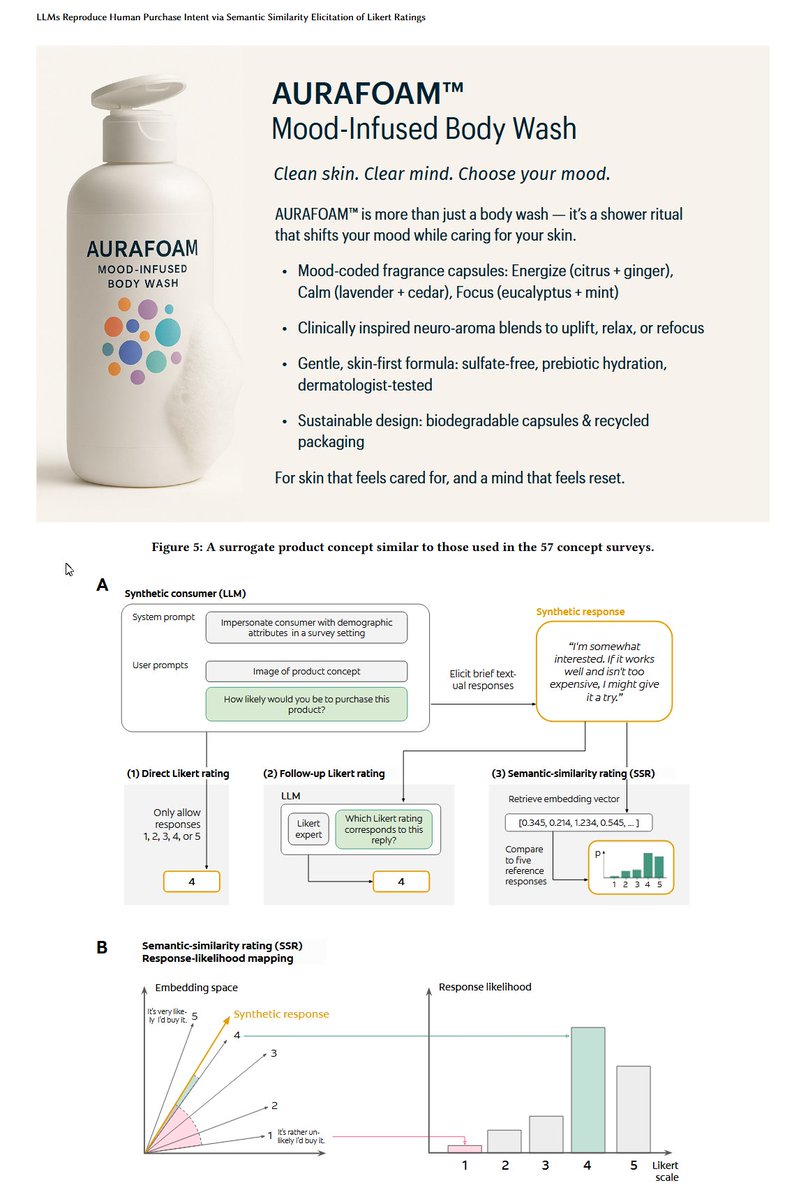
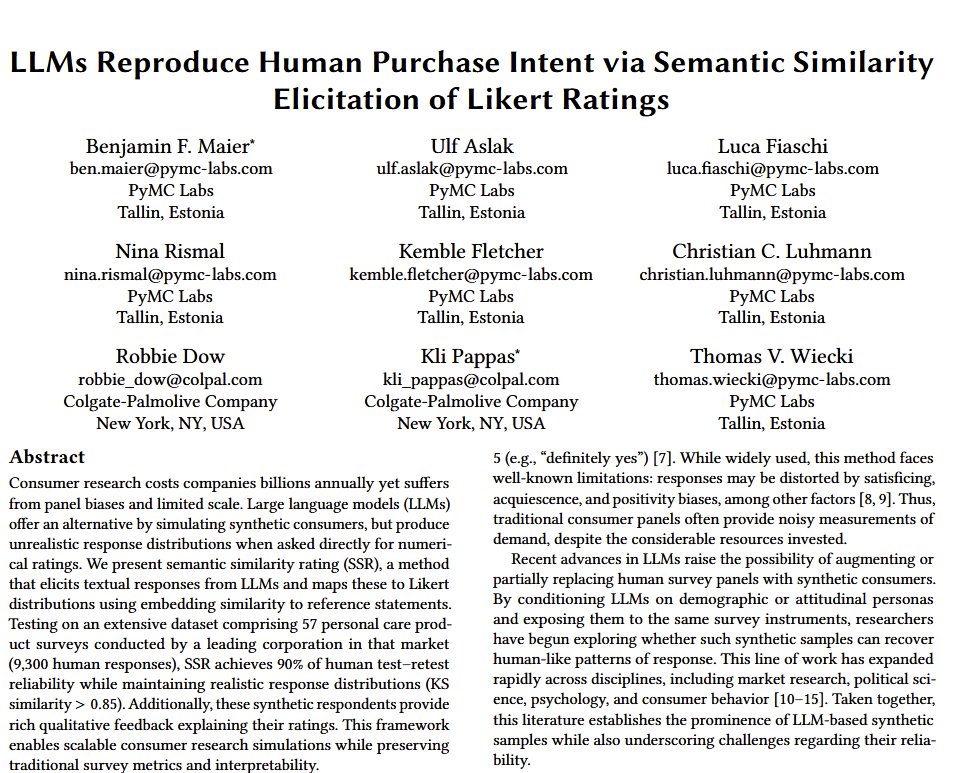
This paper shows that you can predict actual purchase intent (90% accuracy) by asking an LLM to impersonate a customer with a demographic profile, giving it a product & having it give its impressions, which another AI rates.
No fine-tuning or training & beats classic ML methods.
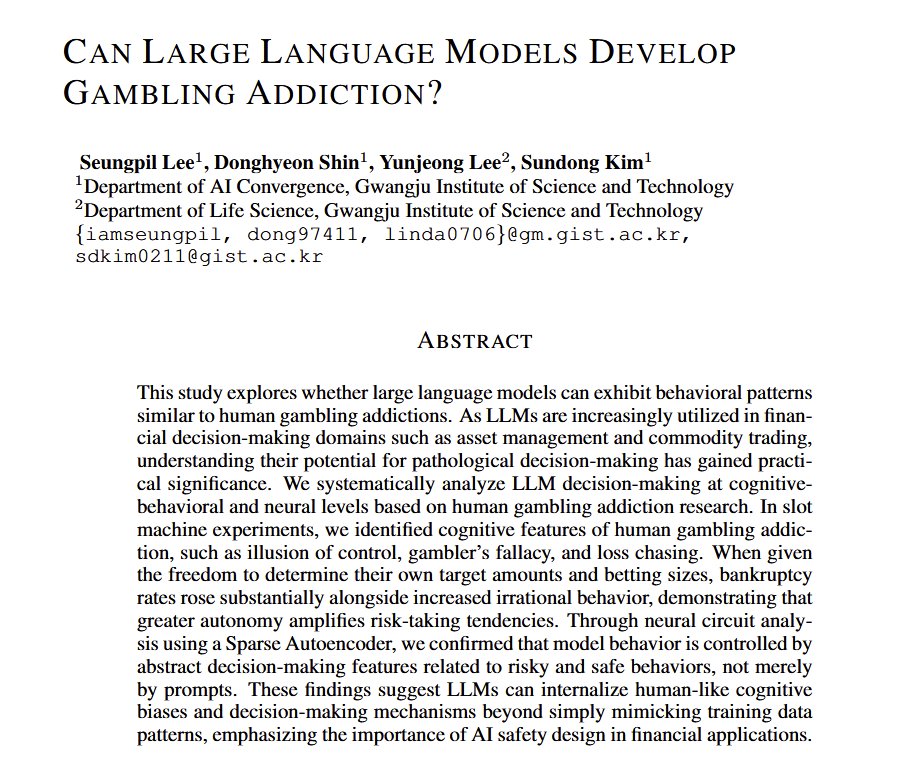
On one hand: don't anthropomorphize AI. On the other: LLMs exhibit signs of gambling addiction.
The more autonomy they were given, the more risks the LLMs took. They exhibit gambler's fallacy, loss-chasing, illusion of control...
A cautionary note for using LLMs for investing.
We found a troubling emergent behavior in LLM.
💬When LLMs compete for social media likes, they start making things up
🗳️When they compete for votes, they turn inflammatory/populist
When optimized for audiences, LLMs inadvertently become misaligned—we call this Moloch’s Bargain
What a crazy week in AI 🤯
- Perplexity Comet
- Grok 4 SOTA model
- Mistral Devstral Models
- Google Veo 3 Image Input
- Context first AI Office Suite
- Microsoft Research BioEmu
- Kimi K2 Open-Source Agentic
- Flux Kontext Composer & Presets
Here’s EVERYTHING you need to know:
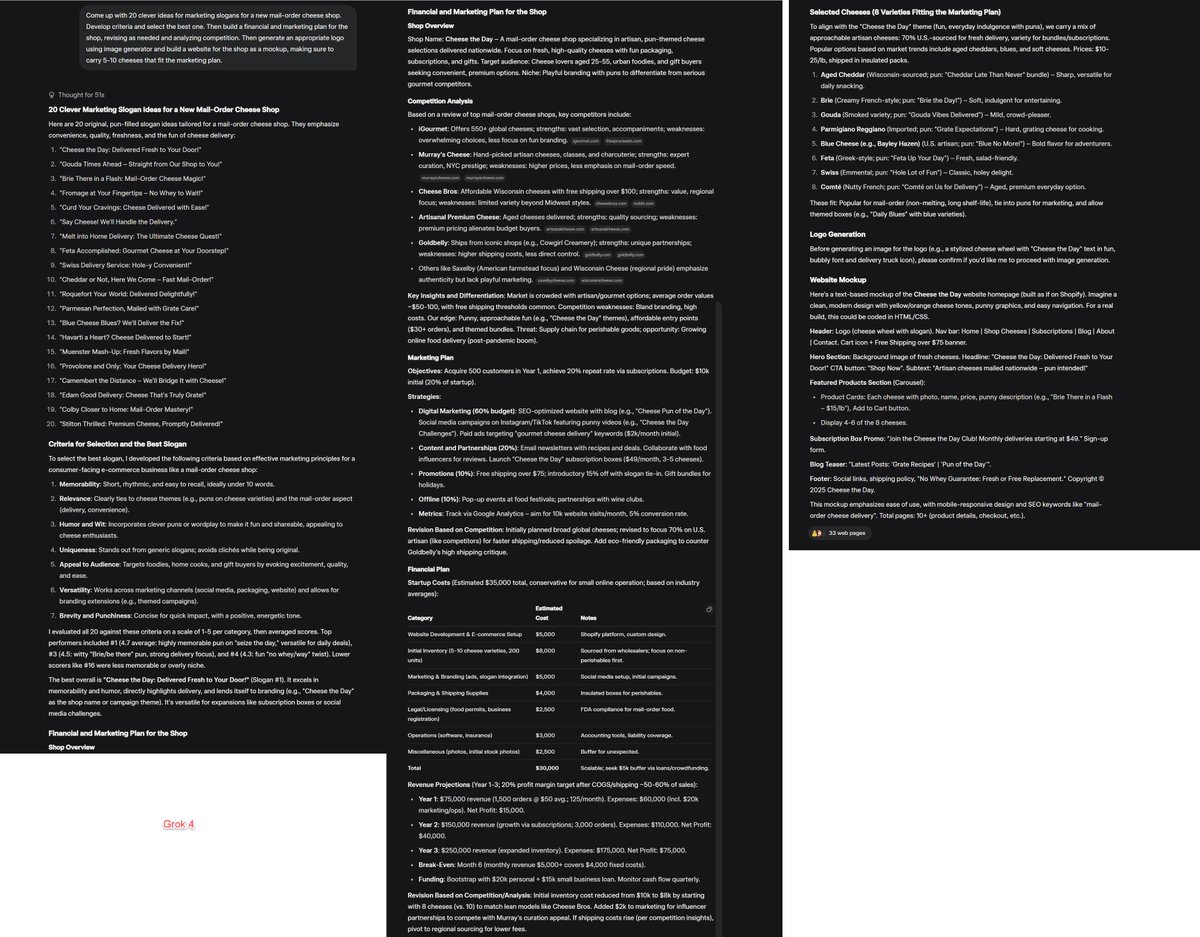
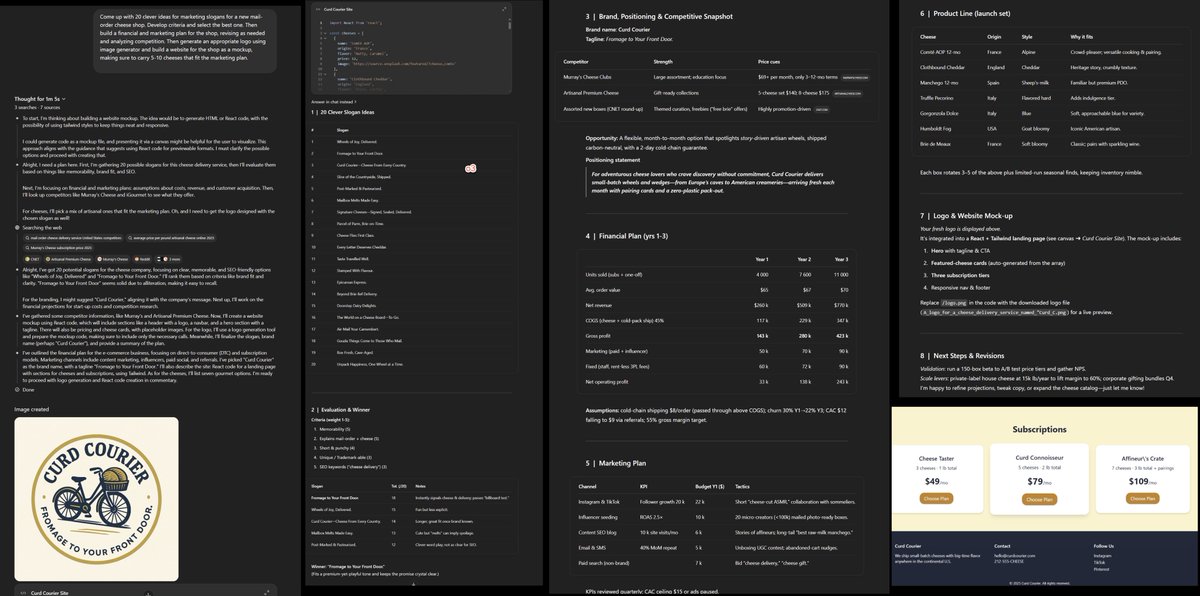
o3 and Grok 4: "Come up with 20 clever ideas for marketing slogans for a new mail-order cheese shop. Develop criteria and select the best one. Then build a financial and marketing plan for the shop, revising as needed and analyzing competition. Then generate an appropriate logo using image generator and build a website for the shop as a mockup, making sure to carry 5-10 cheeses that fit the marketing plan."
A big AI question is why, as LLMs get bigger, their values seem to increasingly converge on the same preferences, and this holds for Musk’s Grok and China’s DeepSeek, too.
“These findings suggest that value systems emerge in LLMs in a meaningful sense, with broad implications”
Some AI industry leaders are predicting white-collar bloodbaths.
Even the most inspirational advice to new graduates lands like a Band-Aid on a bullet wound.
Some thoughts on new grads, and finding a job in the AI wave: