A Princeton grad walked off a Wall Street trading desk, won a World Series of Poker bracelet, then stood at an MIT chalkboard and gave away how the best players in the world actually think.
MIT filmed it. it has been free since 2015. 11 years later almost nobody who watched it changed how they play.
his point is simple. there are two ways to play poker. most people take the read based approach, trying to guess what the other guy has and reacting to it.
the better path is game theoretic, building a strategy that holds up no matter who sits across from you.
he explains it with jujitsu. beginners learn moves that crush other beginners, and those same moves get you choked out against a black belt. so you train from day one to beat black belts. poker is the same.
the tight style that prints money in a home game gets you eaten alive at real stakes.
the man at the board is Matt Hawrilenko, once considered one of the best limit hold em players alive, later trading the felt for clinical psychology at Harvard.
skip to where he separates value betting from bluffing and shows how to price your whole range at once, not one hand at a time. that is the part that separates grinders from winners.
no reads. no tells.
one strategy that works all the way up.
a poker friend of mine rewatches this before every serious session.
save while it's still free and public.
I turned Claude into my personal stock analyst.
It's one of the greatest (and easiest) Claude workflows I've ever set up.
Copy me (5 steps):
Step 1. Connect Claude to live market data
Claude → Connectors → Add connector → Browse connectors → search "FMP." Follow the sign-in steps.
250 free calls a day, plenty to run everything below.
Once connected you get live quotes, 30+ years of price history, fundamentals, SEC filings, earnings transcripts, analyst estimates, insider trades, and screeners across stocks, crypto, and forex.
One catch: Claude sometimes defaults back to scraping the web instead of using FMP, and won't tell you. Fix it by adding this to every session: "Use FMP connector for all queries in this chat."
Step 2. Build your memory folder
Create 5 markdown files on your desktop:
→ Investor-profile.md: your experience, goals, risk tolerance, portfolio size
→ Strategy.md: max drawdown, rebalancing rules, position sizing, entry/exit criteria
→ Portfolio.csv: your current positions and weightings
→ Watchlist.md: sectors, tickers, potential setups
→ Prompts.md: saved prompts so you're not rewriting them every time
You can just ask Claude to build this entire structure for you and inject the data.
Step 3. Set up your workspace
Open Cowork, not a normal chat. Start a new project ("My Investing"), attach your folder, and tell Claude it's strictly for FMP analysis. Verify with "are you connected to FMP?" at the start of every session.
Step 4. Start prompting for real work
→ General portfolio analysis, filtered through your actual thesis, not generic advice
→ Instant earnings breakdowns with bull/bear cases based on your Strategy.md
→ Side-by-side comparisons of stocks or ETFs (expense ratio, performance, holdings)
→ Sourcing small caps or full sector research
Step 5. Automate it
Cowork → Scheduled Tasks → New task. Attach your folder, set a time, done.
Have it deliver a daily 9am market report, overnight move summary, or trading ideas that fit your exact parameters, automatically, without opening the app.
Takes under 5 minutes to set up. Been running this daily for months.
If you want the deeper dive, the full article is linked on my profile.
this is f*cking gold
Andrej Karpathy joined Anthropic five weeks ago.
A friend on his team just showed me the exact Claude.md file he actually uses.
I dropped it into my setup. The very first response was different.
Not slightly different. Completely different.
Claude stopped giving generic answers and started working exactly the way I think.
Bookmark it before it gets lost in your feed.
Read it now, then check the article below.
this is f*cking gold
How to build your first AI agent (Full guide)
if I had this a year ago, I would've shipped my first app in a day instead of 2 weeks
in the right hands, this changes everything:
this is f*cking gold
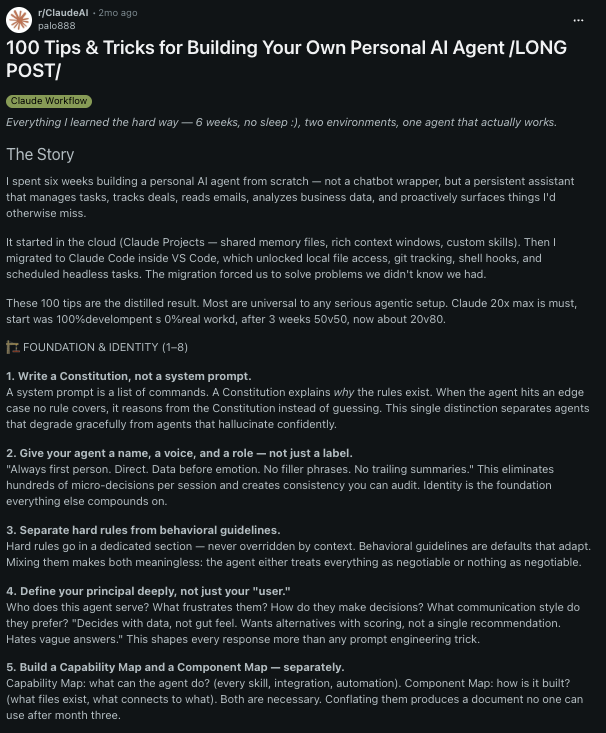
a guy spent 6 weeks with no sleep building a personal AI agent from scratch, then wrote down all 100 things he learned
not a chatbot wrapper. an assistant that manages tasks, tracks deals, reads emails, and flags things before you even ask.
if I had this before I built my first agent, I would've skipped a month of trial and error
in the right hands, this changes everything:
→ separate hard rules from guidelines
→ give your agent a name, a voice, a role
→ build a Capability and a Component Map
→ write a Constitution, not a system prompt
And that's tip 5 out of 100.
(All tips are dropped in the comments below)
then read the full article below: ↓
BREAKING: Claude can now run Stock Market research like a top consulting firm (for free).
Here are 10 Claude prompts that replace $100K/year stock analysts (Save for later)
Bill Ackman literally gave a 44-minute masterclass that explains money better than any business school.
1. Starting early is the single biggest advantage you have. If you save $10,000 at age 22, never add another penny, and earn 10% a year, you have $600,000 by retirement. wait until 32 to start, and the same money only grows to $232,000. The decade you lose at the beginning costs you more than any decade later because compounding does its heaviest lifting at the end.
2. The return rate matters even more than most people grasp. That same $10,000 at 22 earning 10% becomes $600,000. At 15% it becomes over 4 million. At 20%, the rate Warren Buffett has achieved, it becomes 25 million. Einstein called compound interest the most powerful force in the universe. Ackman's lecture is essentially a demonstration of why.
3. Avoiding losses matters as much as chasing returns. if you reach for a 20% return but lose half your money every 12 years from bad decisions or a rough patch, your 25 million collapses to 1.8 million. Buffett's rule one is never lose money. Rule two is never forget rule one. the math of recovery is brutal, so protecting the downside is not caution, it is strategy.
4. Debt is safer, but the upside is capped. Equity is riskier, but the upside is unlimited. In the lemonade stand example, the lender who put up $250 earns a steady 10% and gets paid back first if the business fails. the equity investor who put up $500 earns over 100% if it succeeds but gets wiped out if it fails. The equity holder earns more precisely because they took the risk the lender refused.
5. The risk that matters is permanent loss, not price movement. most people think risk is the stock price bouncing up and down every day. Ackman says ignore that. the real risk is whether you will permanently lose your money. Short-term volatility is noise. the question that matters is whether you get your capital back with a return over the long run.
6. Avoid startups and complicated businesses. You do not need 100% a year to build a fortune. you need 10 to 15% over a long period. so skip the lemonade stands and unknown ventures. Invest in public companies that are established, liquid, and have to clear real hurdles before going public. If you cannot understand how a business makes money, avoid it no matter how good its track record. Ackman cites Enron, a business almost nobody actually understood.
7. Invest in a business you could own forever. if the stock market closed for 10 years, you should not be unhappy holding it. Coca-Cola is his example. easy to understand, sells a syrup and earns a profit on every drink, the population keeps growing, and it is nearly impossible to disrupt with new technology. McDonald's is another. People have to eat, the food is cheap, and they keep growing. find a business you would be comfortable holding through anything.
8. You want products people are loyal to and will pay a premium for. People buy generic flour and sugar without caring about the brand. but they want the Hershey bar, the Cadbury bar, the see's candy specifically. you do not want to sell a commodity that anyone can sell cheaper. You want something unique that customers refuse to substitute even at a 20% discount.
9. Low debt is a safety feature. In the lemonade stand example, $250 of debt was manageable. But if it had been $1,000 and the business hit a rough patch, it could have gone under and wiped out the shareholders. Find companies with little debt or so much profit relative to their interest payments that a bad year cannot sink them.
10. Barriers to entry protect your returns. You want a business that is hard for someone to compete with tomorrow. Coca-Cola's market presence is so strong that you expect to get a Coke at any restaurant. Pepsi has coexisted with it for decades, but neither can put the other out of business. If a competitor can show up next year with a better version and steal the customers, the business is not worth owning long term.
11. The best businesses are immune to outside factors you cannot control. Coca-Cola has survived 120 years through world wars, nuclear weapons, and every kind of crisis, and each year it makes slightly more money. You want companies that do not depend on commodity prices, interest rates, or currency moves. A business that keeps earning regardless of what is happening in the world is the kind you hold forever.
12. Low capital intensity is one of the most underrated qualities. The worst businesses require massive reinvestment to grow. The auto industry has to build enormous factories and buy machine tools before selling a single car, and those tools wear out. GM's stock barely moved over 40 to 50 years for exactly this reason. Coca-Cola, by contrast, sells a formula and collects a royalty. American Express takes a few percent of every dollar spent on its card. a business that earns a royalty on other people's capital is one of the best things you can own.
13. Pay down debt and build a cushion before you invest. If you have high-interest credit card debt, paying it off is a guaranteed return equal to the interest rate. same logic, to a lesser degree, with student loans at 6 or 7%. and you want 6 to 12 months of expenses in the bank so that losing your job tomorrow does not force you to sell. You can only handle market volatility if you do not need the money.
14. Be a buyer when everyone is selling and a seller when everyone is buying. The natural human tendency is the opposite, a lemming-like instinct to sell in a crash and buy in a bubble. people sold into the 1987 crash when they should have been buying. The only way to resist this is to be financially secure enough that the money at risk does not affect your life, so you can withstand the swings without panicking.
15. The stock market is a voting machine in the short term and a weighing machine in the long term. Ben Graham's idea, which Ackman repeats. short-term prices reflect the whims and emotions of investors. long term, prices reflect the actual value of the underlying businesses. If you buy good businesses at reasonable prices and hold them while they grow, you make money over time as long as you are never forced to sell at the wrong moment.
16. A stock is just a bond where you do not know the coupon. Flip a price-to-earnings ratio over, and you get an earnings yield. A stock at 10 times earnings is a 10% earnings yield, which you can compare directly to a 3% treasury. the difference is the bond's coupon is fixed and the stock's coupon, its earnings, moves up and down. Ackman wants an earnings yield higher than a treasury that will also grow over time, so he does not need to be right about explosive growth to earn a good return.
INSTEAD OF WATCHING AN HOUR OF NETFLIX TONIGHT.
This 1 hour Stanford lecture by Joel Peterson will teach you more about negotiation and getting what you want than most people learn in years.
Bookmark it and give it an hour, no matter what.
NVIDIA was $10 in 2022. Palantir was $8 in 2023. Both went up 20x times.
While everyone’s buying the same popular tech stocks…
There are 5 companies that nobody talks about, but could hit similar returns as NVIDIA & Palantir.
Here's what they are:🧵
En lugar de ver Netflix este domingo, dedica 1 hora a esto.
Un CURSO COMPLETO SUBTITULADO AL ESPAÑOL de Claude, te enseña a automatizar lo que te roba 3 horas al día.
El lunes lo agradecerás.
I Don’t Understand Why People Don’t Use Claude For Stock Trading.
Here Are 10 Prompts To Use In Stock Buying, Selling, And Investing:
Disclaimer: These prompts are for research and education only, not financial advice.
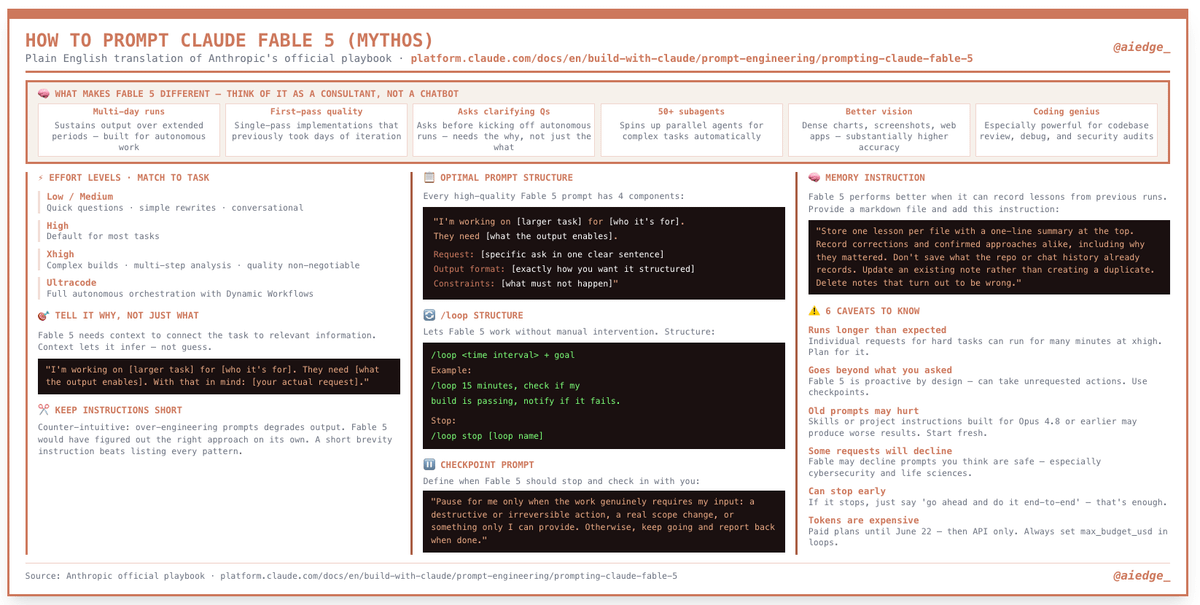
Anthropic just literally spoon-fed you how to use Fable properly.
99% of Claude users missed it.
The way you need to prompt Fable is fundamentally different from all other AI models.
I translated their entire new Fable prompting handbook:
Claude 5.0 built a Chinese girl a trading bot.
skip to 0:08 look at her journal, bot easily earns your monthly salary in a couple of days.
how it works:
the bot runs mean reversion on s&p 500 and nasdaq on 15-min candles, catching the small overextensions indices make every few hours. on bitcoin it switches to momentum breakouts on the 1-hour crypto trends harder than indices, so you ride the move instead of fading it. gold and oil get a slower trend-following layer on the 4-hour, because commodities move in cleaner waves and you don't want noise from intraday whipsaws.
position sizing is ATR-based per instrument, so a quiet day on gold gets a bigger size than a volatile day on bitcoin - risk stays constant even when volatility doesn't. every trade has a hard 1% stop, no exceptions, no "let me give it room." and there's a correlation filter on top: if s&p and nasdaq are already long, it won't pile into another risk-on asset and double the real exposure.
claude code writes and updates the logic. the bot just executes.
then claude cowork sends her two messages a day:
- 7am: what's happening in the market
- 9pm: how did the bot do
that's the whole job. two messages. five instruments. zero screen time.
manually she could only watch one chart at a time. this thing watches five. doesn't sleep. doesn't tilt. doesn't revenge trade at 2am.
what used to need a team of quants and a $200k bloomberg terminal now runs on a laptop and claude.
And your friend is still trading manually and is constantly in the red.
save this and read the article in the comments below to write your own bot using Claude
A TEAM OF AI RESEARCHERS JUST OPEN-SOURCED THE BLOOMBERG TERMINAL FOR QUANT FINANCE.
A Bloomberg Terminal costs $25,000 per year per seat. Banks pay for thousands of them.
This thing reads every quant paper, every financial blog, every SEC filing, every arXiv preprint, and turns it into a searchable knowledge base. For free.
It's called QuantMind.
It just got accepted to the NeurIPS 2025 GenAI in Finance Workshop.
Here's what it actually does:
→ Ingests arXiv quant papers, financial news, blogs, and reports automatically
→ Parses PDFs, HTML, tables, and figures into structured knowledge
→ Tags every paper by research area and topic
→ Builds a semantic knowledge graph you can query in plain English
→ Plugs into DeepResearch, RAG, and MCP for multi-hop reasoning
→ Two-stage architecture: extract once, retrieve forever
Here's the wildest part:
The financial research industry publishes around 500 new papers and reports every single day.
Hedge funds pay six-figure salaries to junior analysts whose entire job is reading them.
QuantMind reads all of it. Tags it. Embeds it. Lets you ask it questions.
154 stars. 22 forks. 173 commits. MIT license. Python.
One honest note: this is a framework, not a magic alpha machine. You still need to know what to ask. But the "I haven't read that paper yet" excuse is officially dead.
The thing Wall Street charges $25,000 a year for is sitting on GitHub. Free.
Link in the comments.