Army veteran buying apartment buildings and sharing the journey along the way. Born in Miami, built by West Point, inspired by Berkeley, thriving in Seattle.
My real estate journey started in 2017 with the purchase of a 4-unit using a VA loan. I then did a few BRRRRs, did a few STRs, did even more furnished rentals, and learned a life’s worth of lessons. Now I buy apartment buildings and run a furnished corporate housing business.
Remember, when you get price quotes from GCs and subs, they are pricing *you* as much as the actual work.
But...that's not always a BAD thing.
Example: I was getting a quote for a large bluestone patio and some other stuff.
4 quotes ranging from $56k to $26k.
Wtf?! Read on 👇
Because real estate deals generally lack the potential to go to the moon (like start-ups or crypto or whatever):
As an investor looking to maximize expected returns, you want to focus disproportionately on removing the subset of outcomes where you go to zero.
Because real estate deals generally lack the potential to go to the moon (like start-ups or crypto or whatever):
As an investor looking to maximize expected returns, you want to focus disproportionately on removing the subset of outcomes where you go to zero.
When they zig, you zag:
Mahogany just came in cheaper than oak or walnut for kitchen cabinets on a current project...bc everyone is getting oak or walnut.
Supply and demand.
So, coming right up: our first mahogany kitchen 🥰
@jasonc_nc The private equity side of fire trucks is fascinating. They've basically been bought up, consolidated, and now there is little competition to drive down prices.
https://t.co/7QpIXSPrg5
To repeat @markbdelaney - veteran hires shouldn’t be handouts.
Hiring vets is actually about getting quality, unique talent.
Something I tell every vet coming out of service:
NEVER go into an interview looking for a handout or someone to take a chance on you.
Destined to be a bad fit if you hire anyone based on anything other than merit.
Hot take: I find that sexist comments are often used to mask incompetence.
If I display high competence/execution, I get sexist comments sometimes. Stuff like "if I wanted to be nagged, I'd call my wife."
I never get that from the A players, tho. Game recognizes/respects game.
People in real estate distress typically wait until the last minute to do something
Many times this is too late
If you approach them before they’re ready with an offer they’ll often be upset with you
Solution:
Tell them that you’re sure they’ll figure it out & they won’t need your help
But just in case it goes sideways hand them a back up offer with your name & contact information
They’ll call you when they’re ready
How to raise money using the "easy" exemption - Regulation D. 💸
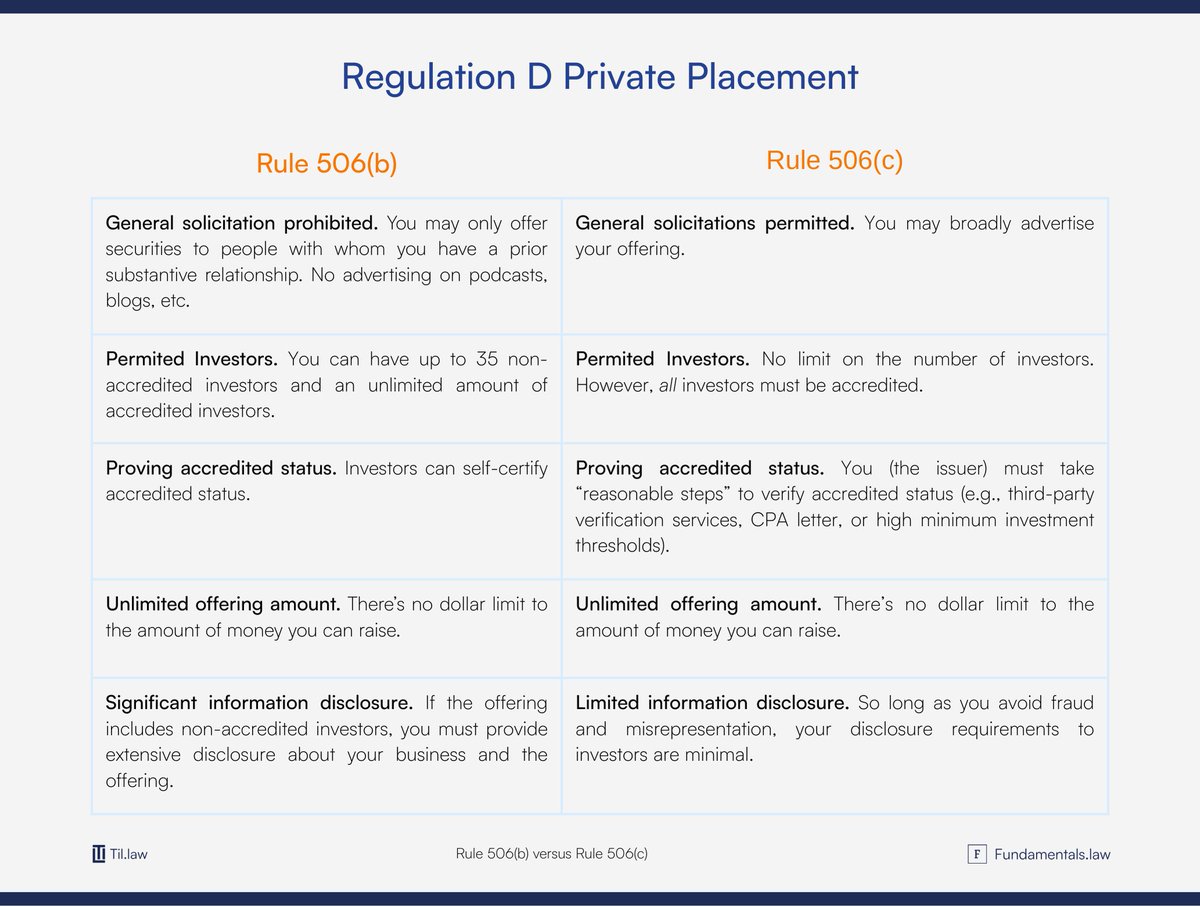
This chart compares two common ways to raise money using Regulation D: 506(b) and 506(c). While some funds, syndications, and startups use other exemptions, 506(b) and 506(c) are far and away the simplest and most common ways to raise capital.
Please share if you find this helpful! 🙏
In general:
🤫 506(b) - 506 "be quiet!"
Benefit: Investors can self-verify that they're accredited, which makes investor onboarding easy.
Drawback: You cannot raise money publicly. No posting on social media about the fact that you are seeking investors. No emailing people you don't know. No publicly pitching at conferences.
Side note: Technically, you can have up to 35 non-accredited investors, but if you accept even *one* non-accredited investor, your disclosure requirements and legal bills increase.
📣 506(c) - Come "see" our fund!
Benefit: You can speak publicly about fundraising (so long as you're not misleading in your materials).
Drawback: You (the one raising money) must take reasonable steps to verify that each investor is accredited. This can sometimes cause friction and slow things down. Note that this is somewhat mitigated by a recent SEC no-action letter that suggests that requiring high minimum check sizes ($200k+ for individuals and $1 million+ for entities) may permit issuers to assume such investors are accredited.
Owners: if you don't have the brain power, time, capacity, or ability to make decisions and stick to them...
...you have no business doing a design/construction project.
Make the time to do the very real work of making decisions, or don't do the project. 🧵
There must be general contractors out there who are close to perfect... but I bet they pretty quickly end up building huge buildings.
So, if you're doing smaller deals, you're very likely going to work with contractors with some flaws (not enough experience, not enough administrative capacity, doesn't speak great English, a little emotionally volatile, etc.)
The trick is to find ones whose flaws you understand and can compensate for.
So much of the debate about housing supply misses this crucial point:
If you want investors to capitalize the construction of very long-duration assets (like apartment buildings), you need to give them confidence that they (or those they seek to sell to) will be treated fairly by regulators for the life of the asset.
"How much do you build for per foot?"
$100
$180
$225
$280
$340
$550
$1000+
All these answers are correct. In my location.
The projects are different.
Don't be fooled by simple answers to simple questions.
I need more than two hands to count instances where I wanted to badmouth someone, didn’t, and somehow ended up interfacing with them in a professional context within 2-3 years.
Life is too short and industries are too small to burn bridges.
Be selective about who you play long term games with, but respect that there are people who have been playing a lot longer than you.
Everyone gets confused about *preferred returns* and *GP catch-ups* in investment funds/syndications. 💰
Here it is in plain English. Please share if you find helpful 🙏
In funds with a preferred return and a GP catch-up, money is typically distributed something like this:
1⃣ Return of Capital: First, 100% to the LPs until they get their money back.
2⃣ Preferred Return: Second, 100% to the LPs until they get an 8% return on their capital contributions.
3⃣ GP Catch-Up: Third, 100% to the GP until the GP has received 20% of the *profits* (the amounts distributed in step 2 above and this step 3).
4⃣ Profit Split: 80% to the LPs and 20% to the GP.
The preferred return is a priority return to the LPs.
After the pref is paid, the GP catch-up is a priority return to the GP until the GP has earned a percentage of the profits equal to the GP's ultimate profit split percentage is step 4. In this example: 20%.
Let me know if you have any questions!
Biggest requests we get from our residential clients these days?
Multigenerational capacity, and aging in place.
If construction is so dang expensive, folks want to build for their whole family, and for their long term comfort in their home.
One relatively simple, uncontroversial change municipalities can make to accelerate development:
Put all of the relevant zoning and permitting info online in one simple, easy-to-use website.
Allows new developers to evaluate opportunities in your city without having to make painful treks down to city hall to meet with planning / zoning / etc.
(Of course, most municipalities actively discourage development, so they bury this info!)