Most AI projects get messy very quickly.
A simple structure makes building and debugging much easier.
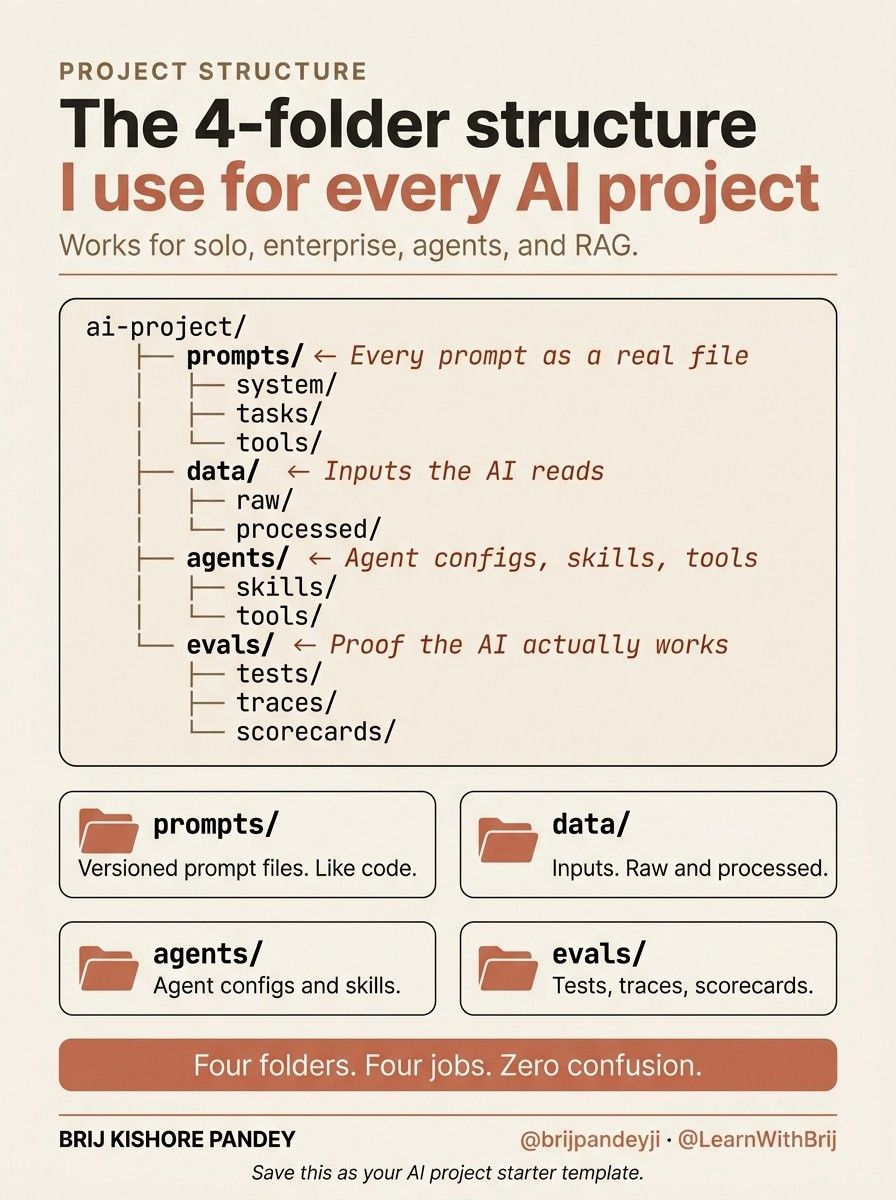
Sharing this 4-folder structure from Brij Kishore Pandey.
ai-project/
├── prompts/
├── data/
├── agents/
└── evals/
Simple structure. Clear purpose:
1. prompts/
Store every prompt as its own file.
Avoid hiding prompts inside notebooks or Python strings.
Keep prompts reusable and version-controlled.
Treat prompts like real code.
Why it matters: prompts are one of the most valuable parts of an AI system.
If they break, you need to track, review, and improve them properly.
Inside prompts:
system/ - system instructions
tasks/ - task-specific prompts
tools/ - tool explanations
2. data/
Store testing samples and RAG documents.
Keep evaluation datasets organized.
Separate raw and processed data.
Always make your workflow reproducible.
Why it matters:
When results fail, you need to know what actually changed - the model, the prompt, or the data.
3. agents/
Keep agent configs and tool definitions here.
Store skills, behaviors, and MCP settings.
Make agents easy to review and maintain.
Treat agents like real software components.
Why it matters:
Modern AI agents are no longer simple scripts.
They are structured systems with their own logic and workflows.
4. evals/
Save test cases and expected outputs.
Track failures, traces, accuracy, and costs.
Measure how your AI performs over time.
Build confidence before deployment.
Why it matters:
Without evaluations, you only have demos. With evaluations, you build reliable products.
The key rules:
One folder = one purpose
One file = one responsibility
Keep everything version-controlled
New team members should understand the project quickly
If someone opens your project and instantly understands the structure, you build a system.
If nobody can find anything, it’s technical debt waiting to happen.
AI projects are no longer random notebooks and scattered scripts.
The best teams now focus on structure, clarity, and maintainability.
Better organization leads to faster building, easier debugging, and smoother collaboration.
Simple systems win long term.
P.S. Do you structure your AI projects properly?
♻️ Repost to help more people build cleaner and smarter AI systems.
Se habla poco de que a la juez que estaba investigando el 11M e intentando reabrir el caso, Coro Cillán, le jodieron la carrera, la vida y fue internada en un psiquiátrico sin posibilidad de recibir visitas por motivos desconocidos.
#PsoeOrganizaciónCriminal
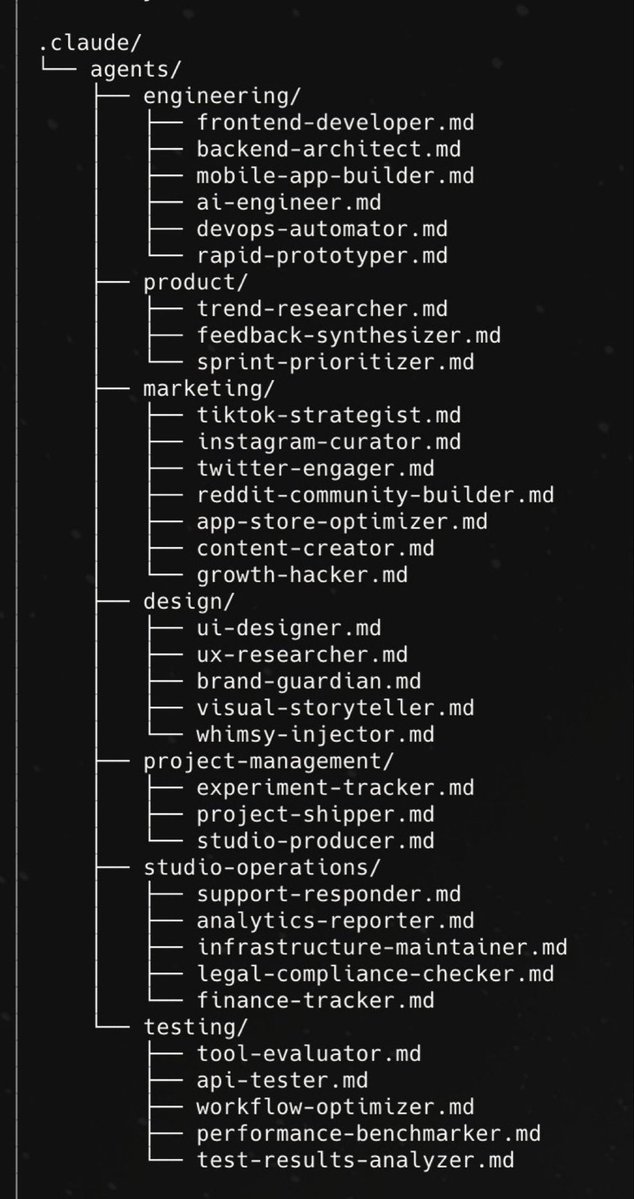
this is what a company looks like in 2026.
not people. not offices. not salaries.
a folder.
.claude/agents/
engineering/
marketing/
design/
ops/
testing/
every role. every department. every function.
all .md files.
i have 12 of these running in OpenClaw right now.
the org chart is dead. the directory is the new company.
This 𝗖𝗟𝗔𝗨𝗗𝗘.𝗺𝗱 file will make you 10x engineer 👇
It combines all the best practices shared by Claude Code creator:
Boris Cherny (creator of Claude Code at Anthropic) shared on X internal best practices and workflows he and his team actually use with Claude Code daily. Someone turned those threads into a structured 𝗖𝗟𝗔𝗨𝗗𝗘.𝗺𝗱 you can drop into any project.
It includes:
• Workflow orchestration
• Subagent strategy
• Self-improvement loop
• Verification before done
• Autonomous bug fixing
• Core principles
This is a compounding system. Every correction you make gets captured as a rule. Over time, Claude's mistake rate drops because it learns from your feedback.
If you build with AI daily, this will save you a lot of time.
I've never felt this much behind as a programmer. The profession is being dramatically refactored as the bits contributed by the programmer are increasingly sparse and between. I have a sense that I could be 10X more powerful if I just properly string together what has become available over the last ~year and a failure to claim the boost feels decidedly like skill issue. There's a new programmable layer of abstraction to master (in addition to the usual layers below) involving agents, subagents, their prompts, contexts, memory, modes, permissions, tools, plugins, skills, hooks, MCP, LSP, slash commands, workflows, IDE integrations, and a need to build an all-encompassing mental model for strengths and pitfalls of fundamentally stochastic, fallible, unintelligible and changing entities suddenly intermingled with what used to be good old fashioned engineering. Clearly some powerful alien tool was handed around except it comes with no manual and everyone has to figure out how to hold it and operate it, while the resulting magnitude 9 earthquake is rocking the profession. Roll up your sleeves to not fall behind.
All the analysts forever writing about OpenAI vs Anthropic vs Google are missing the real story that already happened.
80% of startups pitching Andreessen Horowitz are running on Chinese open-source models. Not OpenAI. Not Anthropic. Chinese models like DeepSeek that cost 214x less per token.
The math here breaks everything. DeepSeek trained its model for $5 million. OpenAI spent $500 million per six-month training cycle for GPT-5. That gap translates directly to API pricing where startups pay $0.14 per million tokens versus $30 for GPT-4.
For a startup burning through 100 million tokens monthly, that’s $1,400 versus $300,000. The difference between 18 months of runway and 3 months.
This tells you the real constraint in AI was never capability. Chinese models are matching GPT-4 on coding benchmarks while costing 2% as much. The constraint was always burn rate, and China solved it first by optimizing for efficiency instead of chasing AGI.
The second-order effect gets interesting. When your infrastructure costs drop 98%, you can actually afford to fine-tune models for your specific use case. American startups paying OpenAI’s API rates are stuck with generic models. Chinese open-source users are building specialized variants.
Silicon Valley thought the moat was model quality. Turns out the moat was cost structure, and they built it backwards. When a16z partner Anjney Midha says “it’s really China’s game right now” in open-source, he’s not talking about benchmarks. He’s talking about who controls the default foundation layer.
Now look at where this goes. American AI labs are optimizing for AGI and superintelligence. Raising billions to chase the theoretical ceiling. China optimized for distribution and adoption. Making AI cheap enough to become infrastructure.
All 16 top-ranked open-source models are Chinese. DeepSeek, Qwen, Yi. The models actually being deployed at scale. While OpenAI charges premium rates for exclusive access, Chinese labs are flooding the zone with free alternatives that work.
The third-order cascade is what changes everything. Every startup that survives the next funding winter will have optimized around Chinese open-source as default infrastructure. Not as a China strategy. As a survival strategy.
That 80% number at a16z only goes one direction. When you’re a seed-stage founder choosing between 18 months of runway or 3 months, economics beats nationalism every time.
America is still competing to build the best model. China already won the race to build the one everyone uses.
El el Dakar 1989 un participante haciendo parapente para encontrar el camino correcto.
Y ahora hay algunos que lloran por un dibujo mal colocado en el roadbook...
¿Quieres participar en un torneo de Street Fighter 6 pero no te atreves? 👊
¿O símplemente quieres hacer torneos por los jajas?
Torneos tranquilos y para todos los niveles:
🎥https://t.co/0w22zJa1xr
Y nuestro telegram: https://t.co/eWX5Ey6veF
#StreetFighter6#StreetFighter
Lebanon was the only Christian-majority nation in the Middle East.
It's where I was born.
We prided ourselves on inclusivity. Always welcoming Arab Muslim refugees from all over the Middle East.
We had the best economy despite having no natural oil. The best universities.
They called Beirut the "Paris of the Middle East" and the Mountains of Lebanon was a tourist destination.
My early childhood was idyllic, my father was a prosperous businessman in town and my mother was at home with me, an only child.
Slowly, the Arab Muslims began to become the majority in Lebanon and our rights began to wither away.
Soon, we would find ourselves unable to leave our small Christian town without fear of being stopped and killed by Arabs. In Lebanon your religion is on your government issued ID.
As the war intensified and the radical Islamists made their way south, my home was hit by an errant rocket and my life was forever changed.
We spent the next almost decade in a bomb shelter, scraping together pennies and eating dandelions and roots just to survive.
If it was not for Israel coming in and surrounding our town, I do not know If I would be here today.
Lebanon is now a country 100% controlled and run by Hezbollah. I lost my country of birth.
I thank God every single day I was able to immigrate to America and live out the dream that BILLIONS of people only dream of having.
Now here in America, my adopted country that I have come to love so much, I see the same threats and warning signs happening now that took place in Lebanon when I was a child.
This is my warning to you, America, reverse course now while you still can.
It's not too late to save our freedom and preserve it for the next generation.
Pues aquí tenemos los mejores momentos del último torneo de nuestro canal de telegram de Street Fighter 6
Os dejo un resumen de los mejores momentos de las semifinales y las peleas íntegras de tercer y cuarto puesto así como la gran final
https://t.co/wV4yrYCRmC
Básicamente un impuesto sobre el patrimonio del 10% significa que se pierde la mitad del patrimonio en 6-7 años. Lo q obliga a vender activos si o si para poder pagar el impuesto