11/
The bull case and its expiration are the same sentence read in opposite directions:
The human in the loop is the lag.
Today that lag is an advantage to whoever minimizes it first. At the limit it approaches zero for everyone.
An advantage that converges to zero was never a fortress. It was a lead measured in time.
1/
Every AI moat is temporary.
And the thing creating the moat is the same thing destroying it.
The hyperscalers are winning because they remove human latency faster than everyone else. But once the human disappears from the loop entirely, the advantage disappears with him.
Here’s the mechanism nobody is pricing.
10/
The same act that builds the moat destroys it at the limit.
The hyperscaler advantage may be real yet structurally temporary. They win by removing the human faster than rivals. They stop winning once the human is gone as the bottleneck entirely.
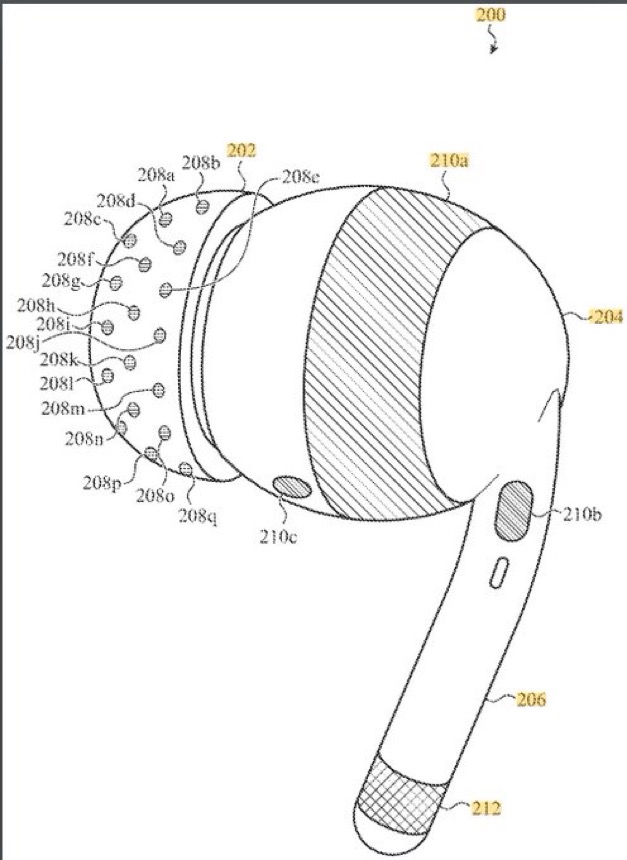
Apple's newest patent turns your AirPods into an EEG device that also reads muscle movement, eye movement, and heart rate.
Neuralink has performed four human brain implants. Apple has hundreds of millions of AirPods in active use.
Steven Hotelling is on the inventor list for patent US20230225659A1. He's the engineer who productized multi-touch for the original iPhone. Apple puts Hotelling on things it plans to ship.
The design packs 17 electrodes around a single ear tip. Ear-EEG has existed in academic research since 2011, and startups like NextSense (spun out of Alphabet X), Neurable, and IDUN already ship consumer ear-EEG products today.
Apple's innovation is dynamic electrode selection.
Here's the constraint that killed ear-EEG as a consumer product for 15 years. Every human ear canal is shaped differently. A fixed electrode placement that reads clean EEG from one person reads noise from the next. Your own ear canal changes shape across a day based on temperature, jaw position, and how the bud seated when you put it in. Every prior ear-EEG product required either custom molds or tolerance for garbage data.
Apple's patent uses more electrodes than are ever needed simultaneously and runs an AI model that scores each one in real time on impedance, noise level, and skin contact quality. It picks the best subset for this person, in this ear, right now. Reference and active electrodes get reassigned on the fly. A weighted algorithm combines the surviving signals into one optimized waveform.
Competitors tried to solve this with better electrodes. Apple solved it with redundancy and silicon.
The roadmap is already visible. AirPods Pro 3 shipped a photoplethysmograph in the ear tip for heart rate. In November 2025, Apple Research published PARS, a self-supervised model that learns EEG patterns from unlabeled data and sidesteps the regulatory bottleneck of annotated clinical datasets. The PPG sensor is the dress rehearsal. The EEG sensor is the feature.
Sleep staging. Seizure detection. Stress classification. Focus state. The clinical applications get through the FDA. The interface applications change computing.
Neuralink needs a surgeon. Apple needs a firmware update.