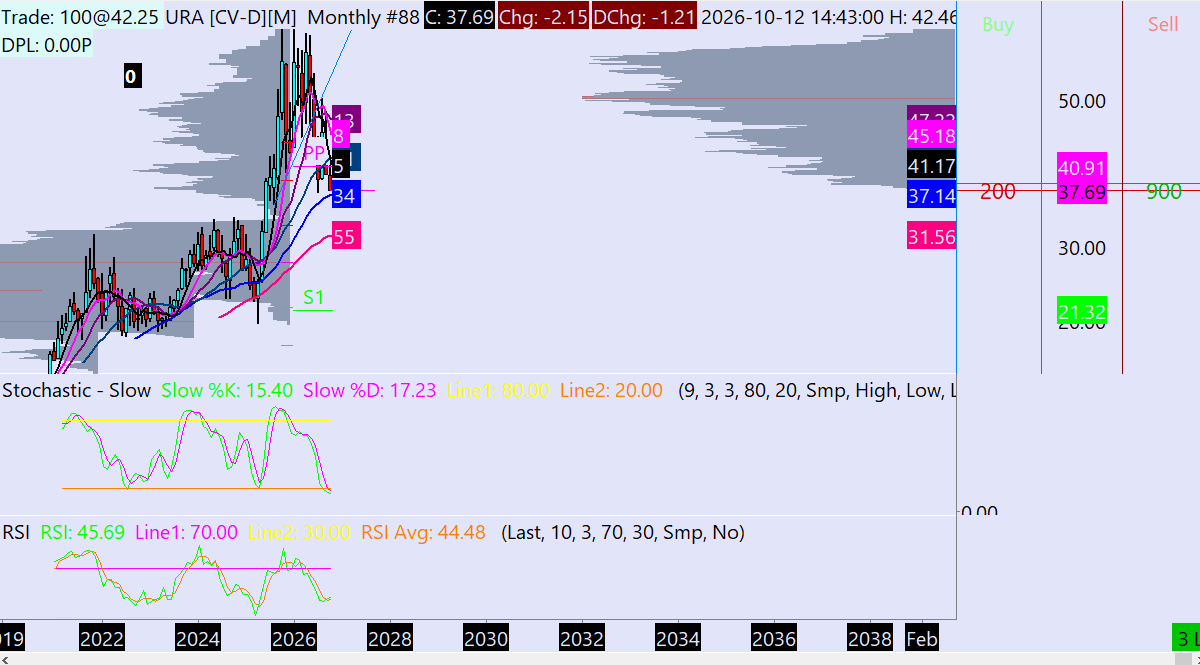
sold a bunch of #URANIUM holdings over the past 3 trading days (needed to restructure the pf)
I currently hold:
$DYL / $DYLLF
$EU
$UEC
$BMN / $BNNLF
$DNN
$AEC / $ANLDF
$PDN / $PALAF
$LOT / $LTSRF
$PEN / $PENMF
$GXU / $GVXFF
$FMC / $FDCFF + $FIND / $BSENF - soon to be Geiger
A question for the technicians: I can't remember ever seeing the daily, weekly, and monthly slow stochastics all line up perfectly like this. But I'm a long-term investor, not a short term trader, and not an expert in TA by any stretch.
How unusual is this degree of bullish alignment across all 3 timeframes? Seems very significant to me but I admit I don't really know. What do the pro traders think about this setup for adding to long-term positions in uranium miners? Is this as rare as it feels to me or not that big a deal?
cc: @chigrl@AnthonyCrudele@BidBird10
BINGO! Daily, Weekly, and MONTHLY stochastics all below the buy-line, all signalling a MAJOR low is near.
TA is never precise and whether this wash-out in U miners has another day, another week, or even longer to go is anyone's guess. But we're already deep into the long-term buy zone.
After 6 years of volatility and global change, what do you think are the top 10 #uranium stocks to hold?
Just answer the question how you initially interpret it. $ccj $uuuu $uec $urnm $dnn $bmn $dyl $nxe $pdn $aec $lot $eu $glo
☢️A Snapshot of the Ongoing Correction in the Uranium Sector
This table ranks the companies in our uranium universe by performance from January 29 through September 9, 2026.
The starting date is not arbitrary: it marks the beginning of the correction that remains in effect across the sector.
Here is how to interpret the data:
🔵 Blue: Companies with positive returns since January 29.
🔴 Red: Companies still posting losses since that date.
The Return % column shows each company’s total return over the period analyzed.
The Maximum Drawdown column shows the largest peak-to-trough decline experienced by each company during the period. In other words, it measures the worst loss an investor would have endured during the correction.
The Current Drawdown column shows how far each company is currently trading below its highest level during the period. The difference between these two drawdowns reveals whether a stock remains near its lows or has already recovered a significant portion of its decline.
The results reveal enormous dispersion. While a handful of companies have delivered extraordinary gains, much of the universe continues to post substantial losses. The $URA ETF is down 24.15%, while $URNM has declined 32.63% over the period.
We are therefore not yet seeing a broad-based recovery across the sector. There are some clear individual winners, but breadth remains weak, and many companies are still experiencing drawdowns of more than 40%, 50%, or even 60%.
The conclusion is clear: stock selection has made an enormous difference in uranium, but the sector-wide correction cannot yet be considered over.
#Uranium #UraniumStocks #URA #URNM #NuclearEnergy #MiningStocks #Drawdown #MarketBreadth #RelativeStrength
let’s get on the same page as a #uranium community.
what are the current top 10 uranium equities with realistic potential to be successful over the next 3 years?
@jeffcomeau I don’t wanna keep picking at the question cuz the answer is the most important part. Just interested in what people’s general thought would be.
Most people roll their eyes when they hear talk about supply or demand in the 2030’s, but the reality is that term contracts that are moving the price NOW are largely for delivery in the 2030’s. This industry lives in the future.
☢️ THE URANIUM RACE: Meta, Amazon and Microsoft are now signing for nuclear power the way they used to sign for cloud contracts. The uranium to feed all of it does not exist yet.
This is the railroads moment for the AI buildout, and the market is still pricing it like a boring utility.
Uranium is having the strangest bull market I've ever watched. The price ripped past 101 dollars in January, then fell asleep for six months while the spot tape did nothing.
Meanwhile governments kept announcing reactors and the hyperscalers kept signing for nuclear power like it was cloud compute. The demand side is screaming and the price is whispering.
URANIUM MINERS
The miners are the leverage trade. When a scarce commodity finally reprices, the companies pulling it out of the ground earn on every pound at the new price while their costs barely move. That's why this group runs harder than the metal itself in every cycle. It's also why it falls harder when sentiment turns.
The catch is that not all of them are actually mining yet. Some are producers with real pounds and signed contracts. Others are developers selling a story about pounds that show up at the end of the decade. In a market this early, I'd rather own the ones already delivering into a rising term price than the ones still permitting a hole in the ground.
Tickers: $CCJ , $UEC , $NXE , $DNN and $UUUU
🪨 PHYSICAL URANIUM
This is the purest way to own the thesis. No mines, no drills, no management team fumbling a ramp. Just pounds of uranium sitting in a vault and a share price that tracks them. If you believe the metal reprices and you don't want to bet on any single operator's execution, this is the cleanest expression there is.
The tradeoff is you give up the leverage. Physical goes up with the metal and not a dollar more, while a good miner multiplies it. So I think of this layer as the anchor, not the moonshot. It's where you park conviction when you want to be right about uranium without having to be right about a company.
Tickers: $SRUUF and $UROY
☢️ NUCLEAR UTILITIES
These are the buyers who cannot walk away. A reactor needs fuel whether the spot price is 40 dollars or 140, and the operators running the fleet have to keep the lights on for millions of people. That's the demand floor under this entire market. It does not blink.
What changed is that these operators went from nobody's favorite stock to the cleanest AI trade on the board. The data center buildout needs power that runs all day and all night, and only one carbon free source does that at scale today. Owning the fleet is owning the toll booth on that demand. Slower than the miners, far more durable.
Tickers: $CEG , $VST , $DUK and $SO
🔋 REACTOR TECHNOLOGY
This is the lottery ticket layer, and I mean that as a compliment. Small modular reactors and advanced designs are the bet that the next wave of nuclear looks nothing like the giant plants of the past. Factory built, smaller, faster to site, dropped right next to the thing that needs the power.
Be honest about what you're buying here. Most of these companies have more PowerPoint than revenue, and the timelines are long and slippery. But if even one design becomes the standard the hyperscalers order by the dozen, the winner is enormous. High risk and genuinely asymmetric. Size it small.
Tickers: $OKLO , $SMR , $GEV , $BWXT and $RYCEY
📈 URANIUM ETFS
If picking the individual layer sounds like work, this is the shortcut. One ticker buys the whole basket and you stop worrying about which miner missed guidance or which reactor startup slipped another year. For most people who just want exposure to the trend, this is the honest answer.
The difference between them matters more than people think. Some lean into the big producers, some hunt the tiny juniors, some blend in the reactor and utility names for a broader nuclear bet. Pick the one whose tilt matches your appetite. A junior heavy fund and a diversified nuclear fund are two completely different rides.
Tickers: $URA , $URNM , $URNJ , $NLR and $NUKZ
🔎 FOREIGN LISTED (flagged separately, not on US exchanges)
$KAP.L is Kazatomprom, the largest uranium producer on earth. The map had it under physical uranium, but it's a miner, the biggest one there is. Listed in London and Astana. Trades over the counter in the US as NATKY.
$YCA.L is Yellow Cake, a pure physical holder just like the Sprott trust. Listed in London. Over the counter in the US as YLLXF.
$U.UN is the Toronto listing of the exact same Sprott Physical Uranium Trust as above. Same pounds, same trust. Two tickers.
🧠 FINAL THOUGHTS
My honest take after mapping the whole thing: the crowd is loud about the miners and quiet about the two layers that matter most. The physical trusts, Sprott and Yellow Cake, are the cleanest way to be right about the metal without gambling on a single company. And the utilities, Constellation and its peers, are the demand that literally cannot quit, now wearing an AI costume the market is only starting to price.
Here's the claim I'll defend in the replies. The reactor technology names are where both the fortunes and the wipeouts live, and most people buying them have no idea which one they actually own. NuScale, Oklo, BWX Technologies and Rolls Royce are not the same bet in different wrappers. One of them might print. The rest are options that expire worthless if the timelines keep slipping.