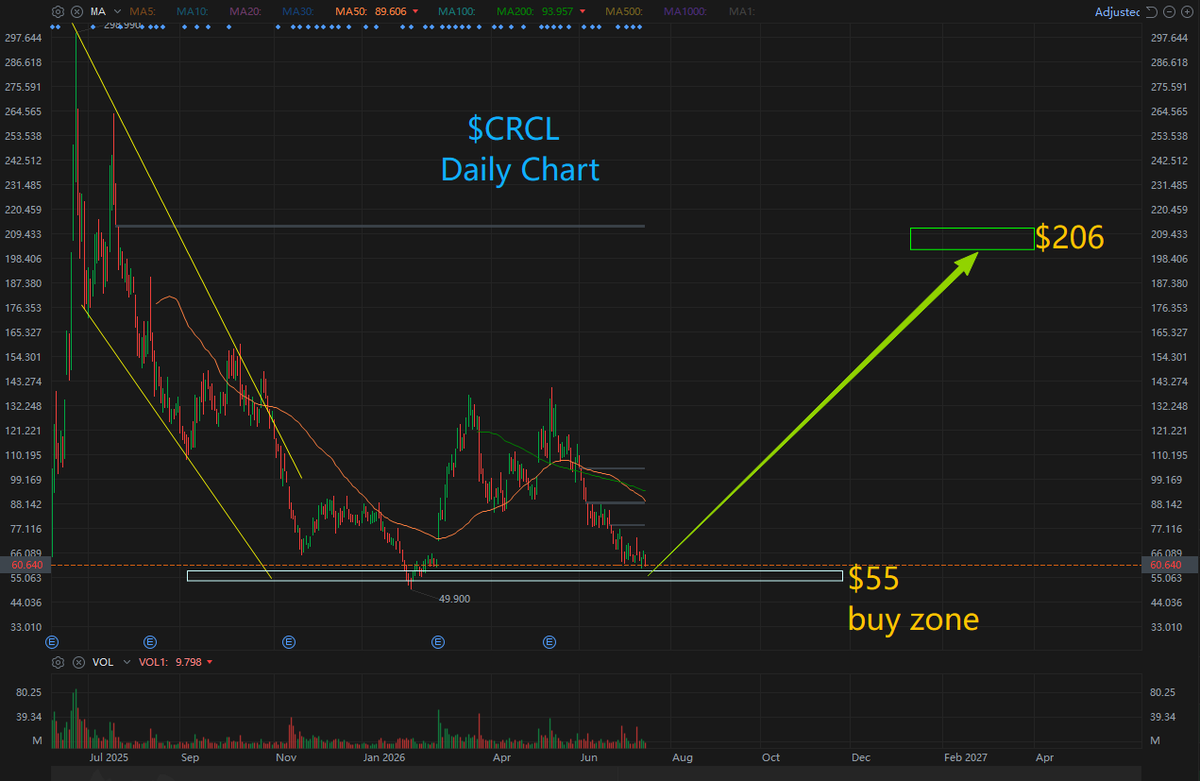
$CRCL --- $CRCL recently secured a U.S. national trust bank charter, a milestone that substantially strengthens its regulatory compliance standing and is viewed as a lasting backbone for the company’s sustainable long-term growth.
Growth Catalyst: Rising Stablecoin Adoption
As fiat-backed stablecoins gain deeper traction across cross-border payments and financial use cases worldwide, industry leader Circle is widely regarded as a foundational financial infrastructure layer for the digital economy.
Profitability Outlook
Analysts project the firm will deliver robust revenue growth and expanding EBITDA through fiscal 2028.
Valuation Reversion Thesis
While the stock has suffered steep drawdowns year-to-date, several institutional firms maintain Buy ratings on CRCL. These investors argue its current market cap fails to fully price in its central, irreplaceable role within global digital financial infrastructure.
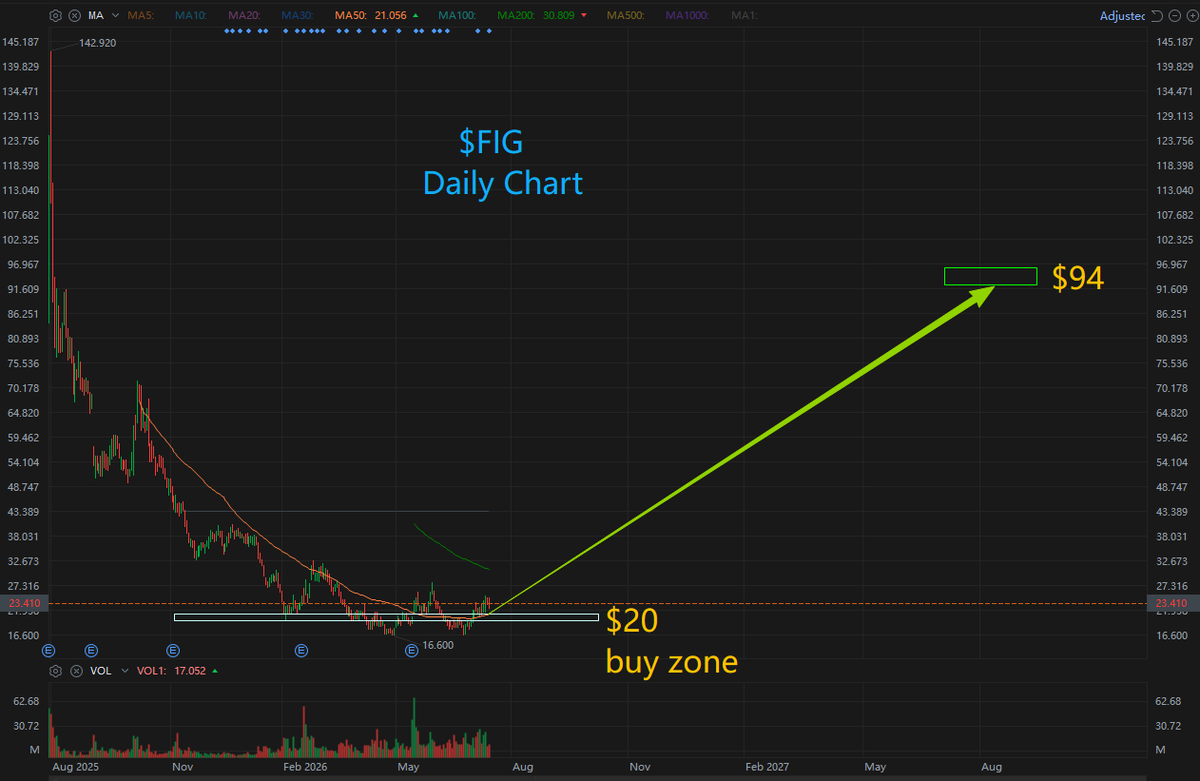
$FIG --- While $FIG’s stock swung alongside its sector in mid-July amid short-term volatility plaguing the broader software space—driven by a shift in corporate capital spending toward AI hardware—investors are highly anticipating its Q2 earnings release slated for August. This bullish sentiment stems from the firm’s robust Q1 growth metrics, including 46% revenue expansion and a 139% net dollar retention (NDR) rate, paired with an upward revision to its full-year guidance.
The primary catalyst behind the stock’s recent rebound lies in its strategic positioning within AI-augmented design. For instance, Citi analysts highlighted Figma as a top AI beneficiary in a recent research note, grouping it alongside Palantir and Microsoft. The bank assigned a $36 price target, underscoring the monetization upside of Figma’s AI tooling as well as the technical advancements unlocked via its acquisition of Bud’s AI team.
1.Moat Built Around AI-Powered Collaboration
The market is shifting away from basic design software toward fully AI-native workflows. By rolling out its proprietary AI design assistant—competing head-on with rivals such as Anthropic’s Claude Design—Figma has retained its dominant market stranglehold across the design industry.
2.Exceptionally Sticky User Base
Its 139% net dollar retention rate serves as concrete proof of deep, entrenched relationships with enterprise clients, a remarkably resilient metric amid the current macro backdrop of slashed software spending.
3. Room for Valuation Re-rating
The stock has logged steep year-to-date losses. With upside from its AI business set to materialize, multiple institutional investors argue the stock is poised for a value recovery after being oversold.
Europe’s tech dependency is becoming a strategic liability. Klaus Hommels, founder of Lakestar, recently sounded the alarm: Europe’s reliance on U.S. tech and capital is no longer just a trade balance issue—it’s a vulnerability.
With Washington tightening the reins on AI exports like Anthropic, the "fairy tale" that Europe can simply outsource its digital future to Silicon Valley has officially crumbled.
The shift is underway. Hommels is pivoting focus from general-purpose VC toward "resilience"—backing European defense and deep-tech startups that ensure the continent can stand on its own feet.
From drone defense to aerospace, the goal is clear: true sovereignty requires owning both the tech stack and the capital that fuels it.
he "globalized tech" era is fracturing into regional silos. While I’m heavy on U.S. innovators like $TSLA and the $SPCX ecosystem, this shift in Europe signals a massive long-term opportunity in "hard tech" and defense. Nationalism in tech isn't just politics; it’s an inevitable capital rotation.
Watch for the EU to aggressively subsidize its own champions—it’s a trend that will define the next decade of infrastructure spending.
The tide in Silicon Valley is turning—and not in the way tech leaders expected. We’re seeing a chilling shift: AI skepticism in the U.S. has escalated from heated boardroom debates to genuine, violent threats.
With executives now hiring armed security and pulling back from public view, the industry is entering a high-stakes era of vulnerability.
The root of this pushback? It’s not just tech-phobia. It’s the tangible strain of energy shortages, rising costs, and mounting fears over job displacement.
When community backlash forces the cancellation of massive data center projects like those from Blackstone’s QTS, it’s clear this is no longer a fringe movement—it’s a systemic hurdle.
The "AI vs. Community" friction is the next major market variable. While the tech is transformative, the infrastructure and social friction costs are being severely underestimated.
For long-term investors, the winners won't just be the ones with the best models—they’ll be the ones who solve the energy and public acceptance puzzle first. Innovation without social license is a dead end.
Is OpenAI the "Lehman Brothers" of the AI Era? 📉
The AI bubble is finally under the microscope, and independent analyst Ed Zitron just dropped a bombshell: the entire artificial intelligence mania is effectively a single-company bubble built on the back of OpenAI.
Zitron argues that OpenAI is the primary reason the tech sector hasn't collapsed yet—and if it stumbles, the fallout could mirror the systemic shock of the 2008 Lehman Brothers collapse.
Think about the ecosystem: OpenAI drives the capital expenditure of infrastructure giants like Oracle and CoreWeave, fuels the existence of rivals like Anthropic, and provides the "justification" for the massive, luxury-spending era of the last two years.
Zitron warns that this is a colossal "misallocation of capital." If the anchor drags, the entire fleet goes down. If the revenue flow stops or the IPO fails to deliver, the shockwaves would likely hit the broader equity markets, signaling that the "AI dream" has hit a hard reality check.
We are reaching a "watershed moment." The market has spent two years pricing in a perfect future for AI, largely ignoring the underlying financials and the sheer scale of the cash burn. While I’m a firm believer in the potential of AI, the infrastructure dependency is real.
If the foundational company of this entire rally faces a liquidity or confidence crisis, the rotation out of tech will be violent. Investors should be asking themselves: are we betting on technology, or are we betting on a single corporate narrative?
When the narrative breaks, valuations follow.
Japan’s AI Darling is in Freefall—Is the Bubble Popping? 📉🇯🇵
In just one month, Kioxia has gone from being Japan’s most valuable company to seeing its market cap cut in half. A 52% plunge from its June highs has wiped out $185 billion in value, a brutal reminder of how quickly the tide can turn in the semiconductor cycle.
The catalyst? A perfect storm of "AI fatigue" and shifting capex expectations. When TSMC signaled a massive hike in 2026 capital expenditures to $64 billion, the market didn't cheer—it panicked.
Investors now fear that surging production capacity will eventually erode the pricing power that made storage chips the gold mine of the last year.
We are witnessing a classic "rotation out of euphoria." As investors question whether the massive AI spending will actually translate into long-term profit stability, the high-flying names are taking the brunt of the hit. Kioxia is a cautionary tale: when a stock climbs 600% on the back of retail leverage and a "growth-at-all-costs" narrative, the descent is rarely gentle.
Smart money is clearly moving to the sidelines, realizing that in cyclical industries, supply-side realities always catch up to the hype.
The New "Swing Producer" You Didn't See Coming: India 🇮🇳⛽
While the world’s traditional energy titans—Russia and the Middle East—struggle with infrastructure damage and geopolitical gridlock, a new powerhouse is quietly seizing the throne.
India is rapidly evolving into the global economy’s "swing supplier" for refined fuels, filling the critical gaps left by a fracturing global market.
The strategy? It’s simple, ruthless, and highly profitable: Buy crude from the lowest-cost sources, refine it, and ship the high-value diesel and jet fuel to whoever pays the highest premium.
With July exports projected at 1.4 million barrels per day—a 50% jump since May—India isn't just reacting to market demand; it's actively shaping the flow of energy.
This is the ultimate "arbitrage of necessity." As Western markets cut ties with Russian supply and Middle Eastern refinery capacity remains under fire, India is playing the long game.
By insulating itself from specific supply dependencies and massively scaling refinery investment, India is positioning itself to be the indispensable balancer of the global energy grid through 2030.
In this chaotic "energy brawl," India is proving that control over the refining process is becoming just as valuable as holding the oil wells themselves.
Is the Fed’s "Wait and See" approach hitting its expiration date? 🏦
The "Hawkish" chorus is getting louder. Even Fed Vice Chair Philip Jefferson, typically a voice of calm, just signaled that if inflation doesn't cool down soon, the table is set for a rate hike.
While he currently views policy as being in a "good place," his emphasis on the risks of entrenched inflation is impossible to ignore.
Behind the scenes, the debate is turning fierce. Dallas Fed President Lorie Logan has emerged as the loudest hawk in the room, openly calling for a rate hike to provide immediate relief to household budgets.
With energy prices spiking due to global instability and potential inflationary pressure from AI-driven demand, the comfort of last month’s cooling CPI data is starting to feel like a fleeting illusion.
We are heading toward a high-stakes showdown at the July 28-29 FOMC meeting. The market is currently betting on a hold, but the internal dissent is signaling that the era of policy complacency is over.
For investors, this is a clear warning: don't get too comfortable with the "transitory" narrative. The Fed is becoming hyper-sensitive to any sign of inflation re-acceleration, and the cost of capital may stay higher for longer than the bulls expect.
Korea’s AI Rocket is Re-entering the Atmosphere 📉
The AI boom in South Korea was a race car with the pedal to the metal. Now, the brakes are on, but they might be too little, too late. With over 1.2 million retail accounts facing margin calls and hundreds of thousands of forced liquidations, we are witnessing a painful deleveraging event.
When 1 in every 30 working-age adults in the country is hit by a margin call, it’s no longer just a market correction—it’s an exodus.
While institutional investors and foreign capital are heading for the exits, retail traders are trying to catch a falling knife, aggressively buying into the tech sell-off. Coupled with a surprise rate hike from the Bank of Korea to combat inflation, the liquidity rug has been pulled out from under the semiconductor giants like Samsung and SK Hynix.
This is a classic "liquidity trap" scenario. When leverage dominates the trade, fundamentals take a backseat to forced selling. As this bubble deflates, capital isn't necessarily abandoning the tech narrative—it's simply seeking safer, lower-valuation harbors.
Don’t be surprised to see a massive rotation of funds into markets where retail leverage hasn't distorted the price discovery. In this cycle, the "easy money" phase is over; now, it’s all about surviving the liquidation.
Is the inflation cooldown a mirage? 📉➡️🔥
Just as we celebrate the best CPI print in five years, a silent crisis is brewing in the shadows: a global "diesel drought." Diesel is the lifeblood of the global economy—it moves the food, materials, and goods that define our daily lives. With US inventories plummeting toward 2003 lows and geopolitical volatility tightening the chokehold on supply chains, we could be looking at a major inflationary rebound.
The numbers are sobering: US diesel futures have surged ~20% in just over a week. Between the ongoing standoff in the Strait of Hormuz and Russia’s export bans, the refined product market is fracturing. When the cost of moving freight spikes, it isn’t just fuel companies that pay—it’s every consumer at the checkout counter.
The market is currently focused on CPI tailwinds, but the supply-side reality is increasingly precarious. If you’re playing the long game, keep a close eye on refining capacity and energy logistics—not just the headline inflation numbers.
When energy infrastructure is squeezed this hard, "transitory" inflation often has a way of becoming a structural headache. The road ahead for logistics and consumer prices is likely to get a lot bumpier.
The line between "insider knowledge" and "insider trading" just got a lot blurrier. Gabriel Perez, a long-time teleprompter operator for President Trump, is now under the microscope by the CFTC. The allegation? Leveraging early access to presidential speech scripts to place winning bets on "mention markets" via Kalshi, pocketing over $90k.
While the White House has placed him on administrative leave—calling the situation a "disgrace"—this isn't an isolated incident. From political figures to corporate insiders, we’re seeing a growing trend of individuals attempting to monetize non-public information on prediction platforms.
As these platforms grow in popularity, they are quickly becoming the new frontier for ethical dilemmas. While the tech is innovative, the regulatory lag is glaring. We need ironclad transparency protocols, or these markets risk losing their legitimacy entirely.
Smart money knows the value of information, but abusing power to game the system is a one-way ticket to career suicide. Integrity remains the most undervalued asset in any market.
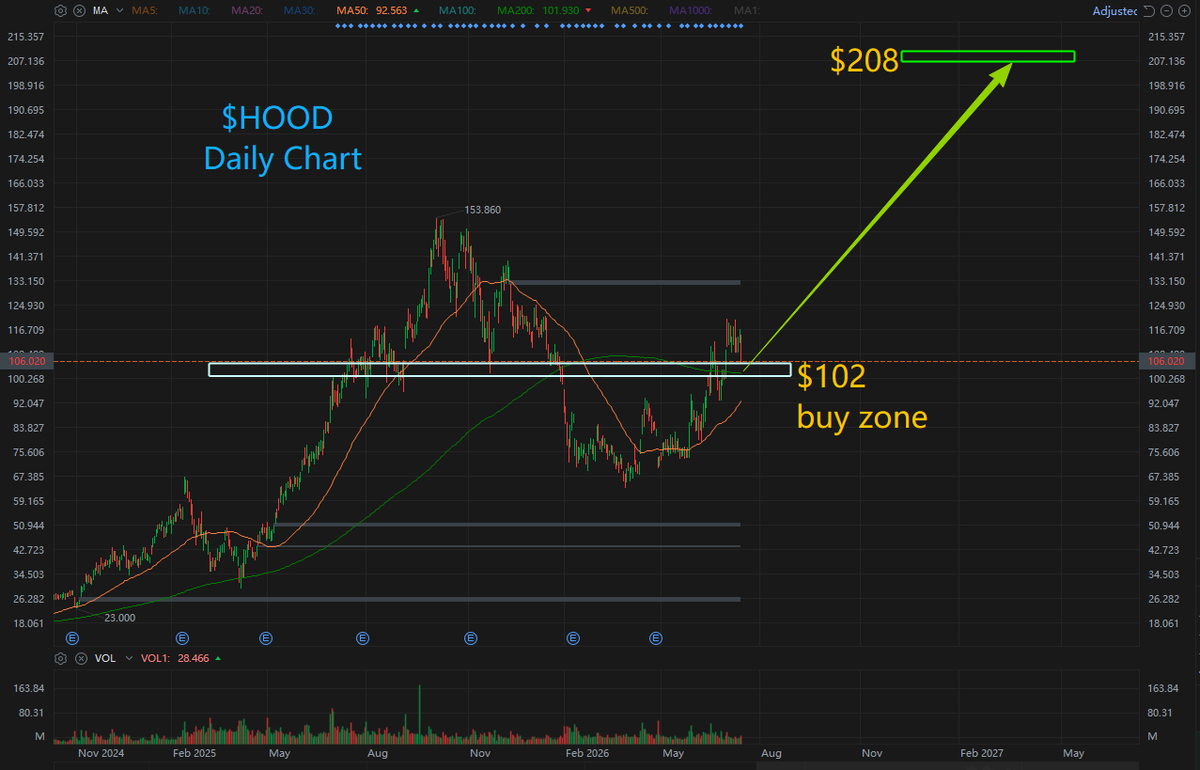
$HOOD --- Robinhood hosted a major launch event in London, officially unveiling the mainnet of Robinhood Chain alongside stock tokenization, agentic trading, and a full suite of decentralized finance (DeFi) products. These moves are designed to deeply integrate crypto assets with traditional finance and kick off its "borderless market journey."
Should Robinhood ($HOOD) gain market traction with its global expansion—particularly across Europe and Canada—and its tokenized offerings, the company’s valuation narrative will shift from a retail trading platform to a high-growth fintech powerhouse.
$HOOD is scheduled to release its Q2 2026 earnings report on July 29, 2026. Wall Street is closely tracking user growth and revenue performance following the platform’s broad product rollout.
1.AI-Powered Financial Services
The firm is aggressively building out agentic trading, which enables AI agents to directly manage user portfolios and execute trades on customers’ behalf. This feature is viewed as a core lever to boost user stickiness and platform operational efficiency.
2.Diversified Revenue Streams
Beyond its core revenue from stock and options trading commissions, Robinhood is broadening its income mix via event contracts for prediction markets, its Robinhood Advisor Network wealth management division, and international expansion including its Canadian market launch.
3.Platform Tech & Asset Tokenization
By rolling out stock tokenization and blockchain infrastructure, Robinhood aims to dismantle the geographic and asset-class barriers inherent to legacy finance, attracting global users seeking cutting-edge financial experiences.
4.Profitability & Cash Reserves
While higher spending on new business initiatives pushed up certain operating expenses in the first quarter, Total Platform Assets surged 39% year-over-year, underscoring the platform’s robust ability to capture and retain customer capital.
$SOFI --- In early July 2026, SoFi rolled out the Social 50 Income ETF (ticker: $SFYI), rounding out its suite of investment products in a bid to draw more growth-focused investors hunting for yield.
From July 13 through July 20 mid-month, SoFi launched a limited-time rate promotion for its home equity loans, waiving the $1,495 origination fee to boost borrowing demand via incentives.
$SoFi is slated to release its Q2 2026 earnings report on July 29, 2026. Investors are closely watching whether the firm can sustain roughly 30% revenue growth and drive further margin expansion.
1.Cost-of-Funds Edge Fueled by Deposits
With deposit balances topping $40 billion and deposits accounting for 96% of its funding mix, SoFi has meaningfully cut its cost of capital, greatly expanding profit margins across its lending vertical.
2.Sticky "Financial Super App" Ecosystem
Cross-selling across its lending, investing, insurance and credit card offerings has steadily grown SoFi’s member base to 14.7 million users, with scale economies bringing down customer acquisition costs over time.
3. Tech Platform Transformation
SoFi’s technology products and services segment continues to scale rapidly. This division generates high-margin recurring revenue, which stands to lift the company’s forward price-to-earnings (P/E) multiple down the line.
4.Robust Profitability Track Record
The company delivered standout Rule of 40 performance in Q1 2026, posting 41% revenue growth alongside a 31% EBITDA margin—proof it can maintain robust profitability while scaling its operations.
$ORCL --- $ORCL posted stellar results for its Oracle Cloud Infrastructure (OCI) segment in Fiscal 2026, with revenue jumping 77%. The company also holds $638 billion in remaining performance obligations (RPO), which underscores its deep, sticky partnerships across AI training and inference infrastructure with marquee clients including OpenAI, xAI and Meta.
While Oracle carries substantial financial leverage, its core operating business maintains robust momentum. Recent reports name Oracle the front-runner for a highly confidential, air-gapped sovereign cloud network contract with the Japanese government. A finalized win would mark a landmark milestone for its enterprise-grade government cloud vertical.
1.Foundational AI Compute Backbone
Far more than a pure software vendor, Oracle is evolving into a global utility provider for AI compute. By building massive GPU superclusters, it has emerged as a critical infrastructure supplier to leading AI developers such as OpenAI and xAI.
2.Enterprise-Grade Defensible Moat
Unlike pure-play AI startups, Oracle boasts an entrenched installed base of legacy enterprise ERP and database customers. Its playbook leverages AI capabilities to augment existing enterprise applications, converting AI compute consumption into recurring, high-retention software subscription revenue streams.
3.Undervalued Candidate for Re-rating
Despite its elevated debt load, Oracle trades at a materially lower P/E multiple of roughly 17–20x versus other large-cap tech peers. For investors bullish on long-term AI demand but wary of stretched valuations across premium software names, Oracle offers meaningful upside rebound potential backed by solid fundamental traction.
$AMZN --- $AMZN Web Services (AWS) delivered 28% year-over-year revenue growth in Q1, marking its fastest expansion across the past 15 quarters. Consensus market estimates call for this momentum to persist through Q2, fueled by surging enterprise demand for AI compute infrastructure.
This July’s Prime Day delivered robust sales results. As a reliable barometer for Amazon’s retail segment, the event lifted Q2 revenue guidance: the firm projects net sales between $194 billion and $199 billion for the quarter, reflecting a 16%–19% YoY uplift.
$AMZN has deepened supply chain partnerships with industrial players including Corning, while ramping up investments in India with a planned $48 billion commitment through 2030. While these catalysts play out over the long term, they underscore Amazon’s deep defensive positioning amid a turbulent global operating landscape.
1.Closed-Loop AI Monetization: AWS Plus Custom Silicon
Unlike peers that rely on third-party GPUs for model training, Amazon leverages in-house AI chips such as Trainium to drive dramatic compute cost reductions. As AI cloud services scale, AWS has evolved beyond basic server provisioning to deliver end-to-end AI model factory solutions for enterprise clients.
2.Underrated High-Margin Advertising Engine
Amazon’s ad business maintains steady growth of roughly 24%. Its high-margin ad segment consistently offsets capital-intensive logistics and e-commerce overhead, serving as a critical pillar supporting overall corporate profit margins.
3.Massive Commercial Backlog Ensures Predictable Growth
Amazon’s signed commercial backlog now stands at $364 billion. This pipeline of contracted revenue yet to be recognized delivers exceptional long-term earnings visibility for the company.
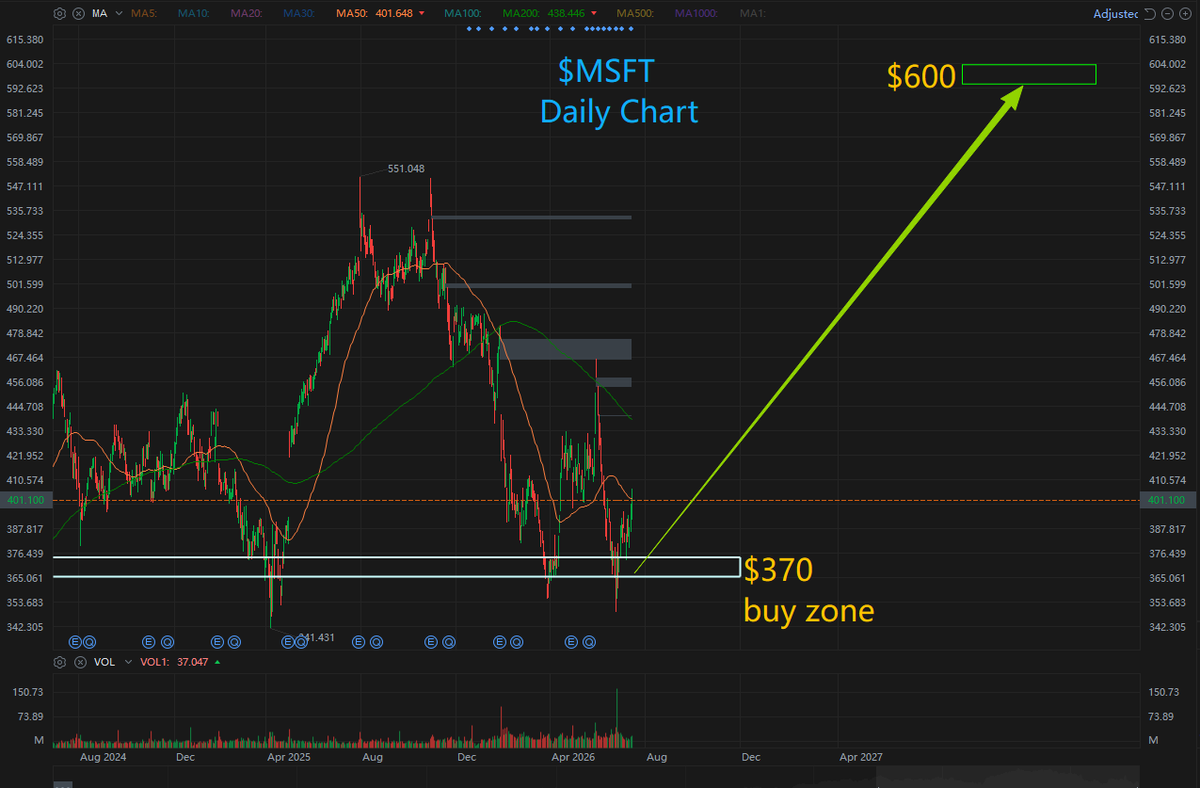
$MSFT --- $MSFT is slated to release its Fiscal Year 2026 Q4 earnings report after market close on July 29, with the reporting period ending June 30. Investors currently view the stock as a top defensive play, projecting steady 15% revenue growth to roughly $87.6 billion.
On July 13, the UK government officially designated Microsoft’s Irish operations hub as a critical third-party cloud provider for the financial services sector. This regulatory stamp of approval further entrenches Microsoft’s competitive moat within financial infrastructure.
As of the end of March 2026, Copilot had secured 20 million enterprise licenses, representing 250% year-over-year growth. A key focal point for markets this month is whether this robust subscription uptake will translate into upside profit beats in the upcoming earnings print.
1. AI as a Standalone Secondary Growth Vertical
Microsoft’s AI initiative is far from a pure cash-burning venture; it has built a highly efficient monetization flywheel spanning the Azure cloud platform and Copilot product suite. So long as AI continues driving measurable productivity gains for enterprise clients, Microsoft stands to capture recurring revenue streams tied to customers’ day-to-day business operations.
2.Oversized Commercial Backlog Delivers Predictable Growth
$MSFT holds a $625 billion commercial order backlog, granting exceptional long-term revenue visibility and insulating the business meaningfully against macroeconomic swings.
3.Compelling Value Following Valuation Compression
$MSFT ’s forward P/E multiple has contracted to approximately 22–23x, down substantially from its 2025 peak and well below the Nasdaq’s average 34x earnings multiple. Many institutional analysts argue Microsoft has transitioned from a high-premium growth stock into a reasonably valued cash cow.
$META --- Exclusive internal intelligence indicates Meta’s capital outlay for AI compute infrastructure is far below Wall Street consensus estimates, paired with drastically accelerated buildout timelines. The firm plans to add a combined 14 gigawatts (GW) of compute capacity across 2026 and 2027, a massive expansion set to solidify its leading position in artificial intelligence.
$Meta has greenlit expansions to its AI data center footprint, including its Louisiana facility. While upfront spending is substantial—full-year 2026 capital expenditures (Capex) are projected to land between $125 billion and $145 billion—the market frames this as a high-conviction bet on long-term industry leadership. The expanded infrastructure will deliver robust compute horsepower to power its AI assistants and content recommendation engines across its social ecosystem.
$META is scheduled to release its Q2 2026 earnings report after market close (AMC) on July 29, 2026. Investors are on edge, closely tracking two core metrics: whether revenue growth can sustainably outpace surging capital spending, and tangible incremental ad conversion lift driven by AI rollouts.
1.AI-Powered Core Advertising Engine
AI has materially boosted ad targeting precision and conversion rates, directly lifting advertiser willingness to ramp up spend. This creates a self-reinforcing snowball cycle: AI optimization drives revenue expansion, which generates greater free cash flow to fund even larger-scale AI infrastructure investments.
2.Defensibility & Unrivaled Moat
Regardless of AI industry evolution, Meta controls the world’s dominant suite of social consumer gateways: Facebook, Instagram, WhatsApp and Threads. Its unparalleled massive user traffic pool delivers an ideal real-world deployment sandbox for AI use cases—a critical advantage pure-play AI developers cannot replicate.
3.Long-Term Personal Superintelligence Vision
Zuckerberg’s strategic roadmap pivots Meta from a pure social media conglomerate into an AI agent platform. If the company successfully monetizes AI agents via commission streams or premium subscription tiers, it will unlock a durable second major growth vertical beyond its core advertising business.
$NVDA --- The U.S. federal government has recently relaxed AI chip export restrictions targeting the UAE and other Middle Eastern nations. For NVIDIA, this unlocks a multibillion-dollar new market for AI compute demand, beyond its China and U.S. revenue pools.
As of July 16, 2026, Wall Street’s consensus rating on NVIDIA remains a Strong Buy, with roughly 98% of covering analysts issuing Buy or Strong Buy recommendations. The consensus average price target stands around $300, reflecting broad institutional conviction in the stock’s long-term intrinsic value.
The single biggest bull catalyst for 2026 centers on progress for NVIDIA’s next-gen Rubin GPU platform. Manufactured on TSMC’s 3nm N3P process and paired with HBM4 high-bandwidth memory, the chip is engineered to resolve critical compute and bandwidth bottlenecks plaguing today’s large AI model inference workloads. Markets expect Rubin to enter mass production in H2 2026, viewed as a core upside driver for the stock going forward.
1.Surging Compute Demand Driven by Tokenomics
Widespread rollout of ultra-large foundation models including GPT-5.1 and Gemini 3 has sparked exponential growth in demand for inference compute. Legacy hardware architectures can no longer handle the massive token throughput required by cutting-edge models, forcing enterprise customers to continuously refresh their fleets with NVIDIA’s high-end silicon.
2.Unrivaled Hardware-Software Moat
NVIDIA’s competitive edge extends far beyond standalone GPUs. Its CUDA software ecosystem and fully integrated end-to-end hardware-software stack deliver unmatched cost efficiency for commercial deployments, boasting the industry’s lowest per-token operating costs. This creates steep switching costs; even when enterprises test rival silicon vendors, they face steep barriers to migrating off NVIDIA’s ecosystem.
3.Diversified Customer Base
To address investor concerns over excessive revenue concentration among a small handful of hyperscale clients, NVIDIA is accelerating expansion into enterprise AI, government sovereign compute infrastructure, and emerging Middle Eastern markets. This strategy effectively mitigates performance volatility stemming from reliance on a limited number of major buyers.
$DUOL --- While the broader tech sector—particularly software names—experienced volatility mid-July driven by macroeconomic headwinds, $DUOL displayed superior defensive characteristics relative to enterprise-focused SaaS firms thanks to its consumer-facing, B2C subscription business model.
$DUOL is leveraging AI to drastically scale its content production. In Q1 2026, the company rolled out 20,500 new course units, a massive jump from just 1,800 units recorded in the same quarter of 2024. This dramatic efficiency gain represents a core competitive advantage, enabling the firm to cut costs and iterate its platform at a rapid pace.
1.User Growth Driver
Beyond standing as the world’s largest language-learning platform, Duolingo is actively evolving into a full-fledged general education ecosystem. Its growth strategy hinges on an extremely low customer acquisition cost (CAC), with most user expansion stemming from organic word-of-mouth and viral social media traction.
2.Evolving Monetization Strategy
The company is piloting new revenue streams, including immersive AI-powered interactive drills and tiered subscription restructuring. Institutions such as Morgan Stanley forecast Q2 EBITDA will beat consensus estimates, and the firm may raise its full-year growth guidance before year-end.
3.Expanding Profitability Profile
Duolingo has transitioned out of its early cash-burning growth phase into a period of meaningful profit expansion. Net income rose substantially over the trailing twelve months, generating ample cash flow to fund increased R&D spending tied to its Vision 2026 strategic roadmap.