It's nice to see this out! Tryg and I rely on a NK model of the global economy with trade disruptions---developed by @pcubab, @Albert_Queralto, Mikael Scaramucci and I in recent research---to quantify the net inflationary effects of the Hormuz closure and the IEEPA tariffs ruling
New research finds that increased costs due to trade disruptions generated by the unexpected closure of the Strait of Hormuz completely undo disinflationary effects of lower tariffs that resulted from a U.S. Supreme Court ruling earlier this year. https://t.co/m97ib07ox1
It's nice to see this out! Tryg and I rely on a NK model of the global economy with trade disruptions---developed by @pcubab, @Albert_Queralto, Mikael Scaramucci and I in recent research---to quantify the net inflationary effects of the Hormuz closure and the IEEPA tariffs ruling
New research finds that increased costs due to trade disruptions generated by the unexpected closure of the Strait of Hormuz completely undo disinflationary effects of lower tariffs that resulted from a U.S. Supreme Court ruling earlier this year. https://t.co/m97ib07ox1
A sequence of major economic and geopolitical events has reshaped the structure of global trade in the past decade. The latest on Dallas Fed Economics explores these shifting global trade patterns. https://t.co/bDIXl3DJjT
@DallasFed We estimate that trade diversion from China should have increased Mexico’s GDP by up to 1 percent by incentivizing additional investment. The results underscore how domestic investment dynamics shape macroeconomic gains from shifting global trade patterns.
Mexico gains from U.S.-China trade war; inefficiencies limit benefit https://t.co/1VAj98bBRu via @DallasFed
Happy to finally have out my first DFE piece!
@DallasFed A central question for policymakers is whether this reallocation has meaningful macro consequences beyond changes in bilateral trade. In particular, has the diversion of U.S. sourcing away from China translated into gains in Mexican aggregate output, such as higher GDP growth?
A few years ago, Christina Skinner and I published “Laboratories of Central Banking,” in the Review of Banking and Financial Law. A Mercatus policy brief on the paper is recently making the rounds and garnering some controversy, so I wanted to make a few comments. (Thread)
I got to organize the @nber International Trade and Macroeconomics meeting with the amazing Yan Bai:
https://t.co/BUGU8OLNPu
It's tomorrow afternoon and for those of you without access to the Royal Sonnesta, it's on youtube:
https://t.co/nDdJU2GPzk
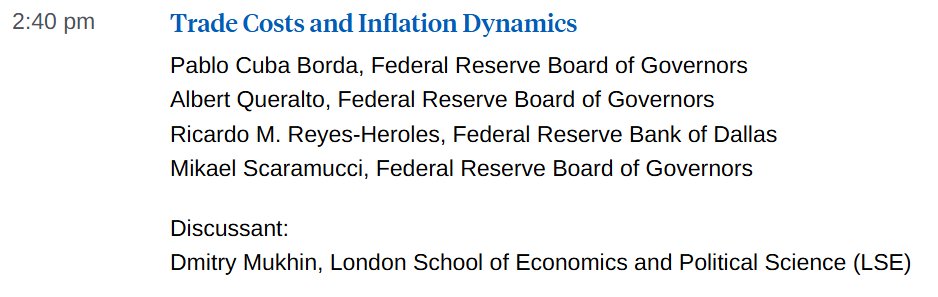
I'm thrilled! Thanks for including my work with @pcubab, @Albert_Queralto, and Mikael Scaramucci in such an amazing program. Looking forward to tomorrow's session!
Another timely one.
How do changes in trade frictions (like tariffs) affect inflation?
by @RichRHC and a team from @federalreserve
Key finding is that when the tariff hits intermediate goods (which is 40 percent of U.S. imports), inflation is more persistent.
Another timely one.
How do changes in trade frictions (like tariffs) affect inflation?
by @RichRHC and a team from @federalreserve
Key finding is that when the tariff hits intermediate goods (which is 40 percent of U.S. imports), inflation is more persistent.
Headed to NBER SI. In addition to seeing the latest research, I'm looking forward to the panels on "The Future Impacts Of Current Trade Policy" (@itskhoki, @skalemliozcan, @akhandelwal8, Rodriguez-Clare) & "The Future of the Global Economy" (@itskhoki, @paulkrugman, Tesar).
Using a multi-country New Keynesian model with trade in final goods and intermediate inputs, the authors estimate that a 10 p.p. increase in U.S. bilateral trade costs leads to about a 1 p.p. increase in U.S. inflation. (2/3) https://t.co/Z42TOgrd0X #IFDPPaper
The inflationary effects persist when trade barriers increase the cost of intermediate inputs. Persistent inflation complicates the monetary policy tradeoff. (3/3) https://t.co/Z42TOgrKQv #IFDPPaper
Using global input-output data & a gravity framework, the authors provide empirical evidence that higher import costs, such as tariffs & non-tariff barriers to trade, act like negative supply shocks that increase inflation & lower output. (1/3) https://t.co/Z42TOgrKQv #IFDPPaper