@EconomPic Good point. I was thinking 70s/early 80s or 2022 style rate rises, driven by inflation fears. If the situation were high real yields along with normal (or high) stock valuations I completely agree with your premise!
Anwyay - more background in the article (which I tried to make short-ish, and so ended up making the footnotes almost as long as the main text): https://t.co/eyuJnYzPhn (whatever/whatever)
None of this is to say don’t buy a home — just that they aren’t the easy-money investment so many think. Best to thoroughly run the numbers with realistic, historically-informed assumptions, to properly weight financial vs. personal considerations.
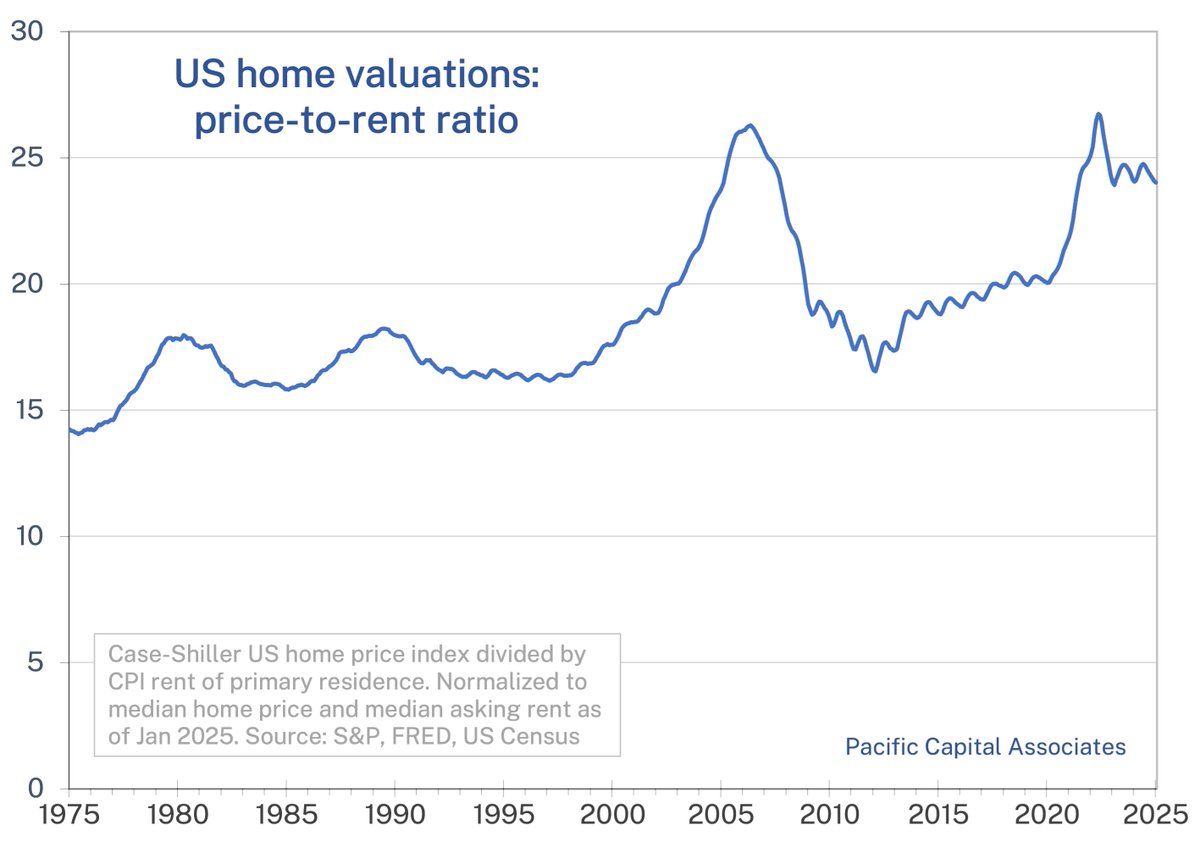
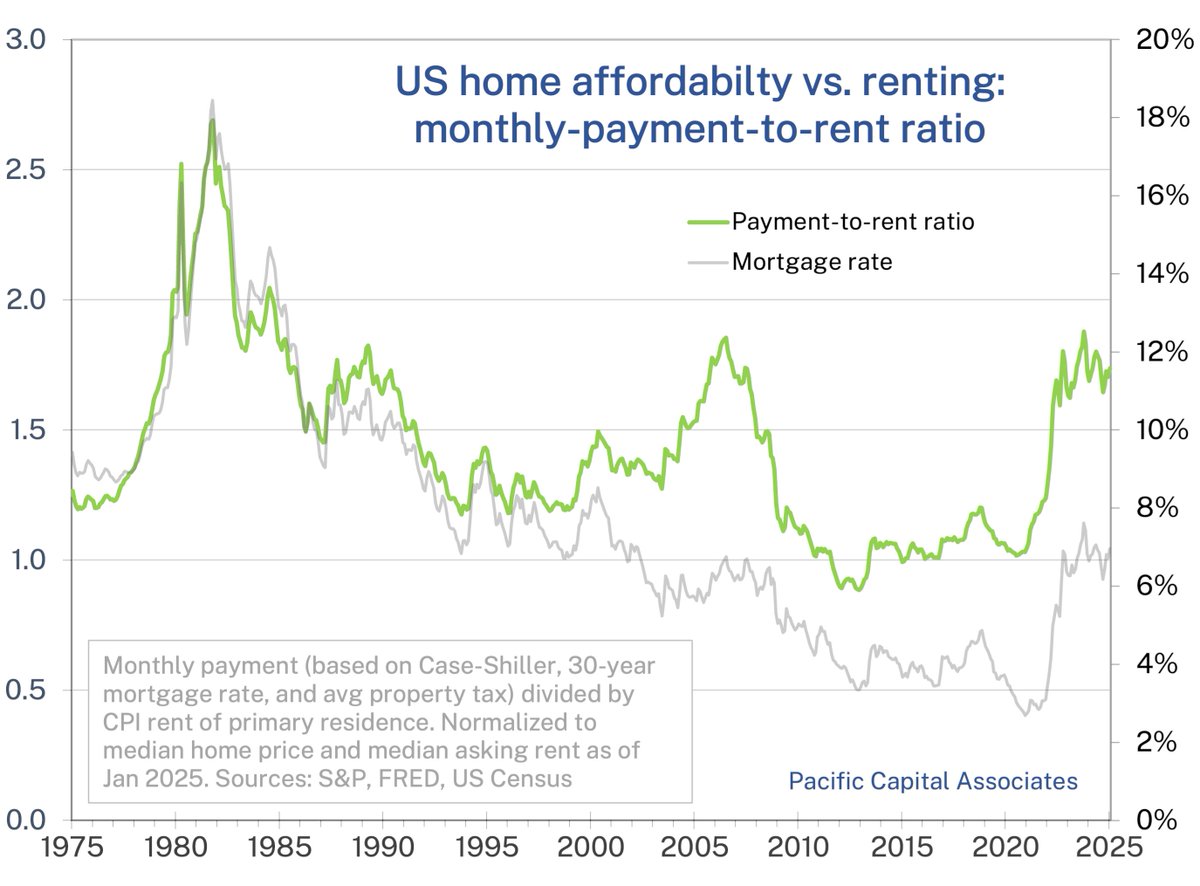
So in sum, housing looks great in the (recent) rearview mirror but looking forward it offers limited potential for price gains, elevated risk of price declines, and rental yields near historic lows.
High valuations are harmful to future returns in 2 ways: they raise the risk of price declines if valuations revert, and they mechnically translate to lower rental yields (historically the main component of RE returns). (6/8)
The shock came from the pandemic; specifically the remote-work revolution (unlikely to repeat) and all-time low mortgage rates (now reversed). These are in the past but they leave behind very high prices and poor affordability. (5/8)
First, US housing supply grew faster than population over this period. Second, the bulk of the decade’s appreciation was crammed into a 2-year period — more consistent with an economic shock than slow-moving factors like demographics. (4/8)
The past decade was different and delivered exceptional appreciation. Real prices went up about as much as they did in the entire 4 decades prior. The standard explanation is a structural housing shortage but the facts don't support this thesis. (3/8)
The long term trend for home prices is just to slightly outpace inflation — or maybe not even that, once quality changes are fully accounted for. (Glamour markets such as San Diego have gone up more, but they have their own issues, discussed in the article). (2/8)
Twitter friends, I am seeking suggestions for a rent-vs-buy housing calculator that accounts for the whole picture (opportunity cost, taxes, etc). The NYT one is excellent, but it's behind a paywall and I'd like an option to recommend to non-subscribers.
Understanding Return Expectations (S7E21)
In this episode, I speak with Antti Ilmanen, Principal and Global Co-head of the Portfolio Solutions Group at AQR Capital Management.
Antti has long been one of the most thoughtful voices in the world of expected returns, having written not one, but two landmark books on the subject. But in his latest paper series, he returns to the topic with fresh urgency—probing the difference between objective and subjective expectations, and asking why even rational models can go so wrong in real time.
We explore everything from CAPE ratios and market timing accusations, to why equity investors tend to extrapolate while bond investors expect mean reversion. We dig into how behavioral biases, valuation anchors, and structural shifts collide when forming capital market assumptions — and how Antti and the AQR team try to navigate that mess themselves.
If you’re in the business of long-term forecasting or just curious why markets often act like they’ve never read the textbooks, this is a conversation you won’t want to miss.
Please enjoy my conversation with Antti Ilmanen.