•Socrates: "I am the wisest man alive, for I know one thing, and that is that I know nothing."
•Einstein: "The problems remain the same, but the answers have changed."
•The Chinese Farmer: "Good luck? Bad luck? Who knows?"
These are currently my three favorite quotes because they pertain to being intellectually humble, adaptable to change, and recognizing that the infinite complexity of reality goes far beyond the basic binary systems of morality and logic (good and bad, right and wrong)
@mountainwesttax Then eat nothing at all. You will lose weight. Start with 24-36 hours a week and eventually you can do up to 48-72 hours every month or two.
@MurrayHillGuy1 Athletes who are already lean can eat plenty of carbs for fuel and performance. Fat and skinny fat sedentary muppets, which is most people, are better served by limiting carbs to some degree and total calories in order to burn off body fat instead.
@HolmerNoah That puffy look appeals to some people, especially powerlifters and bodybuilders.
Personally I’d rather look like a natural track and field athlete. Slender, dense, and wiry.
Elon Musk: “The reason I felt that it was important to acquire Twitter was because I could feel the walls closing in. It was outrageous that they suspended the account of a sitting president.
I think it was only a matter of time before they suspended my account.
Twitter and pretty much all the social media companies, Google and everyone are controlled by far-left activists. That’s the truth of it.
How do you know what’s real when it’s all filtered through a far-left San Francisco Berkeley lens?
They just manipulate the truth constantly."
Asmongold explains why the trans issue is a litmus test for whether someone can be trusted with reality
"The reason the trans issue matters so much to me is because it's an indicator of a person's state of mind. If a person's mindset is willing to deny basic biology, this person cannot be trusted with reality."
"You can't trust them to make decisions that are reasonable because their brain is messed up. It's broken. There's something wrong with their brain. That's the reason why you can never let these people walk it back. You always push them over and over and over. Completely run them out of every institution."
I’m a dermatologist. I’m supposed to say there is no amount of safe sun exposure.
But I won’t, because that’s a lie.
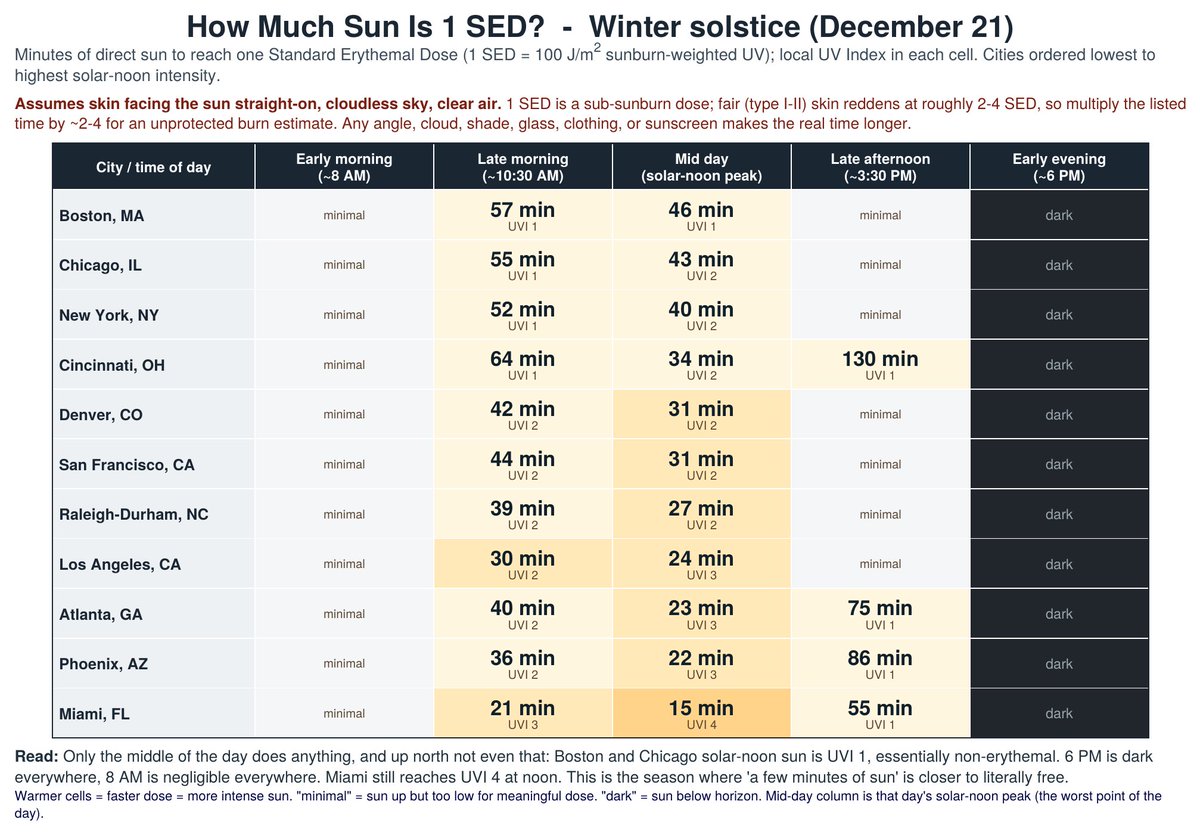
The attached shows how much sun is safe in different cities at different times of year.
What do I mean by ‘safe’?
I mean this: UV causes DNA damage and skin cancer.
But, shockingly, your body repairs that damage. As long as the damage doesn’t outpace repair and start accumulating it shouldn't increase your risk of skin cancer.
Data just came out that tells us how much UV you can get without damage accumulating.
They took the people most susceptible to DNA damage from UV and exposed them to UV, then did skin biopsies to measure the damage, then more skin biopsies to measure the repair, and repeated it daily for 4 days.
At 1.6 ‘Standard Erythemal Dose’ (SED) there was no accumulation of damage.
So, the attached charts show how much sun it takes to get 1 SED in different cities at different times of the year at different times of day.
And there are extra safety margins built in. It assumes a perfectly clear day with zero air pollution and that the sun is hitting your skin perpendicularly. Unless you’re laying flat, most sun is hitting you at an angle, which isn’t nearly as intense.
But a bigger question you might be asking is ‘Why would a dermatologist be telling you to get sun in the first place?’
Because getting sun reduces your risk of death.
Mostly by reducing your risk of heart attacks and strokes. That is very well proven.
But it’s also very likely that sun exposure reduces your risk of autoimmune disease, dementia, cancer and depression. It’s just not as well proven as the protection against heart attacks and strokes.
And before you reply and say ‘just take vitamin D!’, know that it has been ROBUSTLY proven that vitamin D has little (if any) benefit for preventing any of the above. Vitamin D is mostly useful as a marker of if you’re getting enough sun.
What do I do myself and what do I tell my patients?
Get as much unprotected sun exposure as you can without getting a burn.
That’s my GUESS as to what has the best risk/benefit ratio. Dying of skin cancer is actually really rare, especially when compared to the risk of heart attacks, strokes, autoimmune disease, dementia and other cancers.
But I’ll admit it’s not for sure best to get as much sun as possible, since sun does increase the risk of skin cancer and it might be the case the benefits plateau at a low level.
So, if you’re really worried about skin cancer stick to the charts.
The best science I can find says that amount won’t cause skin cancer.
The takeaway?
Sun is good for you, just don’t get a burn.
Sunlight is valuable for FAR more than just vitamin D. Multiple studies have shown that UV wavelengths in sunlight positively affect both the gut microbiome and the immune system. Getting into the sun would absolutely be good for you. You cannot replace the sun with a vitamin D supplement.
Your low stomach acid resulting from autoimmune attack on the parietal cells could also be partially bypassed with the increased nutrient density and more highly absorbable heme-iron found in meat, especially red meat. Heme-iron can be absorbed in an acid- independent pathway in the stomach (heme carrier protein-1).
Your low ferritin has sadly been caused by your vegan diet (non-heme iron) and hypochlorhydria from the AIG. Fearing the sun is also not doing you any favors.
I hope you are able to heal, but it may be time to leave the veganism and umbrellas behind, my friend.
“Don’t have children, go on birth control, have abortions, sleep around, get tattoos, cut your hair short, don’t get married, work full time, get in student loans debt, pay taxes, buy and consume.”
—Feminist propaganda trying to destroy women
Elon Musk literally sat down for a 45-minute talk with Y Combinator that explains how to build world-changing companies better than any business school on earth. This is the advice he gave a room full of young founders:
1. Don't try to build something great. Try to build something useful.
Everyone obsesses over greatness. Musk says that's the wrong target. "I didn't originally think I would build something great. I wanted to try to build something useful. I didn't think I would build anything particularly great. Seemed unlikely, but I wanted to at least try." Aim for useful first. Greatness, if it comes, is a byproduct.
2. When you can't get in the front door, build your own door.
Before Musk started his first company, he tried to get a job at Netscape. "I sent my resume into Netscape and nobody responded. I tried hanging out in the lobby to see if I could bump into someone, but I was too shy to talk to anyone. So I'm like, this is ridiculous, I'll just write software myself." He didn't set out to be a founder. He became one because no one would hire him.
3. He slept in the office and showered at the YMCA.
The origin of his first company was not glamorous. "We couldn't even afford a place to stay. The office was 500 bucks a month, so we just slept in the office and showered at the YMCA." He couldn't afford proper internet either, so he drilled a hole through the office floor and ran a cable to the internet provider downstairs. That was the founder of the future richest man on earth.
4. Keep the chips on the table.
When Musk sold his first company, he received a $20 million cheque. His bank balance went from $10,000 to $20 million overnight. Most people would have stopped. He put almost all of it straight back into his next company. "I kept the chips on the table." He did the same thing decades later, over and over. He hates money sitting idle. Money is fuel for the next mission.
5. Start with the mission, then work backwards to make it a business.
Musk didn't start SpaceX to make money. He went on the NASA website to find out when humans were going to Mars, and there was no plan. So he decided to build one. "There had been no prior example of a rocket startup succeeding. A small chance of success is better than no chance of success." The mission came first. The business model came later.
6. He started SpaceX expecting to fail.
He is brutally honest about the odds. "SpaceX started in mid-2002 expecting to fail. Probably 90% chance of failing. When recruiting people, I said, we're probably going to die, but small chance we might not die." The first three launches failed. The fourth one worked with no money left. "If the fourth launch hadn't worked, it would have been curtains. We made it by the skin of our teeth."
7. Break every problem down to physics.
This is the core of how Musk thinks. "First principles means break things down to the fundamental elements that are most likely to be true, then reason up from there, as opposed to reasoning by analogy." His example is rockets. Everyone priced them based on what old rockets cost. Musk asked what a rocket is actually made of, priced the raw metals, and found the materials were only 1-2% of the historical price. The rest was inefficiency he could attack.
8. When told something takes 24 months, break it down and do it in six.
Last year xAI needed a giant computer to train its AI. Suppliers said it would take 18 to 24 months. "It's like, well, we need to get that done in six months or we won't be competitive." So he broke it into parts. Needed a building, so he found an old factory. Needed power, so he rented generators. Needed cooling, so he rented a quarter of America's mobile cooling capacity. He slept in the data centre and ran cabling himself. It got done.
9. Watch your ego-to-ability ratio.
Musk's single sharpest piece of advice for young founders is about staying honest with yourself. "A major failure mode is when your ego-to-ability ratio gets too high. Then you break the feedback loop to reality." Keep the ego small, internalise responsibility for everything, and stay ruthlessly connected to what's actually true. "You want to close the loop on reality hard. That's a super big deal."
10. Chase work, not glory.
His closing philosophy ties it all together. "It's so hard to be useful. The area under the curve of total utility is how useful you've been to your fellow human beings times how many people. If you aspire to do true work, your probability of success is much higher. Don't aspire to glory, aspire to work."
He was ridiculed for years. The press called him "internet guy attempting to build a rocket company." He agreed it sounded absurd. He did it anyway, because a small chance of doing something useful beat no chance at all.
Here's the thing though....
Musk became the most followed founder alive because everything he does happens in public. The launches, the failures, the talks like this one. The companies made him powerful. The personal brand made his every word travel around the world before he finishes saying it.
We build massive distribution and grow personal brands on X and beyond without our clients lifting a finger.
If you're a founder or VC looking for that kind of exposure, book a call below.
We average 1.5M views a week.
https://t.co/UoXuYlkBQq
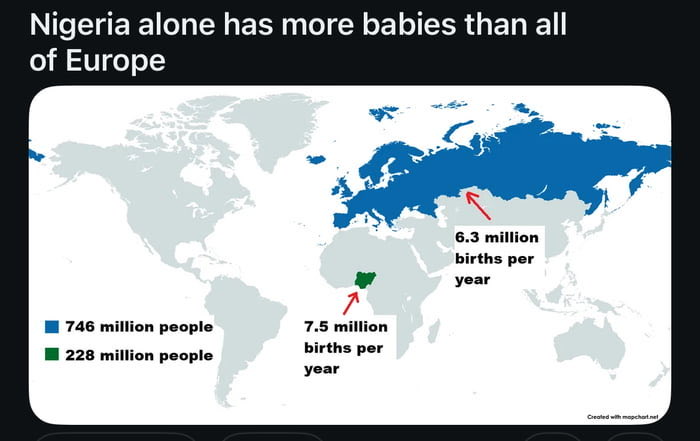
The reason third world countries have high birth rates is that the men in those societies still have a higher status than the women.
If you give women the same or a higher status than men the birth rate will massively fall like what is happening in Europe.
Women used to be 30 years old married with 3 children and a husband living in a house they owned, with a high enough standard of living that she didn’t even need to work and could stay home.
Now 30 year old women have slept with 30 guys, have no children, are not married, live in an apartment and have to go to work full time just to survive.
This isn’t progress, this is societal decline and a dramatically lower quality of life being sold to women as their liberation when in reality it is their enslavement.