Follow the money.
Without a marquee player to attract cash and ratings, team success becomes expendable.
That’s the only explanation for the committee’s decision to exclude Florida State.
As a player there is nothing worse than realizing this terrible reality.
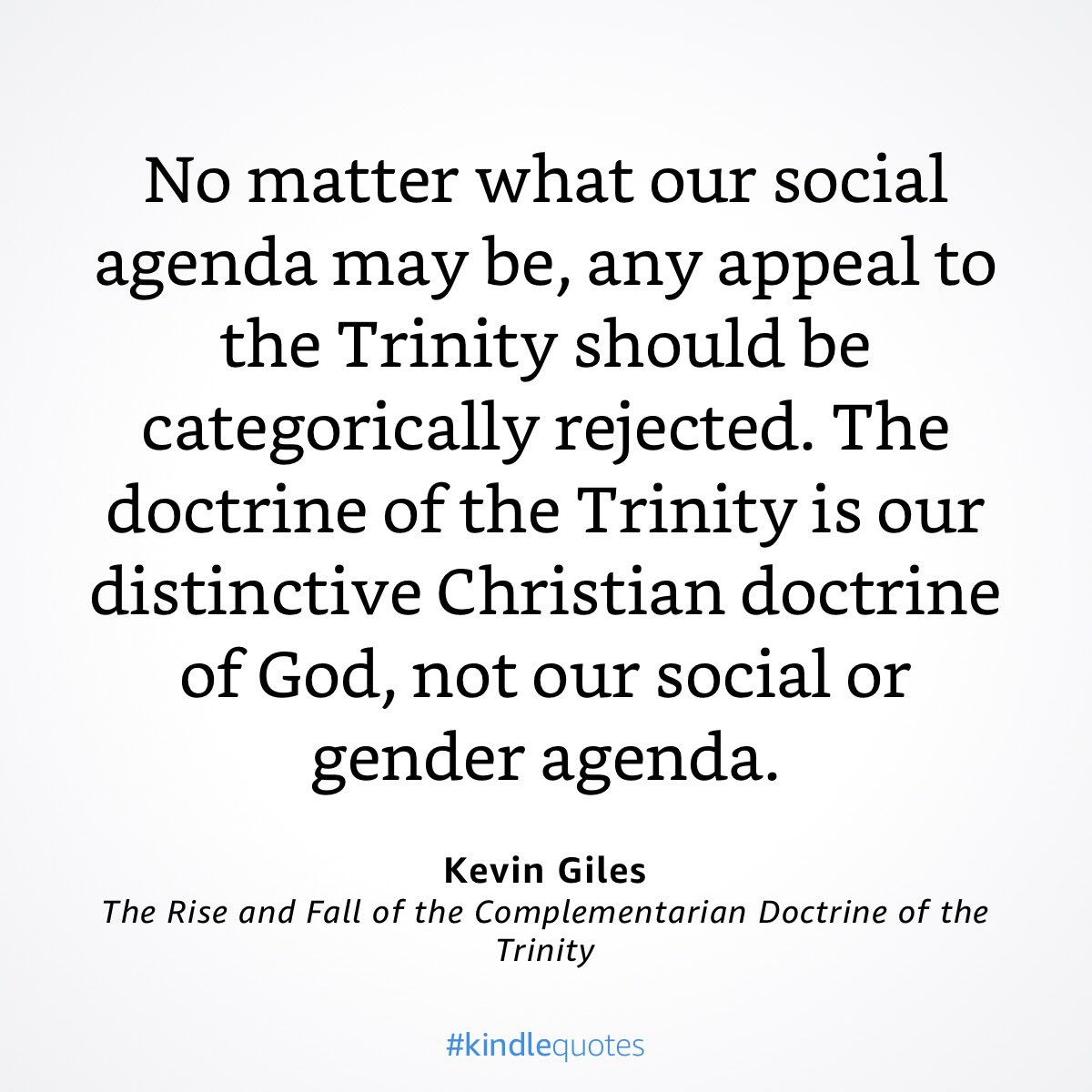
Oh my. Kevin Giles makes the argument that neither Egalitarians nor Complementarians should use the doctrine of the Trinity for the purposes of furthering their social agenda.
Let’s move on to the Trinity. I assume the argument is from ESS or EFS. I reject this claim out of hand, as I find these to be thinly disguised versions of Arianism, a Trinitarian heresy. Some may disagree. That’s fine. They are free to do so. But I reject this argument de facto.
Psalm 23 gives three pictures of who God is, and three declarations we can make as a result.
The LORD is:
—My shepherd in the fields (1)
—My companion in the valley (4)
—My host at the table (5)
Therefore I shall:
—not want (1)
—fear no evil (4)
—dwell in his house forever (6)
I so wish this wasn’t true, but it is. This dichotomy(think that’s the right word), severely and adversely impacts and increases the racial divide between Black and White Christians.
When numerical growth is taken as the criterion of judgment on the church, we are transported with alarming ease into the world of the military campaign or the commercial sales drive.
In the gospel of Luke, the prodigal son doesn't return home because of a renewed love for his father. He comes back home simply to survive because he ran out of money and is starving. And his father is perfectly fine with that!
Just come home. God just wants you home.
@PrestonSprinkle@PrestonSprinkle Is it a fair conclusion that head is used to mean to either source or authority and sometimes both? At the end of the day we can only do our best to understand how Paul used it in context?
What is the most important thing the church must do right now to help our neighbors trust Jesus for their salvation?
We asked leading thinkers and theologians that question. Jeremy Treat’s response is an essay called “Orthodoxy in Exile: Church as an Alternative Community.”
————————
One day, as I was serving meals in my church for the unhoused community in East Hollywood, a man stopped me in the hallway and said, “Hey pastor, I just want you to know I’m only here to serve. I do not need the church.”
“OK,” I replied, planning to circle back later and explore his hesitation. I asked his name and we carried on serving. As I’ve reflected on that encounter, I’ve come to think it represents a broader trend in our city. People want community, and they long to make a practical difference in the city, but they despise the church. It’s not just indifference; it’s disdain.
How can the church thrive in a city that sees it as outdated, irrelevant, and morally offensive? It must be an alternative community that is different from the city but also seeks its good.
𝐃𝐢𝐟𝐟𝐞𝐫𝐞𝐧𝐭 𝐟𝐫𝐨𝐦 𝐭𝐡𝐞 𝐂𝐢𝐭𝐲
To faithfully represent Christ, the church must learn to stand out from its surrounding context. Unfortunately, consumerism and individualism have so infiltrated the American church that it often mirrors worldly values with a veneer of Christian spirituality. The worship service has become a social event. Pastors are entertainers and influencers. Discipleship is self-improvement. Church is merely another consumer good meant to round out my individual spirituality.
Over the last decade, the church has been exposed for this shallowness and hypocrisy, particularly in the areas of political idolatry, abuse of power, and celebrity culture. In our efforts to be all things to the unchurched, we’ve dechurched the church and lost our distinction from the wider society.
What can churches do to recover our witness? We must rediscover our identity as a distinct community set apart by God’s grace.
The mission of the church is not to draw a crowd, but to make disciples. We must combat the secular narratives of our day by telling a more compelling narrative, the story of God’s kingdom. We must teach sound doctrine so our congregations aren’t co-opted by secular ideologies. God’s people must embrace a distinctly Christian ethic that’s grounded in God’s Word. And we must demonstrate that conviction and kindness aren’t mutually exclusive. Lesslie Newbigin captured the need for the church as an alternative community when he said, “The chief contribution of the Church to the renewing of social order is to be itself a new social order.”
𝐅𝐨𝐫 𝐭𝐡𝐞 𝐆𝐨𝐨𝐝 𝐨𝐟 𝐭𝐡𝐞 𝐂𝐢𝐭𝐲
As an alternative community, the church isn’t called to be against the city but for its good. Unfortunately, many Christians have an adversarial mindset toward the city, which is why most non-Christians assume the church is against everything in the world.
This is particularly evident with the LGBT+ community, which often assumes Christians are unloving, narrow-minded, hypocrites. The church, therefore, must go out of its way to show God’s love to all people and defend the dignity all people. To do this in a way that honors God, we must understand (and teach) that one doesn’t have to affirm everything about people to love them. The church can uphold biblical truth about gender and sexuality and still love the people who disagree with us. We follow a Savior who embodies grace and truth.
Another way the church practically shows God’s love for the world is by ministering in both deed and word. Jesus was known for being “mighty in deed and word” (Luke 24:19), and his disciples should have a similar reputation. In an age when justice is a primary societal virtue, Christians can lead the way by being a people who do justice, love mercy, and walk humbly with God (Mic. 6:8). And yet, the church should have a distinct approach to ethics while striving for the common good. We must be like the fourth-century African theologian Athanasius, who was against the world (i.e., its worldliness) because he was for the world (i.e., its creational good and God-given purpose).
𝐅𝐚𝐢𝐭𝐡𝐟𝐮𝐥 𝐈𝐧 𝐄𝐱𝐢𝐥𝐞
Our cultural moment has certainly proven challenging. Yet what’s happening in our world right now isn’t an obstacle but an opportunity for the church to rediscover its true identity as a people in exile who are called to witness to a better kingdom.
One beautiful example of how to be faithful in exile comes from a letter God sent to his people when they were in Babylon. Israel despised their captors, resisted settling in a new land, and longed to return to Jerusalem. Yet God sent a message to them, saying, “Seek the welfare of the city where I have sent you into exile, and pray to the LORD on its behalf, for in its welfare you will find your welfare” (Jer. 29:7).
This is a vision of God’s people being a counterculture for the common good. They were called to be present but distinct. It’s a model for the church today in an exilic, post-Christian context. We’re called to be what James Davison Hunter calls a “faithful presence.” Or, as Miroslav Volf claims, “To live as a Christian means to keep inserting a difference into a given culture without ever stepping outside that culture to do so.”
𝐈𝐧 𝐋𝐨𝐬 𝐀𝐧𝐠𝐞𝐥𝐞𝐬 𝐚𝐬 𝐈𝐭 𝐈𝐬 𝐢𝐧 𝐇𝐞𝐚𝐯𝐞𝐧
By God’s grace, I’m seeing this vision play out in our church in the heart of Los Angeles. It’s a broken and difficult city. Yet Jesus is transforming lives and building his church throughout L.A.
Our church summarizes our values with the phrase “orthodoxy in exile.” By “orthodoxy” we mean we’re unabashedly biblical, upholding the historic doctrines of Christianity and proclaiming the gospel of Jesus as the ultimate answer to sin and sorrow. Yet we’re called by God to love Los Angeles, a city where it’s not easy to follow Jesus and where it often feels like you’re living in exile. We believe God looks on our city with compassion. So, as we seek to flourish in Los Angeles, we seek the flourishing of Los Angeles.
Remember the guy who confronted me in the hallway? A few months later, as we were baptizing new believers at church, I looked over to see him standing in line. When I walked over, he apologized to me. He told me how God had changed his heart. Then we prayed together as brothers in Christ. As he came up out of the water, a demonstration of his new resurrection life in Christ, the shouts of praise from the congregation could be heard well outside the four walls of our church building in East Hollywood.
Jesus is building his church. It will look different from the world. But it’s exactly what the world needs.
“The ways of empire are to be utterly foreign to those who worship and follow Jesus of Nazareth. The priorities of a superpower will inevitably be the antithesis of those found in the Sermon on the Mount.” - @BrianZahnd