Before seeing the underside lights I was skeptical that The Arch would be an iconic venue. Great, but not iconic. Now I'm completely sold! Concert goers and bands are going to be all over this. I can't wait to catch a show soon. #vancouver#vanpoli#PNE
The huge mass-timber roof of Freedom Mobile Arch, the new #PNE amphitheatre, doubles as a programmable light show.
LED lights in the ceiling can be synchronized with concerts, performances & even fireworks, as seen on opening night. #vanre#vanpoli 1/3
https://t.co/o5WFMIl58X
Earlier this year, I was very skeptical of the claim that smartphones reduced birthrates, because fertility declined so, so long before the arrival of smartphones.
But @JesusFerna7026 changed my mind, and studies like this have confirmed that my mind should stay changed.
The way I think about now is something like this:
One set of factors best describes why birthrates declined toward 2 around the world in the last few decades—modernization, contraception, women's education and social freedom, etc.
But another set of factors seems to better describe why birthrates have fallen toward 1 and below one in many places and among many groups. And smartphones belong in the second category.
This is great news. Let's see how SpaceX is valued after lockups expire. Only then should the general public holding S&P 500 index funds be forced to buy in.
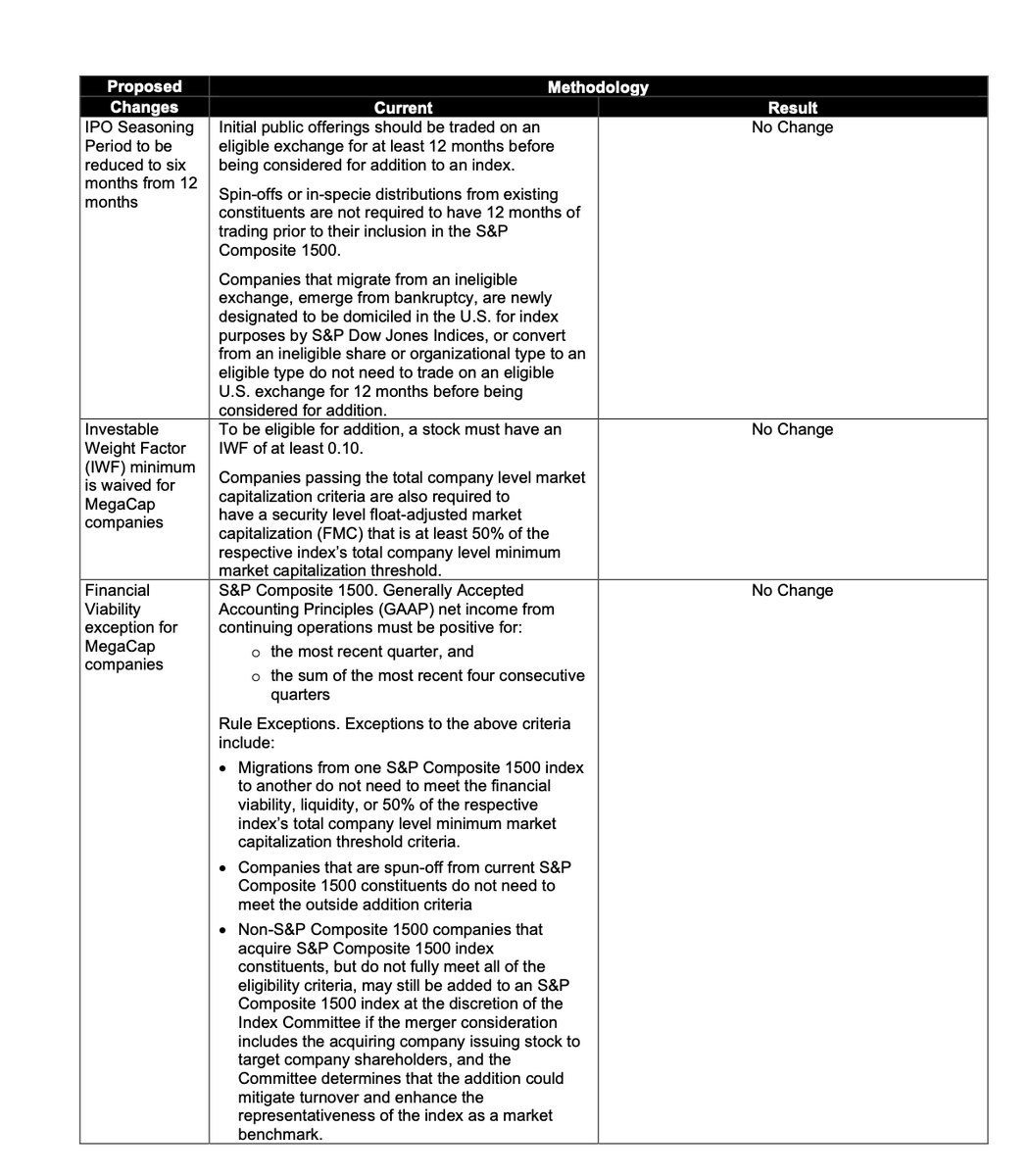
Wow, the S&P Dow Jones Indices has just officially announced that they will NOT be changing their inclusion rules to make it easier for “MegaCap” companies (such as @SpaceX) to be fast-tracked into the S&P 500.
Their reasoning:
"S&P DJI determined that exceptions to the financial viability, seasoning, and IWF requirements should not be granted solely based on market capitalization. The decision not to adopt the proposed exceptions preserves core index principles by maintaining consistent application of these key requirements. Although there may be trade-offs between strict adherence to these eligibility requirements and broad representativeness, the current methodology provides substantial market coverage and sector balance. As a result, the indices can continue to meet their stated objectives while preserving their role as representative and investable benchmarks for the U.S. equity market.
No changes will be made to the eligibility criteria including financial viability screens, seasoning period, or minimum IWF, for the S&P 500, S&P MidCap 400, or S&P SmallCap 600 as a result of the S&P Dow Jones Indices consultation on the treatment of MegaCap companies. Accordingly, there will be no changes to existing methodology for this index family."
This means that the earliest @SpaceX could be eligible to be added to the S&P 500 would now be June 2027.
The requirements that will now remain in place are:
• No changes to S&P 500 eligibility rules for mega-cap companies.
• Mega-cap companies will still need to wait 12 months after their IPO before being considered for S&P 500 inclusion.
• S&P will not waive profitability requirements for mega-cap companies. The company must have positive GAAP net income in the most recent quarter, and the sum of the most recent four consecutive quarters.
• S&P will not waive minimum public float requirements for mega-cap companies. At least 10% of a company's shares must be publicly tradable ("free float").
The S&P rejected proposals that would have:
• Reduced the IPO seasoning period from 12 months to 6 months
• Waived profitability requirements
• Waived minimum public float requirements
This is just the second time in #Canucks history that the coach, GM, and president(s) are all former Canucks players.
It has happened just once before, when Pat Quinn was the head coach, Pat Quinn was the GM, and Pat Quinn was the president.
It’s getting a lot easier to go car free south of the Fraser! The east-side multi-use path on stal̕əw̓asəm Bridge opened to pedestrians and cyclists this morning and the west-side path is on track to open this summer. @TranBC
https://t.co/b2dNpazRNA
@eresc79 Assume that we bottom out at ~10-15% below today in 2027-28 and those prices hold for a few years. At ~5% inflation we'd get awfully close to 2013 prices when adjusted for inflation.
@eresc79 Thank you. This confirms that we are now looking at January 2016 pricing. Honestly, this feels healthy! I guess the question now is if this is the bottom or if we head for 2013 prices. I'm guessing closer to the later.
@MPelletierCIO It is hard to complain though. My main critique is that the highest tax rates kick in too early, especially considering the cost of living in our large centres. It is demotivating to grind any harder if you only see 46% of that.
@MPelletierCIO I work in tech and can confirm. I'm on a team of about 10 people and have lost 3 colleagues to Texas and 1 to UAE over the past 5 years. 40% pay bump to move to the US, not including a lower tax burden. If you are mobile, it is pretty easy to justify for the lifestyle upgrade.
@senorlivin@SteveSaretsky@fabulavancouver A cold climate heat pump is more than enough for Metro Vancouver. We are planning for a gas furnace still, which can be helpful to take the edge off, specifically for defrost cycles where heat temporarily pauses.
@senorlivin@SteveSaretsky@fabulavancouver You need to have a plan for the coldest snaps and that plan is going to be specific to your region. Gas furnace is an option. Cold climate heat pumps can now go down to -25 or lower. Electric heat strips are also an option but expensive to operate. Many don't need them.
@SteveSaretsky@fabulavancouver I haven't looked into the cost for heat pump based water heaters in any depth. I'm in a retrofit situation. Keeping gas for hot water on demand, 1 fireplace (backup/aux heat), and an outdoor BBQ hookup. Everything else is electric (induction stove, heat pumps).
@SteveSaretsky@fabulavancouver One more thing. Assume you are getting a heat pump anyways for cooling. Adding a furnace is additional capital cost of about $8-$10k. If you assume a discount rate of 4-5% range that means you can afford to pay about $1000 more a year to operate and still be TCO neutral.
@SteveSaretsky@fabulavancouver Of all of the things we can do to combat climate change this strikes me as one of the simplest and most impactful. Cost neutral today, likely cheaper in the long run (hello solar and battery storage!). The technology is a solved problem at this point.
The Vancouver Canucks draft lottery luck since they were last competitive:
2014 | 6.2% chance to climb - lost, picked #6
2016 | 48.4% chance to climb - lost, picked #5
2017 | 69.3% chance to climb - lost, picked #5
2018 | 39.6% chance to climb - lost, picked #7
2019 | 64.8% chance to climb - lost, picked #10
2021 | 11.1% chance to climb - lost, picked #9
2022 | 1.1% chance to climb - lost, picked #15
2023 | 6.3% chance to climb - lost, picked #11
2025 | 1.1% chance to climb - lost, picked #15
2026 | 44.3% chance to win - lost, picked #3
That's a 98.57% chance that they would have won at least one time across the 10 lotteries.