Quantitative finance practitioner. Ex-physicist. Post-Lakatosian. Looking for the best coordinate system to map the last few centuries of intellectual history.
@robinhanson Assume your interest in this is as a filter candidate. Seems like a fortunate one though, since the bayesian probability of one hitting us or supernova-ing from nearby is low, given the last 4B years of it apparently not happening.
@mboudry Just telling the elites, as one big block, that they must reform is probably no more effective than telling the masses that.
But the elites aren’t one big block. We need to start giving the good elites more incentives to better understand and to challenge the bad ones.
has fought back in all kinds of ways. But the one surest, most restorative blow was left unstruck. And it was Mitch McConnell’s quivering, doughy hand that could have but didn’t strike it.
https://t.co/qaPAWWxQMj
If there is one man in our politics who is not entitled to any kind of pride it is Mitch McConnell. Historically, he had given indications of being neither a sadist nor a hack, which is notable in that world. But on the one crucial decision—the decision that dwarfs any other
and McConnell surrendered the country to him.
In the final analysis, Trump is just a beast, a natural phenomenon that rises up every century or two who, through unrelenting pressure, found a bunch of new ways to twist and crack (but not break) the founders’ system. The system
Thrilled to see Raghuran Rajan on the balance sheet task force. He had done important work on QE's ratchet effect on the Fed's balance sheet & its deleterious affect on aggregate liquidity. Here is my fist write up of his work https://t.co/LIqjSjlTvd (1/3)
Here's something you probably didn't learn in school, and it's one of the key moments that help us understand why slavery wasn't ended at our nation's inception when Jefferson wrote "all men are created equal"—
250 years ago this month, in the latter part of June 1776, the "Committee of Five" appointed by the Continental Congress—Thomas Jefferson, Benjamin Franklin, John Adams, Robert Livingston, and Roger Sherman—were finalizing work on a document that would constitute a legal separation of the 13 American colonies from Great Britain. Thomas Jefferson, due to his strong reputation as a writer, his home of Virginia being the most influential colony, and upon the insistence of John Adams, was tasked with being the primary author of the Declaration of Independence.
The bulk of the document, bookended by the better known aspirational passages before and after it, was a list of grievances the colonists had against the king, presented as evidence to the king, and to the world, that separation and independence was not only necessary, but justified.
Like most documents or manuscripts, Jefferson wrote a first draft, which the Committee of Five presented to delegates from all 13 colonies for review. And there is one critical passage found amongst the grievances in that first draft which does not appear in the final document, and is rarely spoken of today.
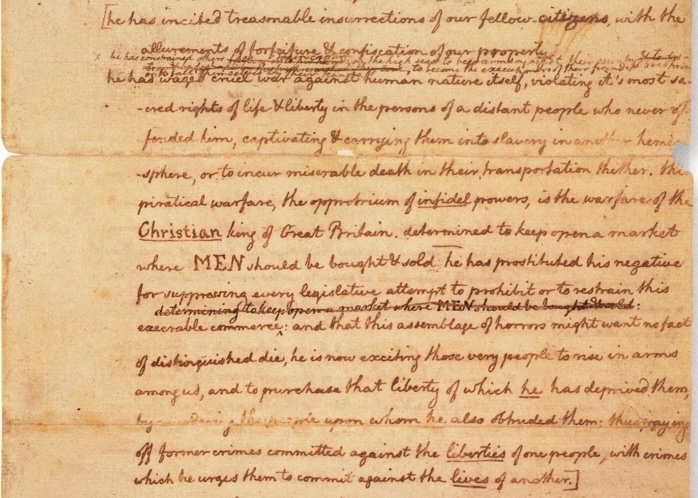
The final grievance Jefferson pens in this almost bullet-point type of list is not only the longest, but also the most emotive in Jefferson's hand. He wrote:
"he has waged cruel war against human nature itself, violating it's most sacred rights of life & liberty in the persons of a distant people who never offended him, captivating & carrying them into slavery in another hemisphere, or to incur miserable death in their transportation thither. this piratical warfare, the opprobrium of infidel powers, is the warfare of the CHRISTIAN king of Great Britain. determined to keep open a market where MEN should be bought & sold, he has prostituted his negative for suppressing every legislative attempt to prohibit or to restrain this execrable commerce: and that this assemblage of horrors might want no fact of distinguished die, he is now exciting those very people to rise in arms among us, and to purchase that liberty of which he has deprived them, & murdering the people upon whom he also obtruded them; thus paying off former crimes committed against the liberties of one people, with crimes which he urges them to commit against the lives of another."
This passage is easily more than twice as long as any other grievance listed in the document, and Jefferson alters his penmanship on the words "Christian" and "MEN" printing them, the latter in all caps. This is important.
Remember the king was not only the king, he was the "Supreme Governor of the Chuch of England" as well. By interjecting the word "Christian" in bold print, Jefferson was essentially mocking the king, saying, "you steal a people from another continent, transport them across an ocean to be sold into slavery, and you call yourself a Christian?"
And then Jefferson pens something that can't be understated. He refers to the African slaves as "MEN." Printed. All caps. And in doing so, not only does Jefferson acknowledge the humanity of these slaves, calling them "MEN," he does it in the very same document where he states that "all men are created equal" which is disruptive to the narrative we've been taught that this phrase was intended only for white men.
The phrase, "he has prostituted his negative for suppressing every legislative attempt to prohibit or to restrain this execrable commerce" essentially refers to a veto-like power the king had used to block attempts by some of the colonies, including Jefferson's own Virginia, to restrict the slave trade leading up to the Revolution.
So why does this passage not appear in the final draft?
Jefferson would later write, "The clause too, reprobating the enslaving the inhabitants of Africa, was struck out in complaisance to South Carolina and Georgia, who had never attempted to restrain the importation of slaves, and who on the contrary still wished to continue it."
While Jefferson noted that there were others that had reservations, he ultimately laid the responsibility for the passage being removed on just two of the 13 colonies. But why give up on such an important issue?
To wrap our heads around it today, imagine this: The Chinese Navy is amassing on the west coast. Submarines with warheads. Aircraft carriers with bombers and fighter jets. Strikes have already been carried out on American soil. And the president is pleading with Congress to formally declare war.
The House and Senate assemble to vote, and a group of senators decide that senators from each state need to come to a consensus on abortion and include a resolution on the issue in the declaration of war.
Impossible. It would never happen.
And in much the same way, the passage on slavery was removed from our Declaration of Independence. The success of the cause depended on, as the document reads at the beginning, "The unanimous Declaration of the thirteen united States of America." The loyalty of even two or three colonies to the British crown would have been disastrous to the cause of liberty, giving the British army a solid foothold, resources, and cooperation to extinguish the rebellion of the American Patriots—and the American Revolution would almost certainly have been lost.
The way math is presented can be really misleading about the actual nature of math.
In theory, someone could have discovered quantum information theory decades before quantum mechanics even existed. It's just about combining linear algebra with probability.
But nobody would have known it was worth combining these fields - or how, exactly, to combine them - before QM.
Math papers and textbooks go rigourously step-by-step, starting with axioms and definitions, then deducing theorems. It's great for making sure proofs can be verified and ensuring the subject is based on sound logic.
But for learners, it hides the really important thing: where did the axioms come from? Why these definitions and not others?
The thing that's missing is the sense that there were concrete problems that these ideas helped solve.
@DKThomp "Correctio is a *cheap performance of insight*" is itself a cheap performance of insight. There is no magic way to objectively judge a given passage by basic, syntactical heuristics like "It uses correctio." We're just stuck with having to actually *understand* what's being said.
@robinhanson@tylercowen The evidence, cumulatively, is still very ambiguous. If the aliens theory is a good one, what we should see is a progression of less ambiguity and more predictiveness over time. I see stagnation at zero predictiveness.
The overgrowth of technical virtuosity is positivism. And the undoing of positivism is reflection: The idea of positivism, itself, cannot be formalized
@DavidDeutschOxf@reach256k For bitcoin as a static algorithm (protocol), yes. But for bitcoin as a self-regulating governance structure, no. The latter just requires that protocol improvements—conceived by anyone and enacted through a democracy of miners—outpace the progress of attackers.
@Metal_Crow a system designed to enforce those rules with minimal friction. The rules are justified by their simplicity and cleverness at unleashing everyone’s productive energies *without* requiring the state to declare who are the truly productive ones.
@Metal_Crow “Meritocracy” was always a terrible term. It implies there will be some group of rulers, so it might as well be the smart/productive. But the essence of liberalism is that there are no rulers. There are just rules, like rights to property and to contract, and that there is a
@robinhanson Many (most?) top quantum foundations experts see Bell’s inequality violations as showing that light speed is *not* a hard limit on influence. Controllability of the influence is more of a stretch but still in play too.