Dhruv had gone to the Costco store in Seattle.
Outside the store, he saw a small boy, barely five years old. In his hands were packets of chips and a small board - on it was written, "For Scout Charity Fund - one packet for $20"
People were passing by him.
With the innocence and confidence of a five-year-old, he was stopping one person after another:
"Would you like a packet?"
Some were buying.
Many were smiling politely and saying, "No, thank you."
But the little boy did not look disappointed.
He would just smile, turn to the next person, and try again.
Dhruv stopped and bought a packet from him.
The boy smiled happily and said, "Thank you!"
Out of curiosity, Dhruv asked him,
"How many more packets do you have to sell? And how long will you stay here?"
His answer is something Dhruv and perhaps all of us will remember forever.
"Until 100 people say no."
Dhruv was surprised.
That's when the teacher standing next to him said:
"It's not important how many packets he sold. What's important is that at this age, he should learn to hear 'no'... to accept it... and still have the courage to ask the next person."
What a lesson that was!
We spend so much time teaching our children only how to be successful.
Study hard.
Come first.
Win the competition.
Get selected.
Get more.
But perhaps the biggest gift we can give them is teaching them how to handle failure.
How to hear 'no' without losing confidence.
How to face rejection without feeling like a loser.
Not being afraid to get up again after falling.
Understanding that one rejection doesn't mean your worth is over.
Because life will not always say 'yes'.
Sometimes exams will be failed, sometimes opportunities will be missed, sometimes you will be rejected in interviews, relationships will break and dreams will take time.
Success makes us happy.
But learning to handle failure makes us strong.
That five-year-old boy outside Costco was not just selling chips.
He was practicing courage.
He was collecting 'noes’.
He was learning perseverance.
He was getting ready for life.
So instead of just asking our children,
"Did you win?"
Let's sometimes also ask,
"Did you try again after failing?"
Don't just raise a child who is prepared only for success.
Raise a child who is not afraid of failure.
Salute to that teacher.
Salute to his parents.
And salute to that little boy, who taught the big world a very big lesson:
Sometimes, a hundred 'noes’ teach more than one 'yes'! #lifelesson #failure
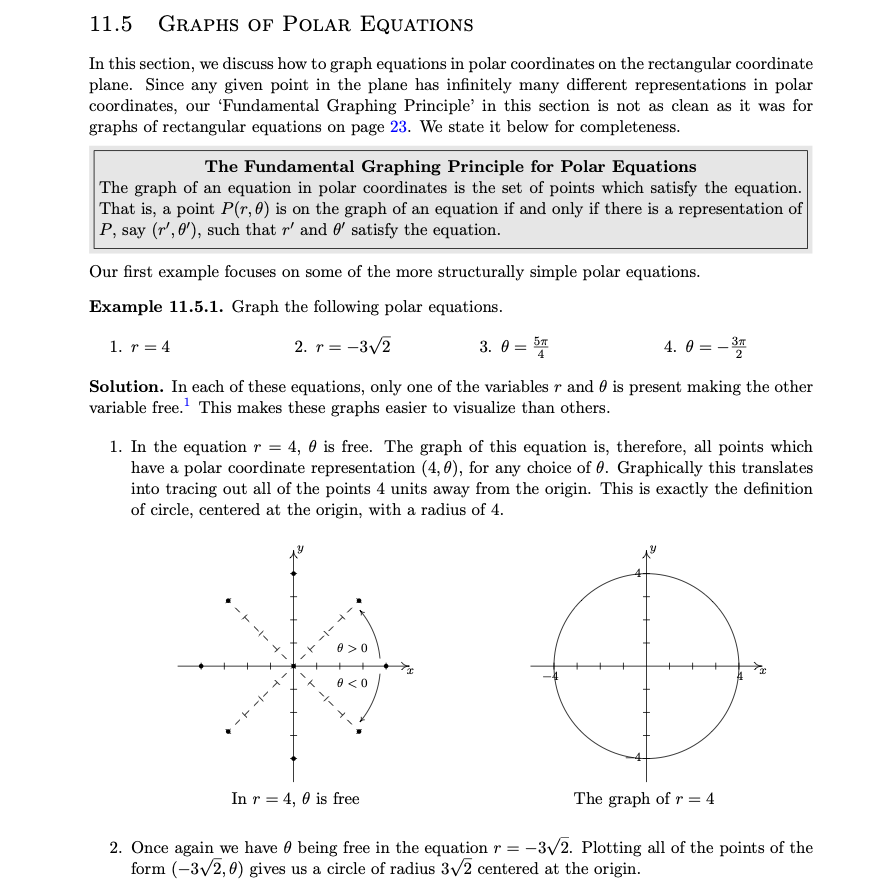
"Precalculus" is a free book I recommend when people ask me for a resource on basic mathematics. It covers many of the foundations you need before moving on to calculus and more advanced mathematics, starting with real numbers, the Cartesian plane, relations and functions, and then developing linear, quadratic, polynomial, rational, exponential, and logarithmic functions.
It also covers conic sections, systems of equations, matrices, determinants, sequences, mathematical induction, the binomial theorem, and a substantial amount of trigonometry, including identities, inverse trigonometric functions, trigonometric equations, polar coordinates, vectors, and parametric equations.
At more than 1,000 pages, it also includes plenty of exercises and answers throughout the chapters, making it useful both for learning these topics for the first time and for reviewing the fundamentals before tackling more advanced mathematics.
https://t.co/yafhBDRpU0
🚨 SHE DID AN IVERMECTIN PARASITE CLEANSE... THEN SHARED THE ENTIRE ROUTINE.
A woman recently shared the exact Ivermectin maintenance routine she and her husband say they followed during a parasite cleanse.
Before explaining anything, she made one point very clear.
❗ This was their personal experience.
She says they were not following a cancer protocol.
Instead, they were using Ivermectin as part of a maintenance parasite cleanse.
And instead of keeping it vague...
She walked through the routine step by step. 👇
💊 Ivermectin only.
No Fenbendazole.
No Mebendazole.
Just Ivermectin, plus a binder, milk thistle, hydration and dietary changes.
💊 Step 1: Ivermectin
She says they used 1.87% Ivermectin oral gel and measured it according to the markings on the product based on body weight.
Her own example:
⚖️ 153 pounds / ~70 kg (She used 3 clicks).
She says they took it once in the morning, on an empty stomach, followed by water.
🍎 She also says they used the apple-flavored gel.
🪨 Step 2: The nightly binder
Ivermectin wasn't the only part of their routine.
Before bed, she says they used:
⚫ Activated charcoal as a binder
🌿 Milk thistle for liver support
💧 Plenty of water
She considers hydration one of the biggest priorities during the routine.
🧠 Step 3: The “die-off” discussion
She talks about symptoms often described online as “die-off,” including:
• Flu-like feelings
• Headaches
• Irritability
• Joint pain
She attributes these symptoms to substances she believes are released when parasites die.
That’s why she says the binder and hydration were important parts of their approach.
🥗 Step 4: Food became part of the routine
During the cleanse, she says they focused on:
🥬 Mostly whole foods
🚫 No sugar during the five-day periods
❌ Less processed food
She says they believed sugar could support parasites, which was another reason they avoided it.
📅 Step 5: The 5-day cycle
This is where the routine gets very specific.
📅 Days 1 to 5
💊 Ivermectin every morning on an empty stomach while avoiding sugar and focusing on whole foods.
📅 Days 6 to 10
⏸️ Took a break from Ivermectin.
📅 Days 11 to 15
🔄 Repeated the same five day routine.
📅 Long term plan
🔁 Repeat the entire cycle every three months as part of their maintenance approach.
After completing the cycle, she says they planned to wait around three months before considering another round.
📊 And the protocol graphics add another layer
The accompanying material presents separate Ivermectin + Mebendazole frameworks, including:
🟢 Low
🟡 Standard / medium
🔴 Intensive / high
The protocol shown in the video also includes body-weight-based dosing examples, different protocol tiers, hydration, liver support, binders, and stated cleanse durations.
This is the routine she says worked for her and her husband.
Whether you agree with parasite cleanses or remain skeptical, one thing is clear:
More people are openly sharing their Ivermectin experiences, comparing different protocols, and talking about what they noticed during their journeys.
And those personal experiences are driving more questions:
What works? What doesn't? And what does each protocol actually involve?
💬 Which part of this routine caught your attention most?
📌 SAVE this post so you can revisit the full routine.
🔄️ REPOST it for others following the growing discussion around Ivermectin and parasite-cleanse protocols.
#Ivermectin #ParasiteCleanse #IvermectinExperience #Mebendazole #Fenbendazole #RepurposedMedicine #RxMeds
THE BIGGEST DECEIT IN MEDICAL HISTORY
Dr. Ryke Geerd Hamer, MD warned us:
“To sell CHEMOTHERAPY as a ‘therapy’ is the biggest deceit in the history of medicine. Whoever masterminded this ‘chemo-torture’ deserves a monument in HELL.”
Chemotherapy originated from mustard gas — a chemical weapon. WWII scientists observed its effects on white blood cells and turned that poison into the first chemo drugs.
The results?
• Studies show ~90% failure rates for solid tumor therapies over decades.
• A 2004 Clinical Oncology study found cytotoxic chemotherapy contributes to only ~2.3% of 5-year survival in adult cancers.
Many are now exploring these alternatives and protocols:
• Ivermectin — repurposed drug with growing research on anti-tumor effects
• High-dose Intravenous Vitamin C therapy — supportive approach in integrative settings
• B17 / Apricot seed (Laetrile) protocol — traditional amygdalin-based approach
• Fenbendazole / Mebendazole — gaining attention in alternative communities
• Artemisinin / Artesunate — showing promise in early research(Clove, Black Walnut, Wormwood)
• Ketogenic diet + fasting — metabolic strategies targeting cancer cells
The system profits from sickness. Do your own research. Question everything.
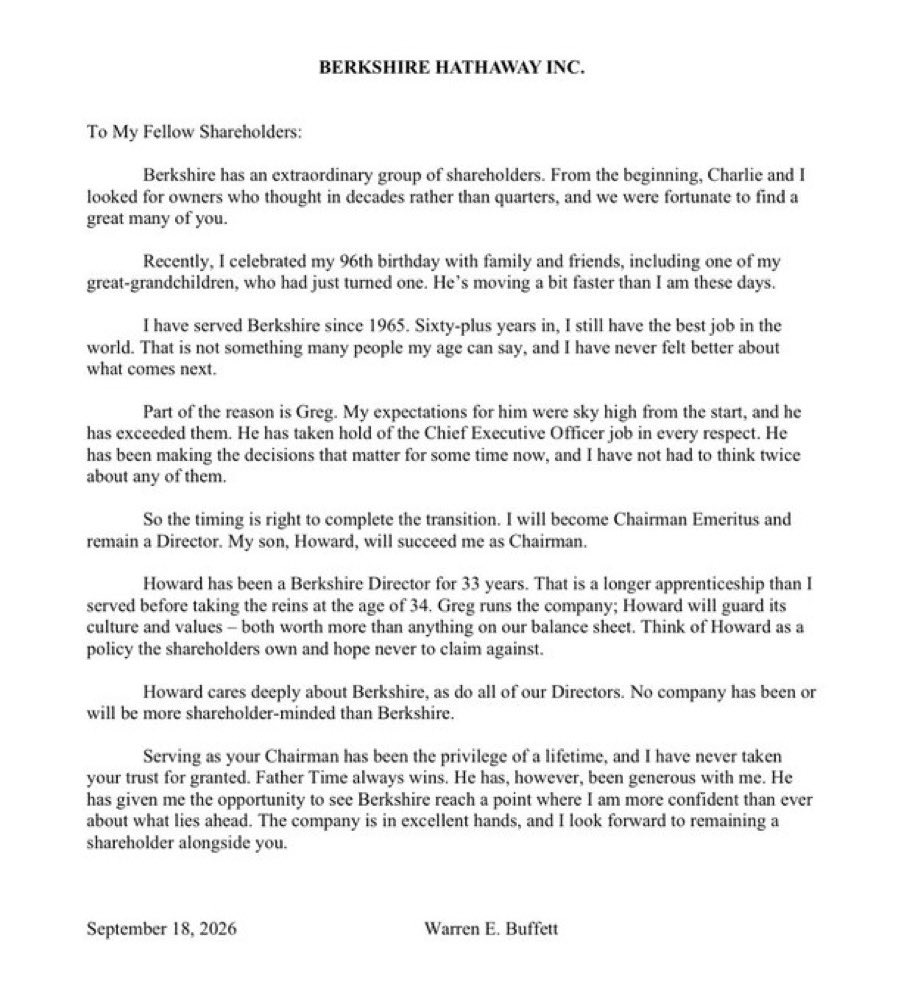
Warren Buffett, 96, steps down as Berkshire Hathaway chairman, becoming Chairman Emeritus while remaining a director.
His son, Howard Buffett, succeeds him, while Greg Abel continues as CEO.
“Greg runs the company; Howard will guard its culture and values.”
"Father Time always wins.
He has, however, been generous with me."
Warren Buffett just stepped down as Chairman of Berkshire Hathaway.
He left the CEO role at the end of 2025. Today he completes the transition. His son Howard takes the chair. Greg Abel keeps running the company.
Sixty plus years at the helm of one of the greatest wealth creating machines in history.
The man who turned a failing textile mill into a trillion dollar company is saying that time always wins. Absolutely true.
Tony Robbins literally explained why the rich keep getting richer while everyone else stays stuck. It is not connections. It is not luck. It is a loop most people never realize they are in.
He drew four boxes. Potential. Action. Results. Belief. They feed each other in a circle. Low belief means weak action. Weak action means poor results. Poor results confirm the belief. The cycle speeds up and you call it proof.
Roger Bannister broke the four-minute mile in 1954 after centuries of failure. He did not get faster legs. He ran it in his head until his brain treated it as done. Within two years, dozens crossed a barrier no human had broken in recorded history.
Robbins compared it to a salesman knocking on 100 doors saying "you don't want one of these, do you?" The action is there. But the belief is so weak that his voice and face guarantee failure before he opens his mouth. Then he blames the product.
The U.S. savings rate is 2.7%. Not a spending problem. A certainty problem. Most people tried saving once, got a tiny result, and the belief collapsed. See, I knew this wouldn't work. The spiral took over.
The person certain they will build wealth finds a way when the math looks impossible. Robbins was $100,000 in debt when he figured this out. Certainty first. Results second.
He charges $750,000 per speech to install that loop.
The talk is free. Almost nobody watches it.
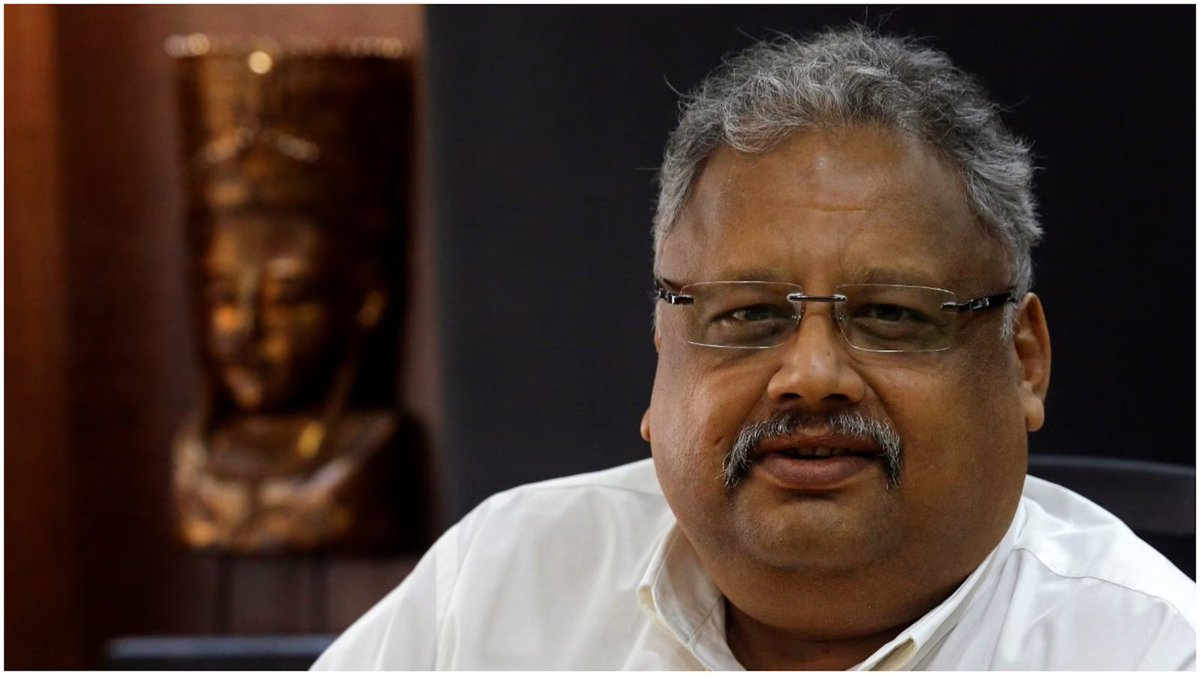
Do you know Rakesh Jhunjhunwala?
He compounded at 65% (!) per year for 37 years.
This means he turned $1 into $15 billion.
I am sharing all his public writings with you for free:
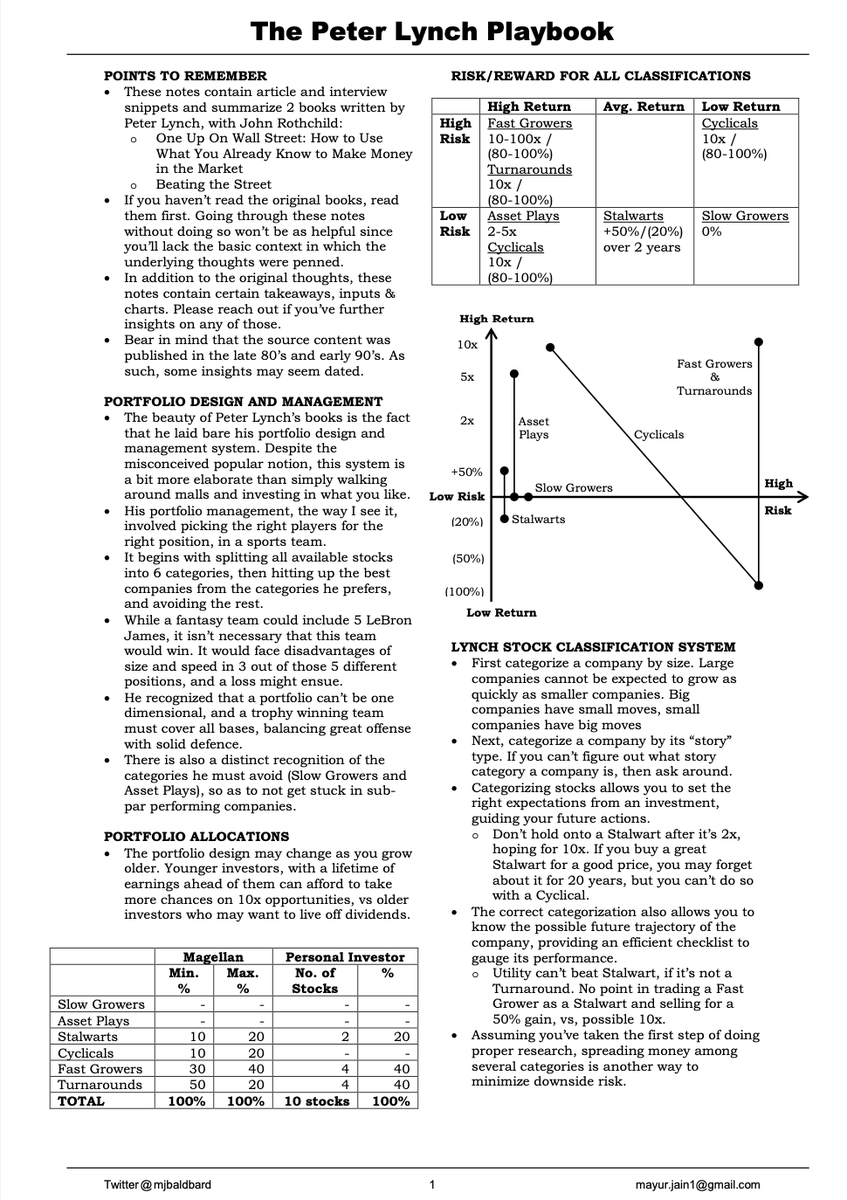
Peter Lynch compounded money at 29.2% per year (!).
He did it for 13 years, turning $18 million into $14 billion.
This playbook summarizes his investment strategy 👇🏻
Ten million people have watched an Australian high school teacher accidentally destroy the entire personal finance industry.
He filmed the lesson on a whiteboard in a regular Sydney classroom and put it on YouTube.
Robo-advisors charge two percent a year to hide the exact equation he teaches for free in seven minutes.
His name is Eddie Woo. He is a Sydney high school math teacher and one of ten finalists for the 2018 Global Teacher Prize.
For years he has been filming his regular lessons for students who missed class.
His entire framework fits on a napkin.
Every growth process has three parts: rate, time, result. The exponent is time. The logarithm pulls it out. Every doubling takes the same amount of time. Divide 72 by your annual return to get years to double. Linear charts lie. Log charts do not.
That last rule alone has probably cost the retirement industry a hundred million dollars in unbought pensions.
"The greatest shortcoming of the human race is our inability to understand the exponential function."
That is Al Bartlett, the physicist behind the most-watched lecture on exponential growth in history. Woo teaches the same idea in seven minutes.
Founders build financial models on linear axes and are surprised when the market grows ten times before their next investor meeting. Retail investors move in and out of the stock market and lose the exact number of doublings that would have made them rich.
The lesson is free on YouTube. Every textbook chapter on logarithms is a hundred years old.
Woo still teaches high school in Sydney. Almost none of the ten million viewers have ever divided 72 by their portfolio's return.
The math is free. The willingness to actually work out how many doublings you have left is the entire edge.
A Costco employee stood at the register and watched a member pay full price for an item that was about to be marked down to half price tomorrow.
She couldn't say anything. Store policy.
The price tag had the answer on it the entire time. The member never looked.
A guy spent 6 years working at Costco 3 on the floor, 3 as a supervisor. He told me something that should change the way every Costco member shops starting today:
"Every single price tag in Costco is telling you a secret. Nobody reads them."
"See that asterisk in the top right corner of the price tag? That item is being discontinued. It's not coming back. If you love it buy it now. When it's gone it's gone."
"See a price ending in .97? That's a manager markdown. The original price didn't sell fast enough. It's been manually reduced. That's the clearance rack at Costco except there's no rack. There's no sign. There's no 'SALE' sticker. There's just .97. And 95% of members walk right past it."
"See a price ending in .00? That's been clearanced to move. The store wants it gone. That's the lowest it will ever go. That $29.00 jacket was $49.99 two weeks ago. No sign told you. The price tag told you. You didn't look."
"See a price ending in .88 or .49? That's a manufacturer's special. The brand is subsidizing the discount, not Costco. It's a deal Costco wouldn't normally offer. And it has an expiration date the store won't announce."
"130 million members. Every single one walks through the same store. Past the same tags. With the same codes staring them in the face. And 95% of them have never once looked at the corner of a price tag."
"But the price codes are just the beginning."
"Costco has a return policy most members don't fully understand. A pharmacy that's open to non-members and cheaper than CVS and Walgreens. An optical department that beats every chain. A travel booking service that regularly undercuts Expedia and Kayak. A free tire rotation program. A food court trick that saves money every visit. And an executive membership cashback that most members don't realize they're not collecting."
"I spent 6 years watching members leave money on the table every single trip. Not because Costco hides it. Because nobody ever told them where to look."
Here are 11 Costco secrets that most members have never figured out:
🧵
🚨Leave Netflix tonight.
Watch this 2 h 34 min Stanford class.
It's the clearest, most complete, and brutally honest explanation out there on how ChatGPT and Claude are really built.
From Tokenization and BPE to the Transformer architecture, the training pipeline, and the next-token decoder. No fluff. No marketing. Just the truth.
Doesn't matter if you've never touched a line of AI code or if you spend your days launching Agents: by the end, you'll suddenly connect a ton of pieces you've been trying to fit together for years.
The real core boils down to this:
How text turns into numbers the model can "eat" (BPE tokenization)
The sole mission of a language model: predict the next token
How the Transformer uses Attention so tokens can pass messages to each other
In training, the NLL loss pushes the probability of the entire sequence
In generation, the decoder builds the response token by token
The big-picture view that takes most people years to form… this class delivers it to you complete in one sitting.
Free up your time.
This could be, no exaggeration, the most valuable class you watch this month.
IIT, chalkboard, zero slides
A 22-year-old at IMC gets paid $500,000 in year one for exactly one skill. Not picking winners. Seeing every trade as a full spread of outcomes, each one with its own odds attached.
Her name is Prabha Sharma. She teaches this exact skill on a bare chalkboard, for free, in a lecture almost nobody outside that room has ever watched.
Most people see a trade as a coin flip. Win or lose. Nothing else.
You already think this way about your own trades, don't you.
That's the mistake. A trade is never just win or lose. It's a spread of outcomes, each with its own odds and its own payoff attached before a single dollar moves. The formula for this is called the binomial distribution, and it's far simpler than it sounds.
Here it is:
P(X = k) = C(n,k) × p^k × (1-p)^(n-k)
n = how many bets you take
p = your real win probability on each one
k = how many of them you actually want to win
Try it yourself right now. Say you have a genuine 55% edge (p = 0.55) and you take 10 trades (n = 10). What's the actual chance you win at least 6 of them?
Plug in k = 6: P(X=6) = C(10,6) × 0.55^6 × 0.45^4 ≈ 23.8%
Add that up across every value of k from 6 to 10, and your real odds of winning at least 6 out of 10 land around 47%. Just under a coin flip, with a genuine edge in your favor.
Sit with that for a second. A 55% edge does not feel like 55% once you actually run the math over a small number of trades.
This is the exact formula that decides how much to risk on any single bet, once you actually know your edge. Sharma builds the whole thing from zero, in notation simple enough for a complete beginner to follow every step.
Wall Street pays $500,000 a year for this one skill. An IIT professor already gave the entire thing away, for free, on a blackboard nobody bothered to watch.
AMAZON PRIME COSTS $139 A YEAR, AND MOST MEMBERS USE TWO FEATURES:
Free shipping and Prime Video. That's it.
But Prime is a giant bundle, and some of the perks you're already paying for quietly expire every month.
Here are 12 most members never touch 🧵
🚨 STOP TELLING CHATGPT: “Make this image better.”
Vague prompts = average results. 😬
Give ChatGPT clear instructions and you can get cleaner, sharper, more realistic visuals with fewer revisions.