Conor Neill on why luck is not random and how to deliberately get more of it:
1. Luck flows through people and travels by conversation. James Clear's framing: keep talking to the same people, keep finding the same opportunities. start talking to new people, start finding new opportunities. If you want different luck, start walking into different rooms. The people you have access to determine the opportunities that reach you. This is not a metaphor. It is mechanics.
2. What separates successful people from unsuccessful ones is not the amount of luck they receive. It is return on luck. Jim Collins's idea: when a luck event presents itself, what do you do with it. Most people get roughly similar amounts of lucky moments. The difference is who is prepared and paying attention when they arrive.
3. A careers advisor in Spain gave one piece of advice that changed everything: meet one new person every week. For 25 years, the speaker kept a slot in his calendar every single week for a coffee with someone new. almost every significant opportunity in his life, his teaching role, his business, came through a single individual and a conversation. The math on one new person per week over 25 years is staggering.
4. When you meet someone new, you are starting at number 21 on their list of priorities. Dan Sullivan's framework: they have at least 20 things more important than talking to you. If you spend the conversation talking about yourself, your goals, what you want, you drop from 21 to 30 to 50 and fall off the list entirely. If you ask about them, their goals, what brought them there, you move up. Most good people, if you explore who they are, will then explore who you are. That is how a real conversation opens.
5. Luck surface area is a size you can control. The more people you meet and the more genuine conversations you have, the larger the surface through which luck can reach you. same people, same conversations, same luck. new people, new conversations, new luck. It is that simple, and most people never deliberately expand it.
99% of men are destroying their body trying to build one.
Wrong supps. Wrong compounds. Wrong doses.
This is the only stack required to look like a Greek God or Goddess at 50 and beyond:🧵
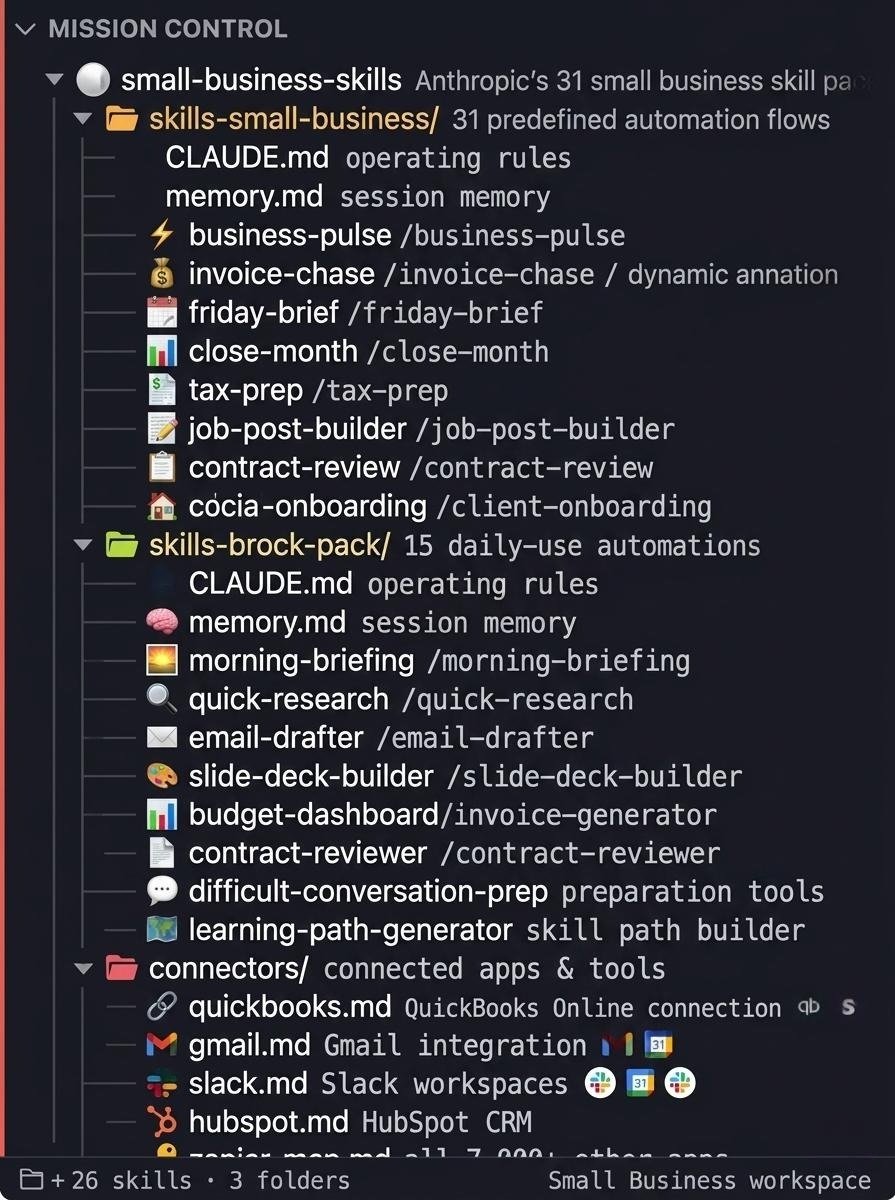
Claude For Small Business is INSANE.
I've built a complete breakdown of all 31 Anthropic Small Business skills that maps every workflow, connector, and automation in under 10 minutes.
The same skill stack that had 382,000 downloads on its first day.
Financial operations, sales and client work, HR and hiring, marketing and growth, reporting and dashboards.
Inside the breakdown:
- All 31 skills organised by function with the 5 to run first
- The 12 connector setup guide in priority order with permission settings for every sensitive action
- Worked examples for Business Pulse, Invoice Chase, and Job Post Builder with real output shown
Want a copy? Like + Comment "31" and I'll send it over ASAP
(Must be following)
Steve Jobs walked into a room full of MBA students and asked how many were going into consulting.
Hands went up.
He said their careers would be “like a picture of a banana.”
“You might get a very accurate picture. But you never really taste it.”
He spent 60 minutes explaining what actually builds careers:
"Without owning something over an extended period of time, where one has a chance to take responsibility for one's recommendations, where one has to see one's recommendations through all action stages and accumulate scar tissue for the mistakes and pick oneself up off the ground and dust oneself off, one learns a fraction of what one can."
He continues:
"Coming in and making recommendations and not owning the results, not owning the implementation, I think is a fraction of the value and a fraction of the opportunity to learn and get better."
"You do get a broad cut at companies, but it's very thin."
Then the line that made the room go silent:
"It's like a picture of a banana. You might get a very accurate picture, but it's only two dimensional. Without the experience of actually doing it, you never get three dimensional."
"So you might have a lot of pictures on your walls. You can show it off to your friends. You can say, look, I've worked in bananas, I've worked in peaches, I've worked in grapes."
"But you never really taste it."
The room applauded.
This was 1992. Jobs had been fired from Apple seven years earlier. He was running NeXT. He had scar tissue.
An MIT student asked him: where would Apple be if you hadn't left?
Jobs paused.
"I've obviously thought about this a lot. I think everybody lost. I think I lost. I think Apple lost. I think customers lost."
"And having said all that, so what? You go on. It's not as bad as a lot of things. Not as bad as losing your arm."
That's Steve Jobs. Getting fired from the company he built, comparing it to losing a limb, and shrugging.
He spent the rest of the talk explaining what he learned about building companies.
On competitive advantage:
"Hardware churns every 18 months. It's pretty impossible to get a sustainable competitive advantage from hardware. If you're lucky, you can make something one and a half or two times as good as your competitor. And it only lasts for six months."
"But software seems to take a lot longer for people to catch up with."
"I watched Microsoft take eight or nine years to catch up with the Mac, and it's arguable whether they've even caught up."
On technology windows:
"You can use the concept of technology windows opening and then eventually closing."
"Enough technology from fairly diverse places comes together and makes something that's a quantum leap forward possible. And a window opens up."
"It usually takes around five years to create a commercial product that takes advantage of that technical window opening up."
"And then it seems to take about another five years to really exploit it in the marketplace."
He gave examples from his own life:
Apple II lasted 15 years. DOS lasted 15 years. Mac was eight years old at the time and would easily last another five.
"These things are hard. They don't last because it's convenient, or even because it's economic. They last because this is hard stuff to do."
On management:
"I've never believed in the theory that if we're on the same management team and a decision has to be made, and I decide in a way that you don't like, and I say, come on, buy into the decision."
"Because what happens is, sooner or later, you're paying somebody to do what they think is right, but then you're trying to get them to do what they think isn't right. And sooner or later, it outs."
His approach:
"The best way is to get everybody in a room and talk it through until you agree."
Then this:
"We don't pay people to do things. That's easy, to find people to do things."
"What's harder is to find people to tell you what should be done. That's what we look for."
"So we pay people a lot of money, and we expect them to tell us what to do. And when that's your attitude, you shouldn't run off and do things if people don't all feel good about them."
A student asked: what's the most important thing you learned at Apple that you're doing at NeXT?
Jobs thought for a moment.
"I now take a longer-term view on people."
"When I see something not being done right, my first reaction isn't to go fix it. It's to say, we're building a team here. And we're going to do great stuff for the next decade, not just the next year."
"So what do I need to do to help so that the person that's screwing up learns, versus how do I fix the problem?"
"And that's painful sometimes. And I still have that first instinct to go fix the problem."
"But taking a longer-term view on people is probably the biggest thing that's changed."
On not knowing your own competitive advantage:
"A lot of times you don't know what your competitive advantage is when you launch a new product."
"When we did the Macintosh, we never anticipated desktop publishing. Sounds funny, because that turned out to be the Mac's compelling advantage."
"We anticipated bitmap displays and laser printers. But we never thought about PageMaker, that whole industry really coming down to the desktop."
"But we were smart enough to see it start to happen nine to twelve months later. And we changed our entire marketing and business strategy to focus on desktop publishing."
"And it became the Trojan horse that eventually got the Mac into corporate America."
The same thing happened at NeXT.
They built software to help developers create apps faster. Their target customers were Lotus, Adobe, WordPerfect.
Then big companies started showing up and saying: "You don't understand what you've got. The same software that allows Lotus to create their apps faster is letting us build our in-house apps five to ten times faster."
"And you dummies don't even know it."
Jobs admitted: "It took them about three months before we finally heard it."
On hiring:
"It seems like all the good people I really want to hire, it takes me a year to hire them. It's always been that way, even at Apple."
"I usually meet somebody that is really good. And you can't get them. And then you go try to find other people. And nobody measures up."
"When you meet somebody that good, you always compare them to this one person. And you know you're going to be settling for second best if you compromise."
"And I've always found it best not to compromise, and just keep chipping away."
His VP of Marketing took a year and a half to hire.
"And they're all worth it."
This talk is Steve Jobs at his most unfiltered. A founder with scar tissue explaining what he learned the hard way.
This 60 minute MIT lecture will teach you more about building companies than every startup book you've read combined.
Bookmark & give it an hour, no matter what.
This 1 hour lecture from a Carnegie Mellon professor who had 3 months to live will teach you more about living than every self-help book you’ve ever read combined.
Bookmark this & give it 1 hour today. It’s the most productive start you can give your week.
36 years old.
Married 10 years.
4 kids.
Multiple career pivots.
Financial pressure.
Outgrew friendships.
If I could talk to my younger self, I’d save him years of pain:
Bookmark this one.