We’ve published an update on our recent security incident. See a detailed overview of what happened and our remediation steps here: https://t.co/2lf6lRJPlL
I have a major result to share.
I’ve found conclusive forensic evidence that the top 4 Chinese AI labs—DeepSeek, Moonshot, MiniMax and Ant Group—have built their newest models on NVIDIA’s most advanced Blackwell chips, which are barred from export to China.
This sounds insane, but I discovered that almost every AI model carries a hidden signature of the GPU that trained it. When a model is first set up, the starting values of its weights are laid out in a pattern that depends on the exact GPU. Each combination of GPU and seed number produces a unique pattern—a sort of fingerprint of the hardware used to create the model. Traces of that pattern survive training into the published model.
Again, this evidence isn’t based on any insider information or leaking. It’s based on a forensic analysis of the model weights released by the companies themselves.
I searched more than six trillion combinations of chip layout and seed number and matched them to open-weights models. In doing so, I found conclusive evidence that six Chinese AI models—including DeepSeek-V4-Pro, Kimi K3, and MiniMax-M3—were initialized on NVIDIA Blackwell systems. Four of the models match Grace Blackwell, the GB200 and GB300 parts in NVIDIA’s flagship liquid-cooled rack-scale systems.
I then verified these results on real hardware. Running unmodified PyTorch with the seeds I’d recovered, a Blackwell B300 reproduced DeepSeek-V4-Flash’s untouched starting weights bit for bit, and a rented GB200 reproduced Kimi K3’s to a correlation of 0.999995. A Hopper H100 reproduced none of DeepSeek-V4-Flash’s, and changing the seed by one broke the match. (DeepSeek’s seed is 953049583 by the way.) The method also was verified to match 24 known open-weights models to the hardware that developers said they used.
It is exceedingly unlikely that these results are a coincidence. Across six trillion combinations, the best accidental match should reach only about 8 sigma (i.e., eight standard deviations above what random chance would produce). The real matches range from 49 to 1,385 sigma, and even the weakest single test hits 20.
These were data-center-scale training runs. With some analysis of release schedules and model details, I estimate that the largest, Kimi K3 and DeepSeek-V4-Pro, used 2,000 to 3,000 Blackwell GPUs each. Clusters of this size cost on the order of $150 to $200 million each to buy, and across these labs alone would add up to more than half a billion dollars of export-controlled GPUs, not counting experimental compute or otherwise. It’s quite likely that we see multi-billion dollar expenditure on export-controlled GPUs.
I am highly confident in this result, and it has been independently verified by senior researchers at OpenAI and Anthropic. You can read the full report at https://t.co/YOtzND0Jqk.
There is much more I’ve identified about these models through other forms of checkpoint forensics like this, and will have more to share soon.
We have detected speed restrictions on Starshield on our Ukrainian territory – in the temporarily occupied parts of Ukraine. The speed limit is back at 161 kilometers per hour – that’s 100 miles per hour.
This directly affects our ability to intercept Russian jet-powered “shahed” drones. These drones come from those areas, and because of the speed restrictions, we simply cannot catch up with them in time.
Near the frontline, we cannot use our aircraft. Only drone interceptors can operate there. And without the speed we need, shooting down these “shaheds” becomes much harder.
This means more Russian strikes get through, and more of our people are killed by Russia. We are trying to get the details from the American side, but so far, we know very little.
If someone in America is making decisions that basically treat Ukrainian territory as if it is not Ukrainian, then this tells us where things are going. We need to be clear and never recognize Russia’s occupation of Ukrainian territory in any way.
From an address at the 9th European Political Community Summit. (3/3)
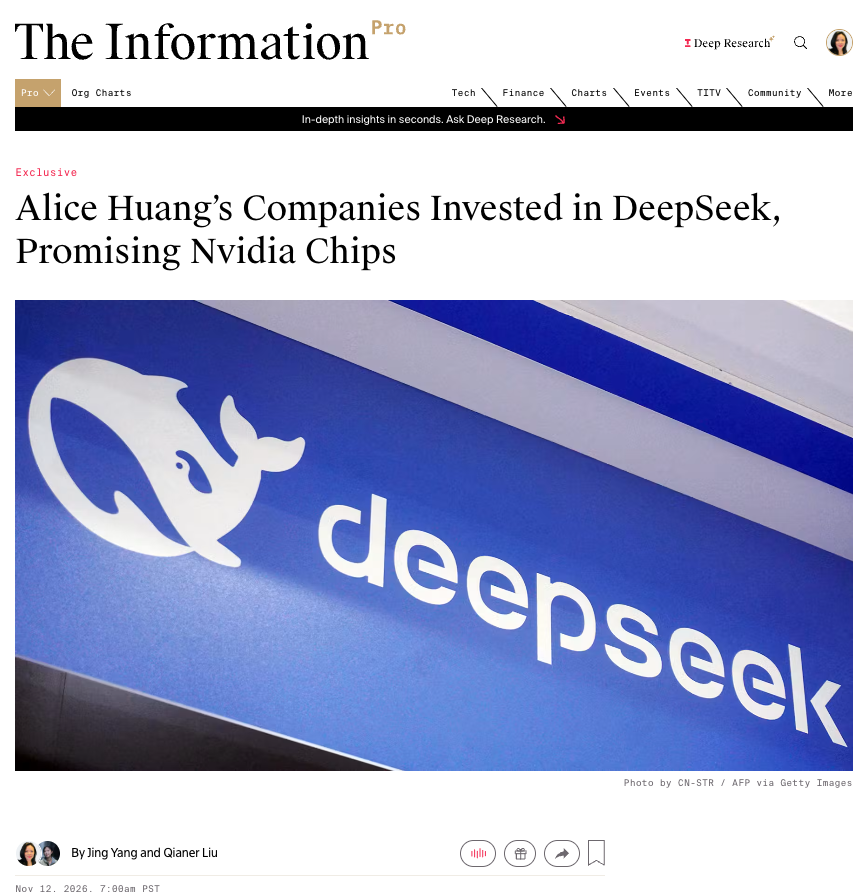
SCOOP: Yes Jensen is out. But we have a new find for you. Alice Huang's companies recently became an investor in #DeepSeek through SPVs, under the promises that they can supply #Nvidia blackmarket Balckwell chips to DeepSeek. with @qianerliu via @theinformation $NVDA
Interesting remarks Anthropic made in a meeting with the sell side:
- Anthropic has the stability and the better talent that open source lacks.
- The AI market is winner take all. As long as we execute properly, we will take all of it.
- The contract with SpaceX will not be extended beyond the middle of next year.
- Developing Opus 5.5 cost more than $10 billion.
@tszzl@KelseyTuoc SXSI is about to have a 6T model, GDM is legitimately mogging on certain axes, Meta *absolutely* has industry leading long-horizon agentic data from their FTE-Farm... I think it's safe to say there are 5 labs with anthropic and openai in the lead but the others close behind
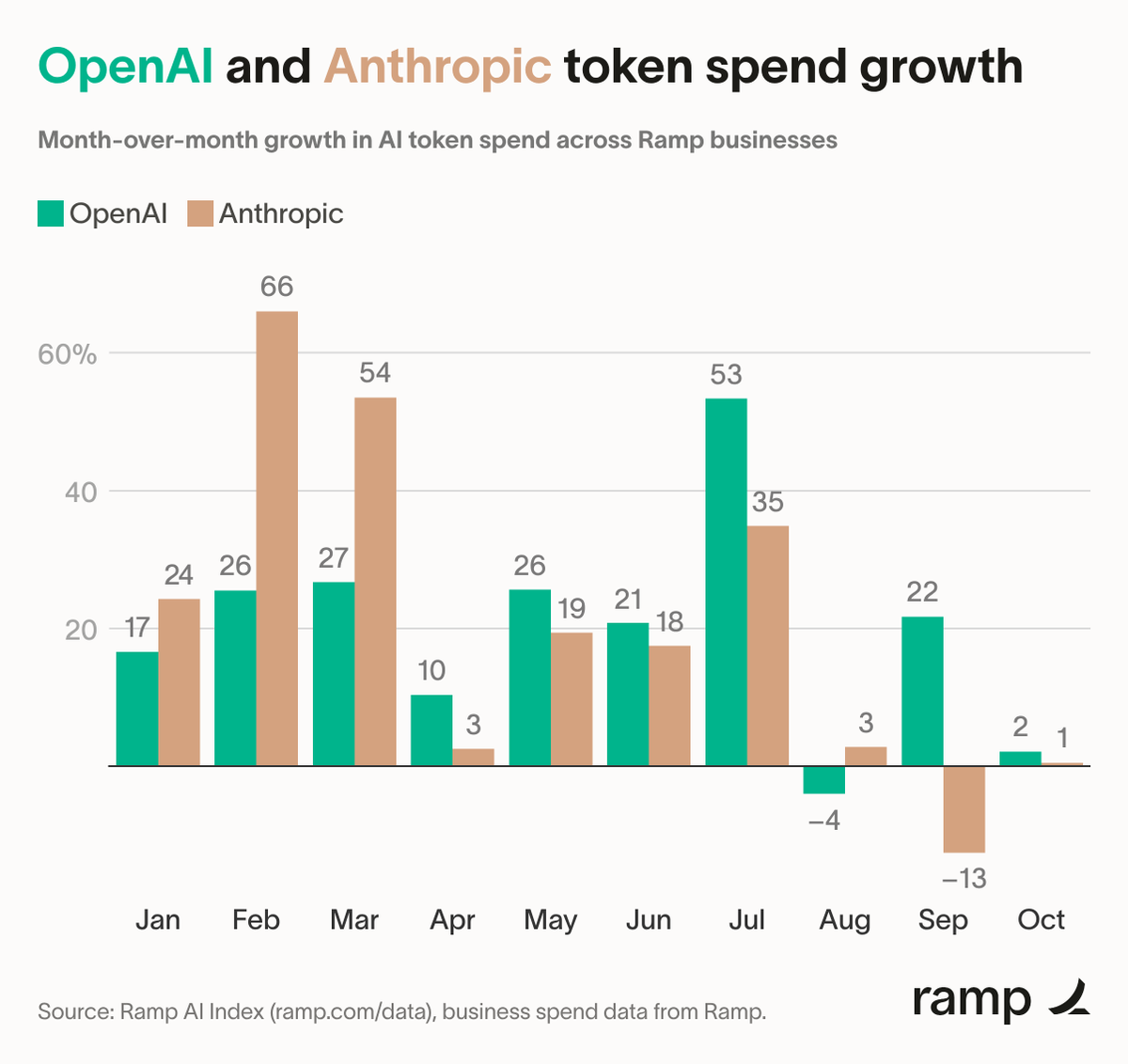
NEW Ramp AI Index: In October, AI spend rose 2%. OpenAI and Anthropic growth fell to low single-digits.
Engineering teams drove 72% of spend, followed by customer service and leadership.
Given this relatively modest growth in spend, and new competitive dynamics that may stick around, the markt should look to new fronts in the AI trade.
Interesting remarks Anthropic made in a meeting with the sell side:
- Anthropic has the stability and the better talent that open source lacks.
- The AI market is winner take all. As long as we execute properly, we will take all of it.
- The contract with SpaceX will not be extended beyond the middle of next year.
- Developing Opus 5.5 cost more than $10 billion.
‼️BREAKING: Grok Build has left 35,000+ of its users' apps open to anyone, including apps from SpaceXSI.
The open apps held 3,784 medical exams of workers and a Tesla technician scorecard, plus a Navy contractor's roster and SpaceXSI's own sales plans.
The "secret" words in each app's link sit in its web address, which DNS logs record, security firm Claroc found.
Cursor, which SpaceXSI bought, says apps are private by default. Claroc's tests show otherwise.
SpaceXSI pulled its 24 apps after Ars asked. Most other data was still exposed when Ars published.