MIT open-sourced an AI model that converts photos into fully editable CAD programs and it quietly kills the $150/hour CAD modeling industry.
Just upload a sketch or photo and it generates the full parametric 3D model. exportable as STL. ready for manufacturing.
→ no SolidWorks license
→ no weeks of modeling
→ no CAD engineer needed
100% Open Source
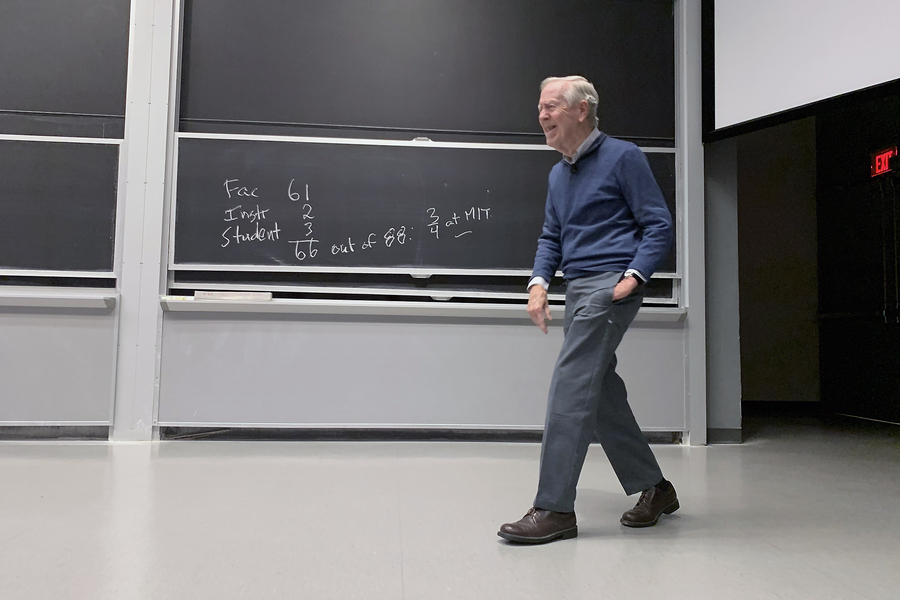
Gilbert Strang, an MIT professor, taught the same linear algebra course for 62 years. When he delivered his final lecture in May 2023, students from around the world tuned in online to watch.
The course is MIT 18.06 Linear Algebra. Millions of machine learning engineers, data scientists, quants, and self-taught programmers learned the essential math behind AI from his clear, free video lectures, even though most never stepped foot on the MIT campus.
Strang joined the MIT faculty in 1962 and retired in 2023. When MIT launched OpenCourseWare in 2001–2002, he was one of the first to embrace it fully. While many professors hesitated, Strang saw it as an opportunity to share mathematics with everyone. He filmed his lectures and made them freely available.
He completely changed how linear algebra is taught. Instead of starting with abstract vector spaces and proofs, Strang began with something simple and visual: matrix multiplication. He built intuition first using concrete examples, then introduced more advanced ideas like eigenvectors and singular value decomposition. He insisted that students should be able to explain every concept with a small, tangible matrix before moving to theory.
Beyond the content, his teaching style stood out. He spoke to students with genuine respect, patience, and kindness, never using words like “obviously” or “trivially.” He regularly paused to check if anyone was lost and treated beginners as thoughtfully as he would his colleagues.
As a result, Strang became the default linear algebra teacher for much of the planet. Universities in many countries began recommending his lectures to their own students. Some even replaced their in-person courses with his videos because they could not match their clarity.
His final lecture ended with a long standing ovation. Strang seemed surprised by the applause, smiled humbly, and simply thanked everyone.
In his short comment under the YouTube video, he expressed gratitude for a wonderful life of teaching and hoped others would continue teaching the subject well. No self-promotion, no grand farewell—just quiet sincerity.
When you add up every version, every upload, help sessions, and all the different recordings MIT has shared over the years, the total has surpassed 20 million views.
Today, the full course, including all lectures, problem sets, and solutions, remains freely available on MIT OpenCourseWare. One of the most important mathematical foundations of modern AI is still just one click away.
Introducing Claude Managed Agents: everything you need to build and deploy agents at scale.
It pairs an agent harness tuned for performance with production infrastructure, so you can go from prototype to launch in days.
Now in public beta on the Claude Platform.
People are bearish on memory, but the leaked Claude Code source code is showing us some additional memory demand that the market hasn't priced in IMO.
1. The market thinks about AI memory demand as a server-side story: HBM on H100s/B200s for inference. What the bug reports reveal in this code is that the client-side of AI coding agents is also extraordinarily memory-hungry. Idle Claude Code processes growing to 15GB each, active sessions hitting 93-129GB. This matters because the feature flag pipeline (DAEMON, PROACTIVE, CRON) points toward future always-on background agents. If a developer has a persistent daemon agent running alongside their active sessions, you're looking at baseline memory consumption of 15-30GB+ just for Claude Code on a developer workstation - before they even open their IDE, browser, or anything else. This means either enterprise IT needs a big uplift to higher-RAM workstations or we move even more memory-hungry workloads towards the cloud.
2. The Auto Dream consolidation feature runs background Claude sessions to clean up memory files. One observed consolidation took 8-9 minutes processing 913 sessions. In other words, a meaningful fraction of Anthropic's token consumption is the system managing its own memory, not the user doing productive work. As memory systems get more sophisticated (team sync, cross-session event buses, memory consolidation), this overhead grows. It's a recursive cost - more memory features require more inference to manage memory. I don't think anyone is modeling this as a distinct line item in token consumption estimates.
3. 1M token context windows for Claude Code. Moving from 200K to 1M context is a 5x increase in KV cache memory per session on the server side. Combined with multi-agent (5-15x per user) and the proactive/daemon features (sessions that persist for hours/days instead of minutes), you get a compounding memory demand curve that's steeper than linear adoption growth that many analysts model.
Memory demand per active user is increasing faster than user count, because each user's sessions are getting longer, wider (more agents), and deeper (larger context windows).
Today we're introducing TRIBE v2 (Trimodal Brain Encoder), a foundation model trained to predict how the human brain responds to almost any sight or sound.
Building on our Algonauts 2025 award-winning architecture, TRIBE v2 draws on 500+ hours of fMRI recordings from 700+ people to create a digital twin of neural activity and enable zero-shot predictions for new subjects, languages, and tasks.
Try the demo and learn more here: https://t.co/VkMd1YpQWI
@SonohennoKuma After Fukushima, to support Japan, I personally visited the area and ate locally grown food to prove that there was no nuclear danger.
I also donated a small solar system.
https://t.co/KxUgJIsvo4