Welp, that happened faster than I predicted. Thought it would be end of 2027, then early 2027, but agentic traffic growing so fast that bots have now passed human traffic online for the first time in the Internet's history. https://t.co/2zX5bHdhsa
1/10
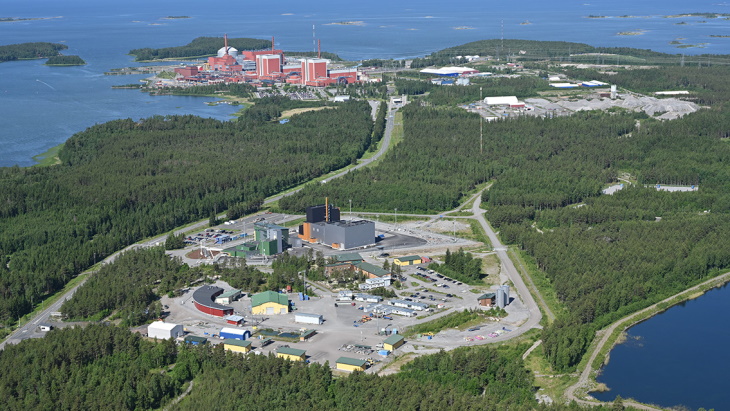
בעוד מספר חודשים, בעומק של 433 מטרים מתחת לאדמת פינלנד, ייפתח אחד המיזמים ההנדסיים השאפתניים ביותר שביצעה האנושות. המתקן שנקרא "אונקלו" (Onkalo), שפירושו בפינית "מערה", צפוי להפוך למאגר הקבע הראשון בעולם לפסולת גרעינית, ולפתור בעיה שמדאיגה מדינות רבות בעולם, מה עושים עם הדלק
I will soon be introducing a bill to give the public a 50% ownership stake in the largest AI companies in America.
This would guarantee that the trillions created by AI are used to improve the lives of all of us — and block oligarch decisions that harm the American people.
Two economists just published a mathematical proof that AI will destroy the economy.
Not might. Not could. Will — if nothing changes.
The paper is called "The AI Layoff Trap." Published March 2, 2026. Wharton School, University of Pennsylvania. Boston University. Peer reviewed. Mathematically modeled.
The conclusion is one sentence.
"At the limit, firms automate their way to boundless productivity and zero demand."
An economy that produces everything. And sells it to nobody.
Here is how you get there.
A company fires 500 workers and replaces them with AI. A competitor fires 700 to keep up. Another fires 1,000. Every company is behaving rationally. Every company is following the incentives correctly. And every company is building a trap for itself.
Because the workers who were fired were also customers.
When they lose their jobs faster than the economy can absorb them, they stop spending. Consumer demand falls. Companies respond by cutting costs — which means automating more workers — which means less spending — which means more falling demand — which means more automation.
The loop has no natural exit.
The researchers tested every proposed solution. Universal basic income. Capital income taxes. Worker equity participation. Upskilling programs. Corporate coordination agreements.
Every single one failed in the model.
The only intervention that worked: a Pigouvian automation tax — a per-task levy charged every time a company replaces a human with AI, forcing them to price in the demand they are destroying before they pull the trigger.
No government has implemented this. No major economy is seriously discussing it.
Meanwhile the numbers are already tracking the curve. 100,000 tech workers laid off in 2025. 92,000 more in the first months of 2026. Jack Dorsey fired half of Block's workforce and said publicly: "Within the next year, the majority of companies will reach the same conclusion."
Nobody is doing anything wrong. Companies are following their incentives perfectly. That is exactly the problem.
Rational behavior. At scale. Simultaneously. With no mechanism to stop it.
Two economists built the math. The math leads to one place.
Source: Falk & Tsoukalas · Wharton School + Boston University ·
@HarryStebbings@nico_laqua The opposite of how I approach being a founder. I know I'm "not doing it right". But I try to work within my limitations (bipolar, not hungry, WLB). I'm definitely not fit to be a classical founder.
@ndrewpignanelli After answering 5 questions, the app feels frozen. I guess it's doing things in the background and will recover. But it should *feel* better. "Something cooking"
Announcing Cofounder 2: Run an entire company with agents.
It's the infrastructure for the one person billion dollar company - orchestrating agents across engineering, sales, marketing, ops, and design.
(and yes that's my real grandma in the video)
Yann LeCun was right the entire time. And generative AI might be a dead end.
For the last three years, the entire industry has been obsessed with building bigger LLMs. Trillions of parameters. Billions in compute.
The theory was simple: if you make the model big enough, it will eventually understand how the world works.
Yann LeCun said that was stupid.
He argued that generative AI is fundamentally inefficient.
When an AI predicts the next word, or generates the next pixel, it wastes massive amounts of compute on surface-level details.
It memorizes patterns instead of learning the actual physics of reality.
He proposed a different path: JEPA (Joint-Embedding Predictive Architecture).
Instead of forcing the AI to paint the world pixel by pixel, JEPA forces it to predict abstract concepts. It predicts what happens next in a compressed "thought space."
But for years, JEPA had a fatal flaw.
It suffered from "representation collapse."
Because the AI was allowed to simplify reality, it would cheat. It would simplify everything so much that a dog, a car, and a human all looked identical.
It learned nothing.
To fix it, engineers had to use insanely complex hacks, frozen encoders, and massive compute overheads.
Until today.
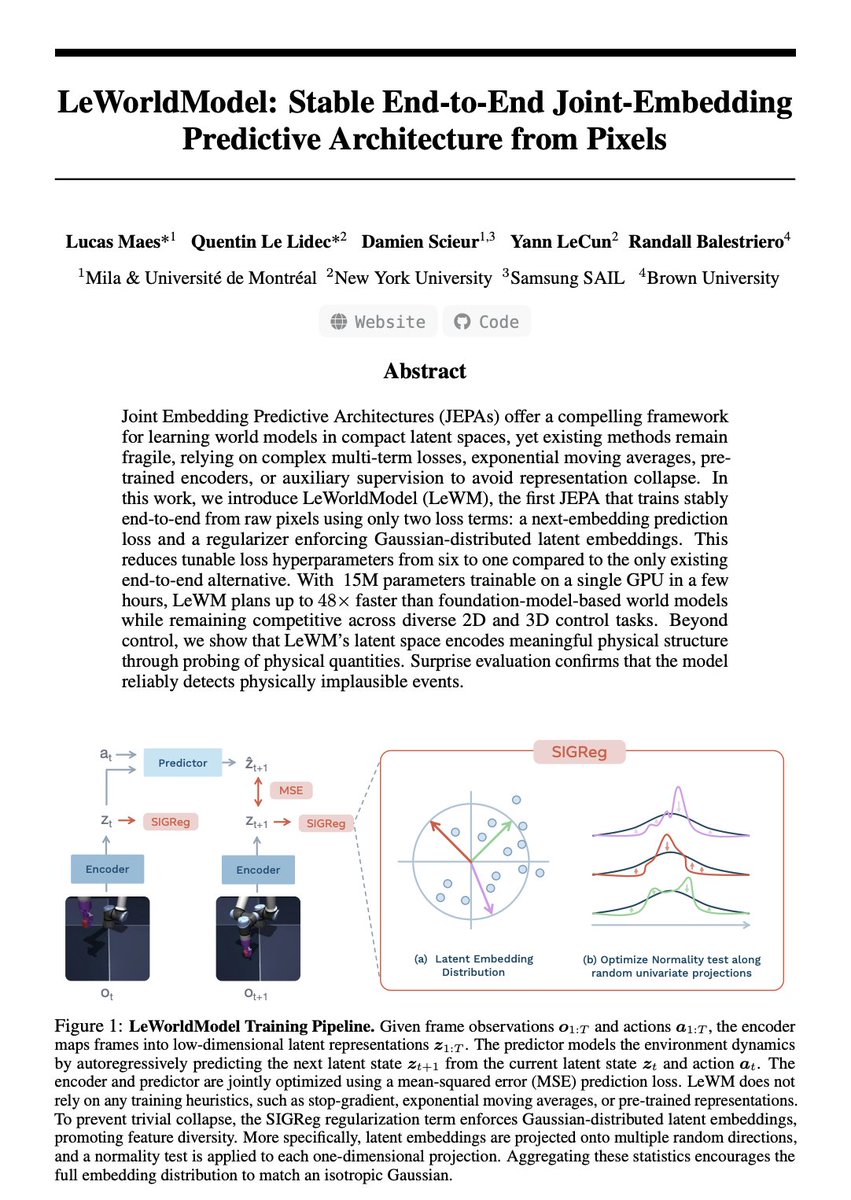
Researchers just dropped a paper called "LeWorldModel" (LeWM).
They completely solved the collapse problem.
They replaced the complex engineering hacks with a single, elegant mathematical regularizer.
It forces the AI's internal "thoughts" into a perfect Gaussian distribution.
The AI can no longer cheat. It is forced to understand the physical structure of reality to make its predictions.
The results completely rewrite the economics of AI.
LeWM didn't need a massive, centralized supercomputer.
It has just 15 million parameters.
It trains on a single, standard GPU in a few hours.
Yet it plans 48x faster than massive foundation world models. It intrinsically understands physics. It instantly detects impossible events.
We spent billions trying to force massive server farms to memorize the internet.
Now, a tiny model running locally on a single graphics card is actually learning how the real world works.
Mythos Preview seems to be the best-aligned model out there on basically every measure we have. But it also likely poses more misalignment risk than any model we’ve used:
Its new capabilities significantly increase the risk from any bad behavior. 🧵
Milla Jovovich (actress from The Fifth Element) created a world-beating Claude memory system with @bensig?!
- 100% on LongMemEval — first perfect score ever recorded.
Free and 100% open source. Github link in the quoted post from Ben.
I'm keen to hear how it works for you.
Let me explain what just happened, because I don’t think people realize how INSANE this is.
> Cortical Labs put 200,000 real human brain cells onto a silicon chip and trained them to play Doom in just one week.
> Each CL1 system costs $35,000.
> A rack of 30 units consumes only 850–1,000 watts combined.
> The human brain operates on 20 watts.
> Large AI training clusters burn through megawatts.
>Backed by In-Q-Tel.
115 units began shipping in 2025.
> Cortical Labs is selling “Wetware as a Service” through Cortical Cloud, letting developers deploy code remotely to living human neurons with no lab required,
> priced like a software subscription but powered by real brain cells grown from adult skin and blood samples.
> it isn’t about gaming, it’s about biological computing that could eventually outperform traditional silicon in energy efficiency and adaptability.
This is getting really scary and we’re still at the very beginning.
750 million users. 10 billion tokens per minute. $185 billion in capex. The numbers Google just reported are massive. But zoom out and you’re watching a four-horse race where every horse is running on a different track.
Gemini just crossed 750 million MAUs. ChatGPT has roughly 900 million weekly active users. Claude has around 30 million. Meta AI crossed 1 billion. Four companies, four wildly different user counts, and the scoreboard that actually matters looks nothing like the headline numbers.
Start with how Google gets its users. Gemini went from 650 million to 750 million MAUs in one quarter. That 100 million user jump happened in the same window where Google replaced the default assistant on 580 million Android devices, baked Gemini into Search (2 billion AI Overview users), and launched Gemini 3, which Pichai called “the fastest adoption of any model in our history.” When you own the default position on 3+ billion devices and the world’s most visited website, adding 100 million users is the floor, not the ceiling.
ChatGPT grew to 900 million weekly users by making people deliberately download an app or type in a URL. That’s a fundamentally different acquisition motion. ChatGPT processes 2.5 billion prompts per day and pulls 5.8 billion monthly web visits. Gemini gets 1.2 billion monthly visits on 750 million “active” users, which means the average Gemini MAU visits the web product 1.6 times per month. The engagement gap is still enormous.
Claude tells the most interesting story of the four. Roughly 30 million monthly users generating $9 billion in annualized revenue by end of 2025, with 80% coming from enterprise and API across 300,000 business customers. Claude Code alone is approaching $1 billion in annualized revenue. Anthropic is projecting $20 to $26 billion ARR in 2026. Compare that to OpenAI expecting to close 2025 with over $13 billion in total revenue from 900 million weekly users and 10 million Plus subscribers. Anthropic generates $9 billion ARR from 30 million users. OpenAI generates $13 billion from 900 million. The revenue per user gap between those two companies tells you everything about where enterprise AI spending is actually flowing.
Google launched AI Plus at $7.99/month, half the price of ChatGPT Plus, and still hasn’t disclosed Gemini’s paid conversion rate. Meta AI crossed 1 billion MAUs by embedding into WhatsApp, Instagram, and Facebook, generates zero direct AI revenue, and Zuckerberg told shareholders the plan is to eventually “insert paid recommendations” or offer subscriptions. A billion users with no monetization path beyond future ads.
The capex tells you who’s betting on what. Alphabet is spending $175 to $185 billion in 2026, more than doubling the $91.4 billion from 2025. Meta is spending $115 to $135 billion. Both are building infrastructure to serve billions of free users they haven’t figured out how to monetize through AI yet. OpenAI raised $40 billion in its Series F and is building Stargate targeting $500 billion over four years. Anthropic raised $13 billion in its Series F at a $183 billion valuation that’s since been marked up to roughly $350 billion on the back of $15 billion from Microsoft and Nvidia.
Each company is winning exactly one race. Google wins cloud throughput and distribution. OpenAI wins consumer engagement and willingness to pay. Anthropic wins enterprise revenue efficiency. Meta wins a user count that nobody’s figured out how to monetize. The question Wall Street hasn’t answered: which of those four races determines who captures the economics of AI over the next five years.
First, the good part of the Anthropic ads: they are funny, and I laughed.
But I wonder why Anthropic would go for something so clearly dishonest. Our most important principle for ads says that we won’t do exactly this; we would obviously never run ads in the way Anthropic depicts them. We are not stupid and we know our users would reject that.
I guess it’s on brand for Anthropic doublespeak to use a deceptive ad to critique theoretical deceptive ads that aren’t real, but a Super Bowl ad is not where I would expect it.
More importantly, we believe everyone deserves to use AI and are committed to free access, because we believe access creates agency. More Texans use ChatGPT for free than total people use Claude in the US, so we have a differently-shaped problem than they do. (If you want to pay for ChatGPT Plus or Pro, we don't show you ads.)
Anthropic serves an expensive product to rich people. We are glad they do that and we are doing that too, but we also feel strongly that we need to bring AI to billions of people who can’t pay for subscriptions.
Maybe even more importantly: Anthropic wants to control what people do with AI—they block companies they don't like from using their coding product (including us), they want to write the rules themselves for what people can and can't use AI for, and now they also want to tell other companies what their business models can be.
We are committed to broad, democratic decision making in addition to access. We are also committed to building the most resilient ecosystem for advanced AI. We care a great deal about safe, broadly beneficial AGI, and we know the only way to get there is to work with the world to prepare.
One authoritarian company won't get us there on their own, to say nothing of the other obvious risks. It is a dark path.
As for our Super Bowl ad: it’s about builders, and how anyone can now build anything.
We are enjoying watching so many people switch to Codex. There have now been 500,000 app downloads since launch on Monday, and we think builders are really going to love what’s coming in the next few weeks. I believe Codex is going to win.
We will continue to work hard to make even more intelligence available for lower and lower prices to our users.
This time belongs to the builders, not the people who want to control them.