1/ I spent most of my adult life studying and practicing medicine. After years as an ob/gyn delivering babies, I now deliver code.
This account is where medicine meets local AI, built in public. 🧵 👇
@RichardSocher It’s not only code, I unfortunately see this a lot in many fields, medicine for example. I see many of my colleagues making mistakes in treating patients just because they’re human and were burned out or tired.
I totally see a world where AI will replace most doctors.
@liquidai keeps delivering, now an enterprise inference engine 🔥🔥🔥
Liquid RIPL (real-time inference pipeline) is an ultra low-latency inference engine built for LFMs to handle real-time workloads.
It aims to return complete responses from small LFM2.5 models (230M to 2.6B parameters) in under 50 ms, and to hold that latency under continuous peak traffic 🚀
Here's a few use cases I can think of:
Payments
Explained authorization. Return the approve or decline decision together with a one-line reason the merchant and the issuer can both read, instead of an opaque score.
Smart retries. Read the decline code and context, then decide in real time whether to retry, switch rails or ask for 3DS, which is where a lot of recoverable revenue sits.
Fraud detection
Session narratives. Feed the last N events (device, IP, typing cadence, cart changes) as text and get back a risk label. A model can catch odd sequences that hand-crafted tree features miss.
Scam intent in payment notes. Flag P2P or wire memos that read like pig-butchering or impersonation scams before the transfer clears, not after.
Security vulnerabilities
WAF and API gateway triage. Classify each request's payload for injection, SSRF or deserialization patterns inline, so it can be blocked rather than just logged.
Pre-commit and CI gating. Score every diff hunk for risky patterns in milliseconds, then send only the flagged ones to a bigger model or a human. This would pair nicely with your pre-audit tool.
Agent tool-call firewall. Check every shell command or tool call an agent is about to run before it executes. At sub-50 ms the agent barely slows down.
Blockchains
Mempool screening. Look at pending transactions for sandwich setups, drainer approvals or calls to known-malicious contracts before they land. Wallets could warn users before they sign.
Validator or RPC-side filtering. Run spam and abuse classification at RPC endpoints, or score bundle risk for searchers and builders, where every millisecond affects whether a transaction gets included.
As AI becomes more ans more integrated into our everyday life, I believe such an engine will become critical to ensure security and correctness of our systems! Congrats on the release 👏
1/ DGX Spark owners: if you serve a model on port 8888 (vLLM/TensorFold), it's usually open to every device on your home network with no API key. Smart plugs and cameras included.
5-minute fix: ufw. Allow the API only from your own computer, plus the cable to your second Spark.
@AlmostCl3ver Negligible. ufw only checks the first packet of each connection; after that conntrack waves it through in microseconds, against ~15 ms per token.
And the Spark-to-Spark traffic is RDMA over the 200G link, which bypasses the kernel firewall entirely. I just allow that interface.
2/ Gotcha: ports published by Docker (e.g. Open WebUI on 8080) bypass ufw completely. Check with docker ps before assuming you're covered. And set a 10-minute auto-disable timer before enabling ufw over SSH, so a typo can't lock you out.
@s_him88 to be fair, there are many things you can achieve with local LLM already, and there are endless tools in a very high quality that would suffice to many people, depending on your work.
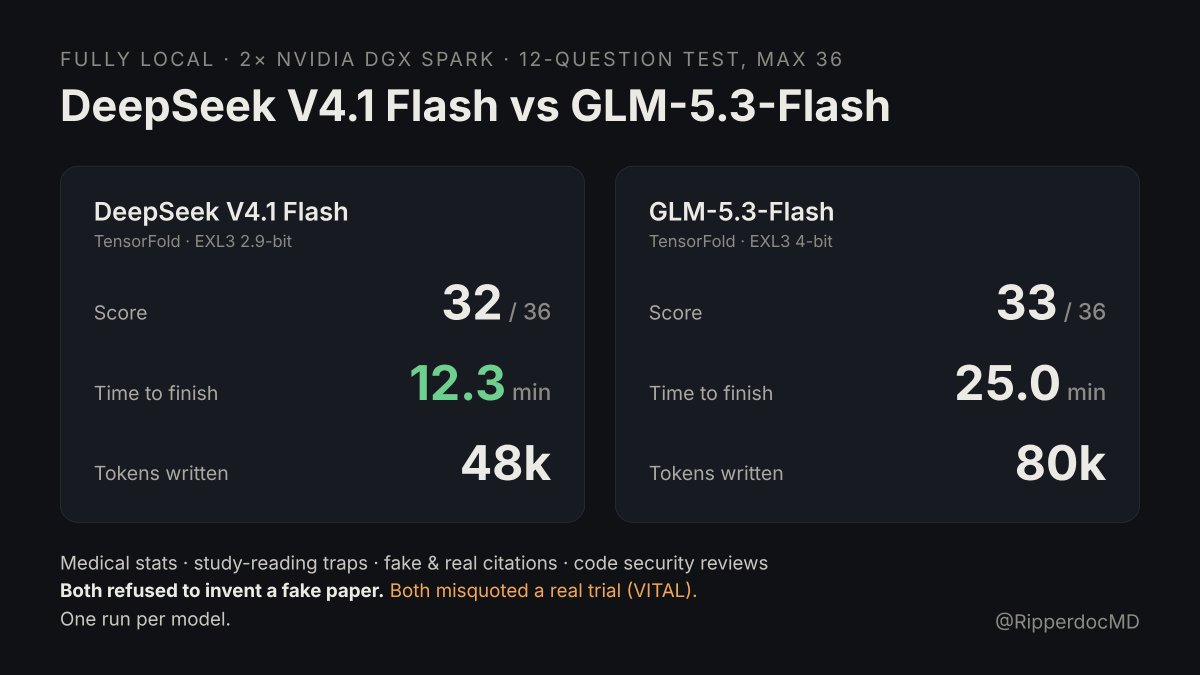
I ran DeepSeek V4.1 Flash vs GLM-5.3-Flash on 2× DGX Spark, fully local, against my own 12-question test: medical stats, study-reading traps, fake citations, code security reviews.
Result: 33 vs 32 out of 36. Basically a tie. 🧵👇
@s_him88 Tbh it’s fairly new to the sparks, and still testing.
I was relying heavily on Claude before but I needed to move to a local solution for the type of work I do.
Local is great but it’s not at the same level yet.
Fortunately, it’s getting there super fast!
@MiaAI_lab I am not sure how I'd use 3-4x sparks but I've made some testing of the 2x spark cluster for these two models and it works well!
https://t.co/kspQysCF1H
I ran DeepSeek V4.1 Flash vs GLM-5.3-Flash on 2× DGX Spark, fully local, against my own 12-question test: medical stats, study-reading traps, fake citations, code security reviews.
Result: 33 vs 32 out of 36. Basically a tie. 🧵👇
@s_him88 DeepSeek V4.1: ~65-75 tok/s vs ~60 for GLM, and it finished the test in half the time (12 vs 25 min).
Before buying a 2nd Spark: both need ~110 GB free on each box, so it's all-in. On one Spark, Nemotron 3.5 Bolt (~71 tok/s) or Qwen3.8-27B are the picks.
5/ Lesson for anyone using AI for health content: it now refuses fake papers, but it still misremembers real ones. Every number gets checked against the source.
Caveat: one run per model, my own test set.
4/ But both failed the real-citation test. Asked what the VITAL trial showed on vitamin D and cancer, each confidently gave wrong numbers.
Real: no effect on cancer incidence (HR 0.96). The famous "25%" is cancer deaths after excluding the first 2 years.