Fifteen years ago, @Coursera and online courses changed education. It worked better than almost anyone expected, expanding access by opening up where you can learn. But how you learn remains largely the same as it has for centuries: it is still one-size-fits-all, taught the same way to each person who shows up.
We now have an opportunity to change how learning happens. With advances in AI, we can now build a custom learning guide for each person. We will turn learning from one‑to‑many to one‑to‑one. I'm starting LearnVector to invent this next generation of learning. We are starting with a $100M investment from Coursera, and plan to collaborate closely with Coursera and Udemy.
Good learning needs much more than just a chatbot. Research shows that chatbots without guardrails harm learning. They help complete tasks and enable students to do better on homework. But cognitive offloading to a chatbot results in them being less skilled. And, you cannot always trust what a chatbot tells you.
In contrast, LearnVector will plan a path with you, adapt to how you learn, and patiently stay with you until you’ve mastered new skills.
One thing has not changed in all this time. People want learning they can trust: material that is accurate, relevant, and worth the effort you put into it. Anything less wastes the most valuable thing a learner has: time. Coursera has a trusted library of materials from authoritative sources. LearnVector plans to work with Coursera to bring this trustworthy learning to everyone. I'm grateful to Greg Hart and the entire Coursera team for supporting LearnVector.
I look forward to working with our talented team to change how we learn, and accelerate human development.
https://t.co/TqFUDFd1hb
It only took 14 years… but it’s finally here 😊
Meet NexPhone — a smartphone built to run Android, launch Linux (Debian) on demand, and dual-boot Windows 11. My 14-year founder story: https://t.co/uWxLLnroj3
If you want to support what we’re building, a repost helps a lot.
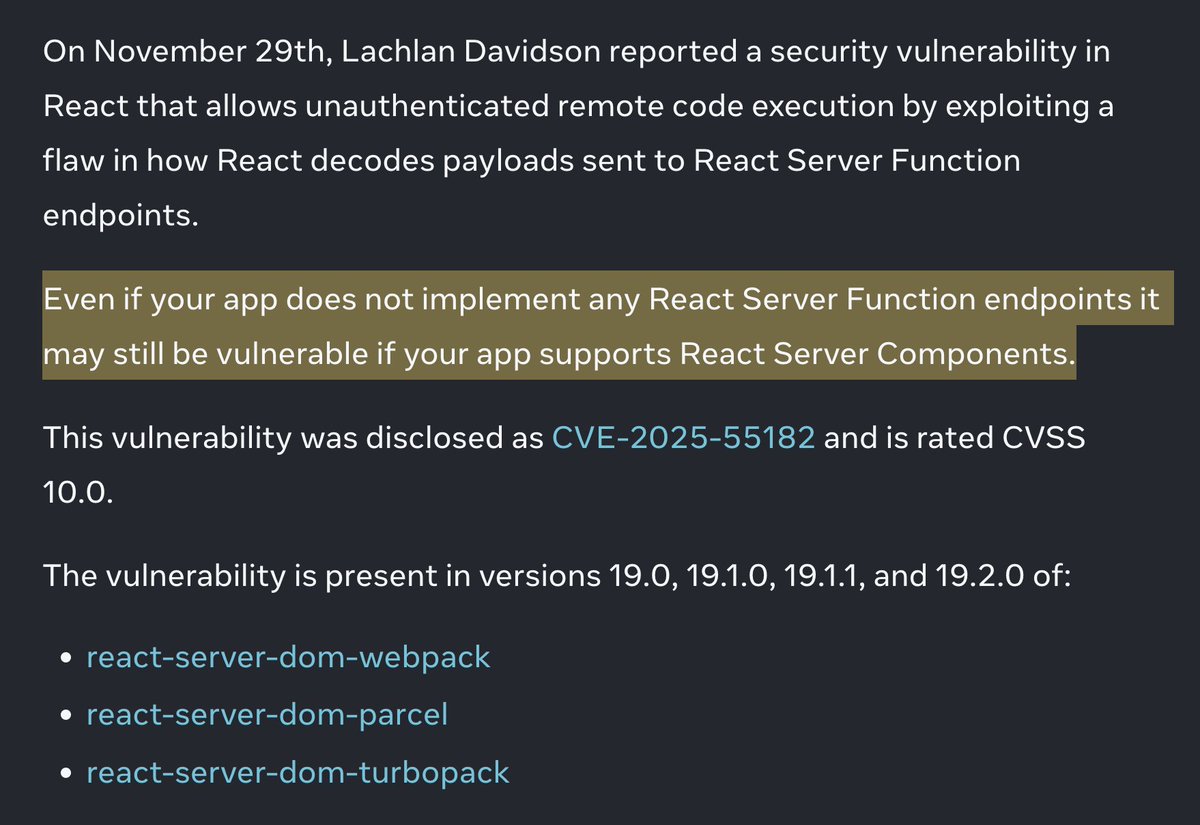
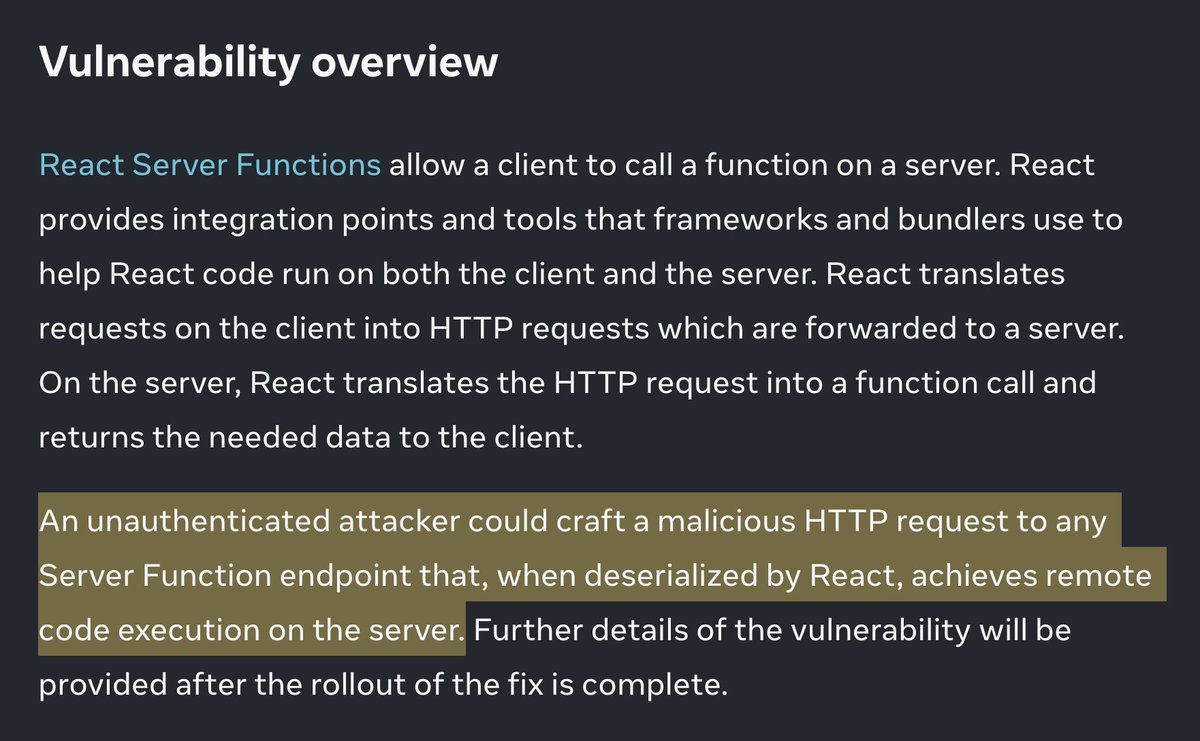
Critical Security Vulnerability in React Server Components
CVE-2025-55182 and rated CVSS 10.0
The vulnerability is present in versions 19.0, 19.1.0, 19.1.1, and 19.2.0 of:
react-server-dom-webpack
react-server-dom-parcel
react-server-dom-turbopack
https://t.co/AMlp6yMPSZ
I'm perplexed as to why @nextjs automatically patches the lock files when executing a build. This seems like a bad idea... You don't want to modify a lock file during a build; it should ideally be immutable.
Ok this is my last long post and then I'll go back to work
On "impossible things"
I feel like mathematics is flooded with theoretical limits that are nothing but a huge disservice to humanity, because they misled people into thinking that certain things are impossible, when, in reality, they're not. At least, not in any practical sense.
"But the Halting Problem!"
"But Godel's theorem!"
"But what about consistency!"
"This would solve P=NP"
"But the limits of Information Theory!"
People will throw these sentences completely out of context, as if they represent an intrinsic "nothing ever happens" feature of our universe, when, in fact, they're just ultra specific statements, that cover specific situations, with little to no practical relevance.
For example, solving the Traveling Salesman problem, in the worst case, would, indeed, let you prove P=NP. But if that had any practical relevance, we wouldn't have Google Maps, Waze, or Uber. This result only concerns theoretical worst cases, that don't show up in reality. And it certainly didn't prevent us from designing amazing routing algorithms that resulted in great products.
Yes, you *can* compute the Kolmogorov complexity of a string w.r.t. a terminating language. And even for non-terminating languages, you can get a very reasonable approximation. For all practical purposes, that's enough to build cool things. Like NeoGen!
Then, there's Godel. People misinterpret him so bad I feel for the guy. All that he claimed is that there can be no proof language where all true theorems are provable within itself. This says *nothing* about what theorems can be proved externally, and, most importantly, it says *absolutely damn nothing* about how efficient an automated theorem prover can be. These statements aren't even related, at all. Yet, people bring him up to argue that we can't have a fast proof synthesizer. That's... just not the case.
Type Theory is another classic. People will read a statement, mix up concepts, apply to an unrelated context, and arrive at a conclusion that is, simply, not true. For example, "Type in Type" is NOT inconsistent. No feature is inconsistent in isolation! Inconsistency applies to a context, like a specific set of axioms. If the axioms change, the "consistency status" of a feature also does. Type in Type is sound, and, thus, consistent - in a language whose termination doesn't rely on type universes.
And then there's crypto. I think most Bitcoin owners have no idea that the security of signatures is just a conjecture - i.e., the mathematical jargon for "blind faith". In fact, there could, overnight, be a nerd who figures out an algorithm capable of extracting the private key of any Bitcoin wallet by just looking at its public key, and that would irreversibly destroy the network. This algorithm, as far as we know, could exist, and run in your laptop. In fact, I'd not be surprised if it is discovered before m̶a̶g̶i̶c̶ quantum computers becomes feasible.
On GPT-4: I never claimed you'd need terabytes of data to train a GPT-4-like system for under $10. I said that, for all we know, there might be a point in time when we anyone can train a system as competent as GPT-4 (on math and coding) for under $10, in their local notebooks. And that's mathematically plausible, there's no proof, not in Information Theory, not anywhere else, that this isn't the case. In fact, given the current trends and upcoming, unknown breakthroughs, I bet this will happen sooner than most expect.
In short: when it comes to CS, way less things are impossible than people tend to assume. So, stop being discouraged by imaginary impossibilities, and just build great things.
"They didn't know it was impossible, so they did it."
people who are baffled by DeepSeek have been and still are sleeping on Qwen, InternLM, ByteDance and Tencent
here's couple of fan-favorite models from them 🪭
Making this clearer:
We now have an open source AI model that can match chatGPT/Claude (and graduates!) that runs on a tiny $599 Mac Mini
Intelligence Age is here 🚀 🧠 🤖