The result I keep thinking about in ParallACT: given its partner’s task, one agent did both 15% of the time while the other stepped aside! Fine for two agents, not a hundred...
Joint work with @rishabhmediratt@EliasEskin@PeterStone_TX@Joydeepb_robots 👇
Excited to share ParallACT! 🎉
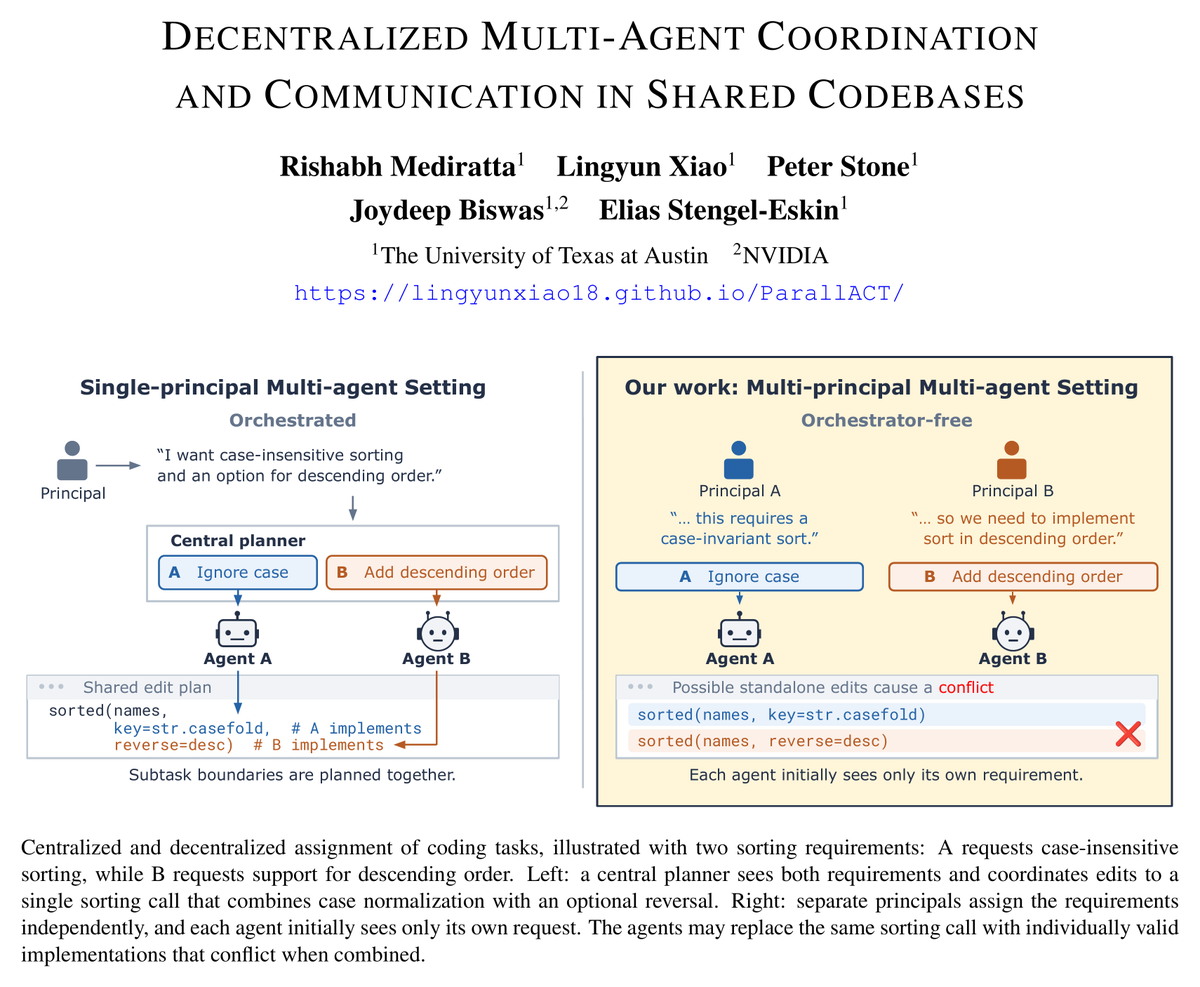
Multi-agent coding usually splits up 1 request across agents. But when many devs each give their own task to agents, nobody plans who edits what. Can agents sort it out? Not yet.
w/ @xiaolingyun98, @EliasEskin, @PeterStone_TX, and @Joydeepb_robots
Large repos often have 1000+ devs working at once. What happens when devs delegate to agents?
We introduce ParallACT, a benchmark of multi-principal multi-agent tasks requiring coordination.
Frontier models struggle (e.g. 16% success for Opus 4.8), even when they can talk.
This setting differs fundamentally from most current multi-agent settings, which decompose a single problem and assign to parallel agents. These problems all started as a centralized request. In contrast, ParallACT is multi-agent by necessity: the requests come from different principals, and sometimes happen to conflict. This happens all the time, e.g. with devs working on monorepos.
Key takeaways:
1️⃣ Parallel agents fail on the same tasks where a single agent succeeds: on contradictory specs, single agents given both tasks achieve 62%, vs 16% for two agents working in parallel (46 pp drop). This holds across models and harnesses. Often each parallel agent’s half works on its own, but the combined code doesn't.
2️⃣ Communication helps a little and costs a lot: the best message channel reaches 32%, at more than twice the tokens. Just knowing a peer exists doesn't help.
3️⃣ Agents know what to talk about, but not how to talk: they communicate about the right code but read messages too late, and often still make conflicting edits after agreeing on a design.
4️⃣ Taking turns recovers much of the gap, but doesn't scale beyond a few agents. Sequentially iterating between agents lets them coordinate better but requires central orchestration.
🧵👇
@GoogleWorkspace yeah suspicion confirmed it is something hardcoded cause as soon as it turned 1 AM in Central daylight time (midnight otherwise) it fixed itself
I had this bug with @GoogleWorkspace sheets where something like this - =DATEDIF(I470,TODAY(),"D") wouldn't update till midnight pacific. noticed a few days ago this got fixed and started working at the right time for central. its daylight savings now and i think it broke again