The result I keep thinking about in ParallACT: given its partner’s task, one agent did both 15% of the time while the other stepped aside! Fine for two agents, not a hundred...
Joint work with @rishabhmediratt@EliasEskin@PeterStone_TX@Joydeepb_robots 👇
Large repos often have 1000+ devs working at once. What happens when devs delegate to agents?
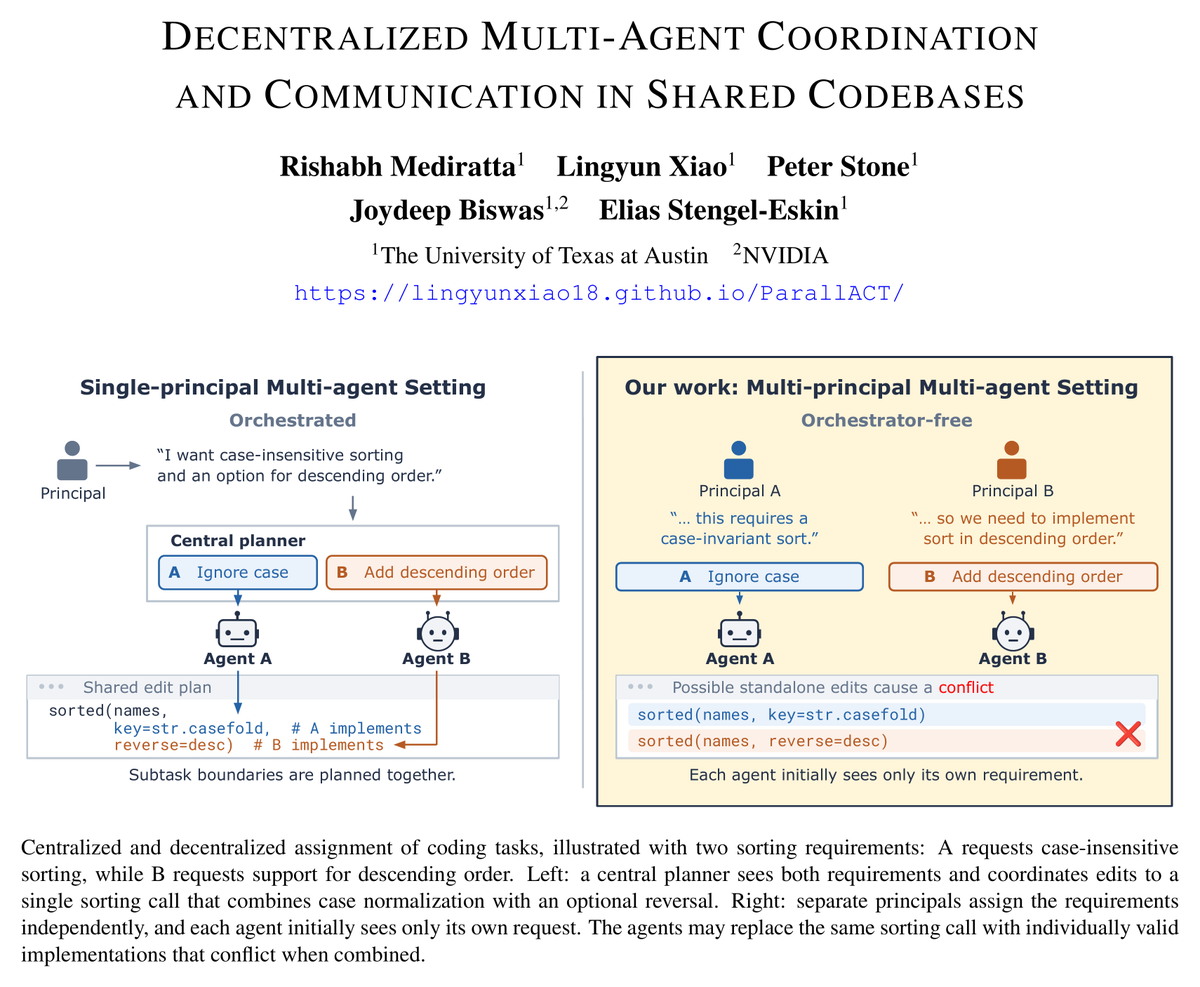
We introduce ParallACT, a benchmark of multi-principal multi-agent tasks requiring coordination.
Frontier models struggle (e.g. 16% success for Opus 4.8), even when they can talk.
This setting differs fundamentally from most current multi-agent settings, which decompose a single problem and assign to parallel agents. These problems all started as a centralized request. In contrast, ParallACT is multi-agent by necessity: the requests come from different principals, and sometimes happen to conflict. This happens all the time, e.g. with devs working on monorepos.
Key takeaways:
1️⃣ Parallel agents fail on the same tasks where a single agent succeeds: on contradictory specs, single agents given both tasks achieve 62%, vs 16% for two agents working in parallel (46 pp drop). This holds across models and harnesses. Often each parallel agent’s half works on its own, but the combined code doesn't.
2️⃣ Communication helps a little and costs a lot: the best message channel reaches 32%, at more than twice the tokens. Just knowing a peer exists doesn't help.
3️⃣ Agents know what to talk about, but not how to talk: they communicate about the right code but read messages too late, and often still make conflicting edits after agreeing on a design.
4️⃣ Taking turns recovers much of the gap, but doesn't scale beyond a few agents. Sequentially iterating between agents lets them coordinate better but requires central orchestration.
🧵👇
[1/4] 🚀 We’re excited to announce the v1 release of JaxAHT – a new library for Ad Hoc Teamwork (AHT) research, built with JAX for speed & scalability! Check it out 👉 https://t.co/Vmpbm72YwS #AI#MARL#ReinforcementLearning#JAX#AdHocTeamwork