If you think a $300K corporate salary is payment for 40 hours of weekly labor, I've got news for you...
There is a persistent cynical narrative that large enterprises are bloated engines of inefficiency, filled with overpaid professionals who spend their days looking at slides and doing "nothing."
I mean, it's a comforting myth for critics, but I think it fundamentally misunderstands modern knowledge work.
That $300K salary (or $400K, or $500K) isn't a reward for linear effort but an option premium on high-leverage thinking.
We are still haunted by the ghost of the assembly line, ie, the outdated idea that compensation must directly correlate with time spent + physical output.
In the factory world, if you leave your station, production stops, but in the knowledge economy, value is almost totally decoupled from time.
Folks... An enterprise paying a senior leader or specialist $25K a month is not buying 160 hours of typing, they are buying *insurance* against catastrophic errors and positioning themselves for asymmetric upside.
I'll try to make it tangible with an example...
Consider a complex matrix organization busy with a $40M product migration. In this environment, the value distribution of a worker's is heavily spiked.
Most days look like nothing... alignment meetings, reading documentation, maintaining steady state. Yes, to an outsider, it looks like "doing nothing."
But then a critical day arrives. A vendor fails, a timeline slips, a crossroads appears, whatever... If that $300K professional has the institutional memory and capability to make just 4 or 5 correct decisions during those critical moments, the ROI is staggering! A single right call can avert a $5M problem.
Suddenly, that $300K salary doesn't look like bloat but, to me, seems like the cheapest asset on the p&l.
These days we are bombarded by tech CEOs promising fully autonomous, AI-driven organizations and I keep saying these pitches miss the entire point of how complex enterprises actually move.
Data computation can be outsourced to an LLM but going through the decision fabric of an enterprise cannot. You need people for:
> Knowing *how* to build consensus across disconnected departments with competing incentives;
> Understanding the unspoken history of why past projects failed, and how to position a new initiative so it doesn't trigger corporate antibodies;
> When a multi-million-dollar decision goes sideways, an algorithm cannot stand before a board of directors or regulators and take ownership of the corrective action.
An AI can give you a pristine strategic framework with nice and difficult sounding words, but it cannot navigate the human matrix required to execute it.
The ability to be effective inside a complex enterprise is a rare AND expensive skillset precisely because it cannot be automated or easily replicated.
My point is you aren't paying for the 9-to-5 "grind", but more for the readiness.
Like an elite surgeon or an expert technician, you pay for the decades of accumulated knowledge that allow them to fix a crisis in 5 minutes, not the 5 minutes itself....
Leverage, not labor.
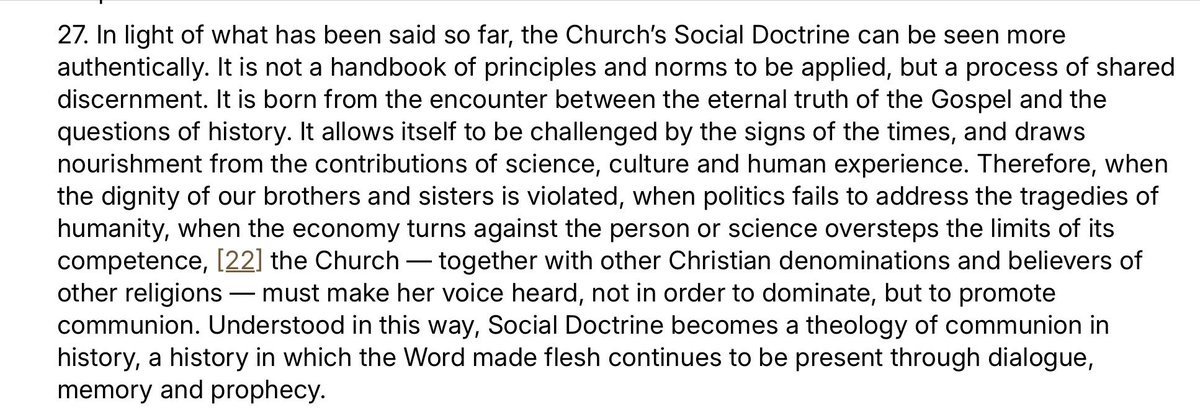
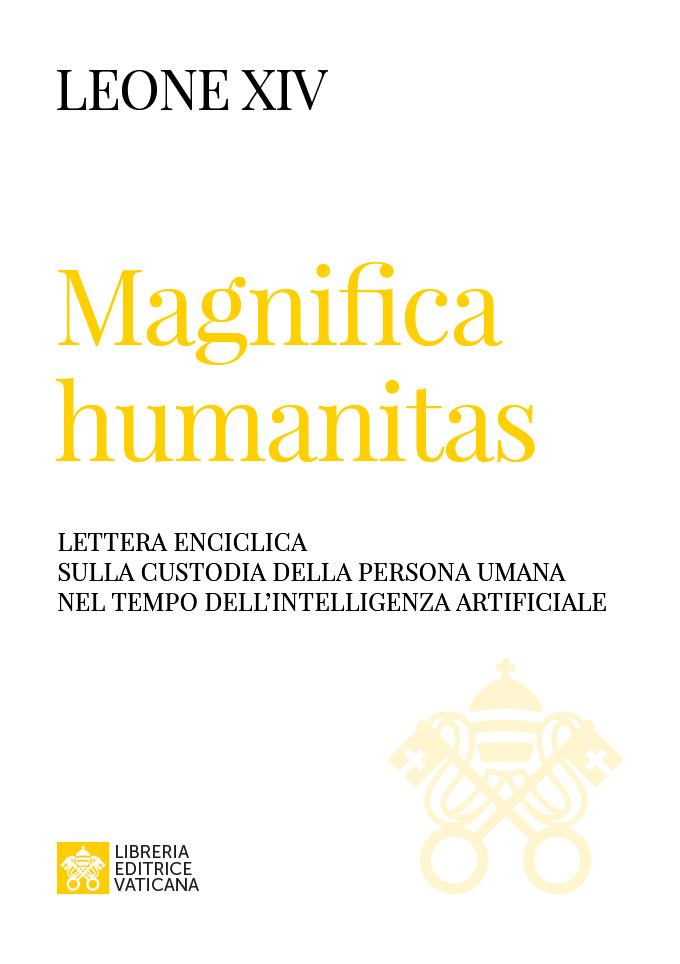
I am working my way through Magnifica Humanitas and can honestly say that the Holy Father may have permanently changed my understanding of the nature of Catholic social teaching. See, eg, paragraph 27. Though Pope Leo doesn’t cite him, this way of viewing Social Doctrine has obviously roots in Saint John Henry Newman’s (aka, Cardinal Newman) arguments on the development of doctrine. Without ever explicitly articulating it, I have always thought of Social Doctrine precisely as a set of “principles and norms to be applied.” But I now see that Leo (and Newman) offer a better way.
Some preliminary thoughts on "Magnifica humanitas," the Pope's upcoming encyclical on the care of the human person in the age of artificial intelligence, to be released at the Vatican on May 25.
First, AI has been a concern of the Holy Father since at least the beginning of his pontificate, mentioned several times early on in his papacy. Just a few days ago, he established a new papal commission, bridging several dicasteries, to address this topic; and he also mentioned the topic in his recent address for the World Day of Communications. So the topic is not a surprise. The question will be: what other topics will be included: workers rights? labor unions? capitalism more broadly?
Second, as someone who studied mathematics, Pope Leo XIV has perhaps a firmer grasp on this issue than some might imagine of a pope.
Third, that the Holy Father will personally present the document on May 25 in the Paul VI Aula (where the Synod convened) is highly unusual. To me (and I have no inside information on this, nor have I read the document) it may indicate the Holy Father's deep personal interest in the topic, and a desire to ensure that the media "get it." Pope Leo is an expert communicator.
Fourth, the Vatican has been providing guidance on this topic, in both formal and informal ways, to those who work in this field for some years, and has a surprising number of respected experts (theological and technical) in their orbit. Not long ago, at a meeting of the Dicastery for Communication, we heard from one and I was stunned by the breadth of his knowledge (at least to this neophyte).
Fifth, the encyclical was signed (and therefore will be formally dated) on the 135th anniversary of "Rerum Novarum," Pope Leo XIII's groundbreaking encyclical on labor, workers' rights, unions and many other social issues, which set the stage for the modern movement of social justice in the church. Pope Leo XII is seen as the father of the modern tradition of Catholic social teaching. There were many who believed that Cardinal Robert Francis Prevost took the name "Leo" at his election as pope (his first decision after saying "yes" to his election) as a nod to this champion of social justice and workers' rights.
Finally, like "Laudato Si," which recast the issue of climate change as not simply a scientific and social one, but a spiritual one, "Magnifica humanitas" may do the same for AI, helping the church and the world see this pressing topic from a spiritual vantage point and also, as "Laudato Si" did, in a systematic way.
And, as an important aside, an encyclical is one of the very highest levels of church teaching.
All in all, by any measure, an exciting new encyclical to read, study and pray over!
I love being Catholic *because* the edicts of my faith constantly challenge my political beliefs. I cannot imagine a religion that would pride itself on being a reliable voting bloc, because service to Christ is first, not service to some temporal political party.
I’m honestly shocked how few people I talked to today have seen Wargames.
It’s literally about an AI nearly destroying the world when it plays a game of Global Thermonuclear War.
What would Stephen Falken think about the Anthropic / DOD fight?
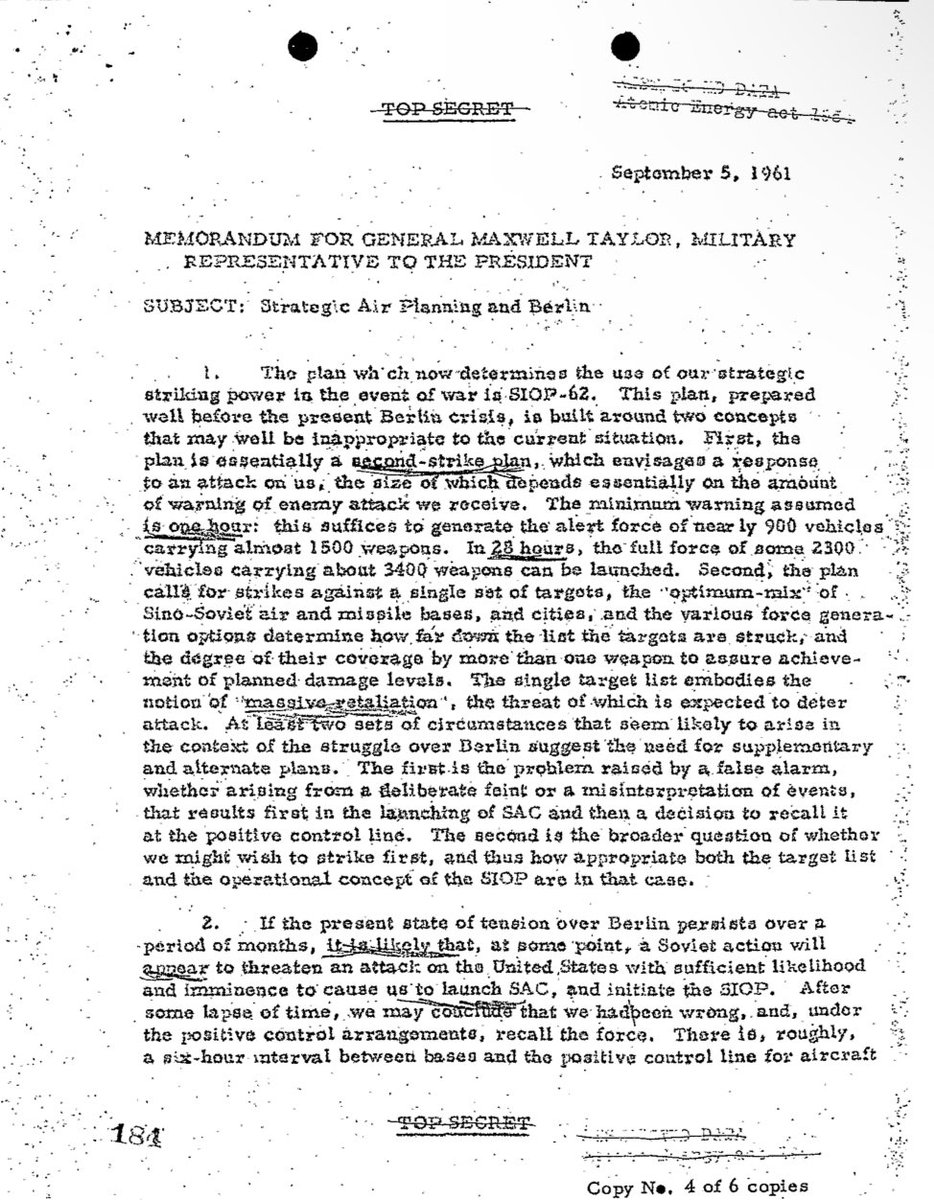
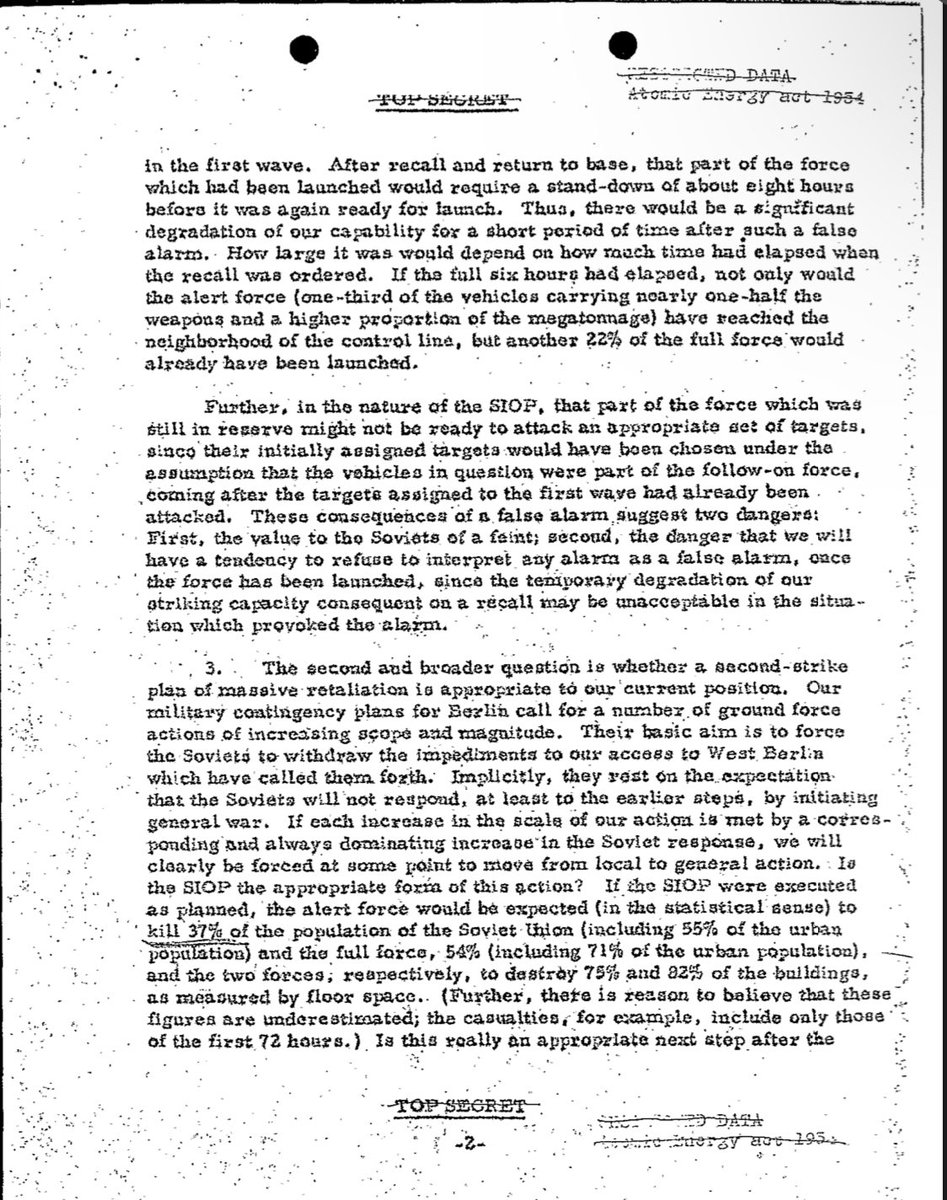
"And we call ourselves the human race.” These declassified documents from 1961 prove that the military leadership was prepared to trigger a nuclear apocalypse over a single standoff in Berlin. When the war hungry insane Joint Chiefs briefed JFK on their nuclear war plan, SIOP-62, they laid out the math for an all-out "spasm" attack designed to kill over 200 million people in a single afternoon. On Page 2 of this memo, you can see the literal evidence where they estimate wiping out 54% of the Soviet population and 71% of their cities instantly and they even admitted these numbers were "underestimated" because they didn't count the millions who would die slowly from radiation. JFK was so repulsed by the cold, calculated way these insane crackpots talked about mass murder that he famously walked out of the briefing, turning to his Secretary of State and saying, "And we call ourselves the human race." While Kennedy was desperately looking for a diplomatic way to avoid World War III, the Joint Chiefs were trying to bully him into a global graveyard. This document is the ultimate proof that the Pentagon was being run by people who didn't care about humanity, and it shows exactly why the relationship between JFK and the military became a total death struggle.