The real issue is not just about people or the government — it is a deeper failure of civic education. We have created highly educated people, but failed to create responsible citizens.
When basic manners, cleanliness, and respect for public spaces are missing, it shows a gap in our upbringing and education system. A dustbin nearby is useless if the mindset is missing.
Civic sense should not be a choice; it should be a lesson taught from childhood.
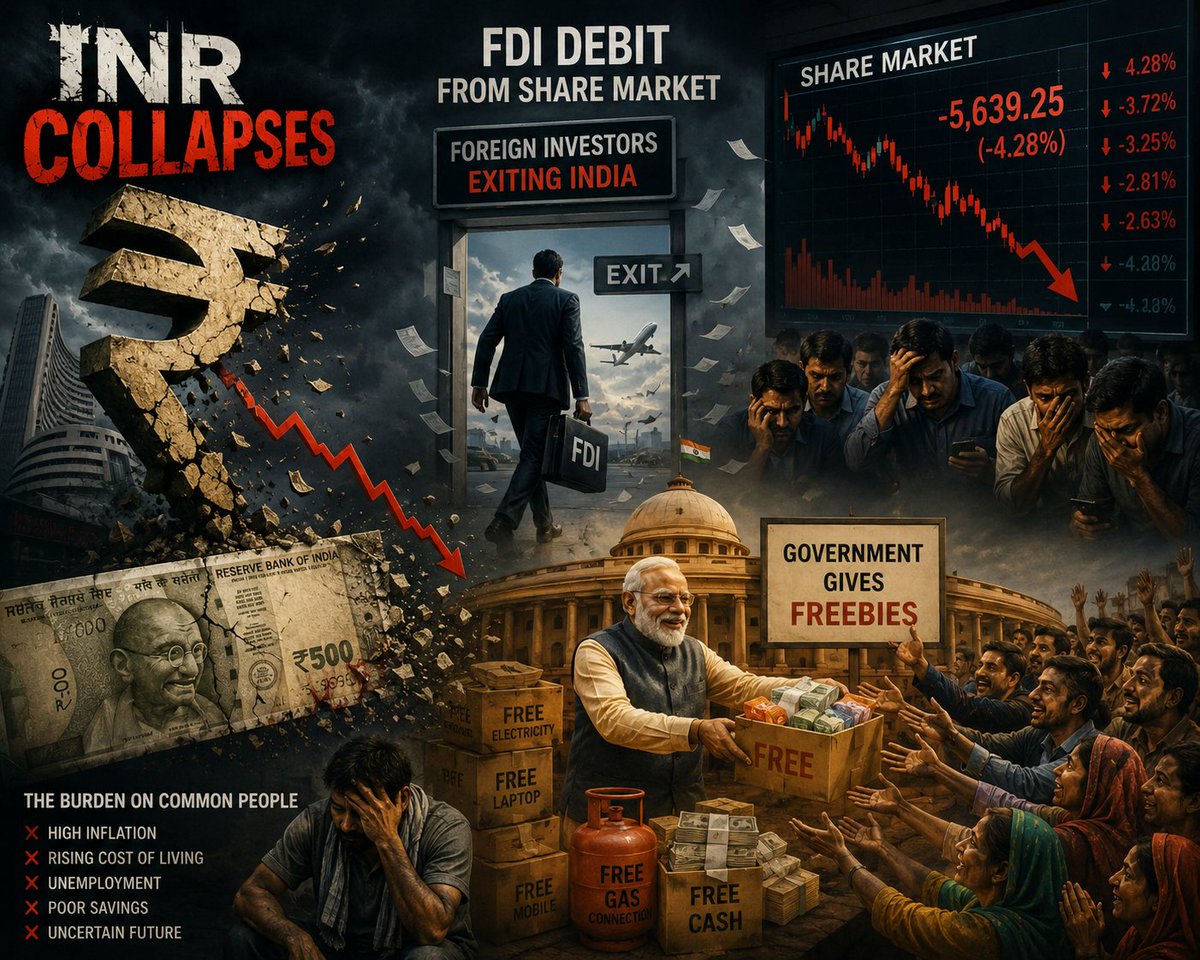
India’s economic story needs an honest conversation.
The Indian Rupee has faced continuous pressure over the years, foreign portfolio investors (FPIs) have periodically reduced exposure to Indian equities, and concerns about high market valuations have been discussed by global investors.
At the same time, India continues to spend heavily on subsidies and welfare schemes. Welfare support can be important for vulnerable citizens, but the bigger question is whether public money is creating long-term value through jobs, productivity, infrastructure, and sustainable growth.
A strong economy cannot depend only on short-term relief. It needs investment, innovation, manufacturing growth, employment opportunities, and fiscal discipline.
The biggest concern is not just economic data — it is the lack of public discussion. When ordinary citizens are busy fighting daily battles of inflation, expenses, and survival, larger economic decisions often go unquestioned.
Citizens deserve transparency. Taxpayers deserve accountability. And the future generation deserves an economy built on strength, not temporary solutions.
India has enormous potential — but progress requires responsible policies, informed citizens, and the courage to ask difficult questions.
#IndianEconomy #EconomicGrowth #FiscalResponsibility #Taxpayers #Rupee #FDI #sensex
The aggressive push towards ethanol as a fuel alternative raises serious questions. A policy that directly impacts millions of vehicle owners and consumers should be introduced with proper planning, transparency, and accountability — not forced without addressing ground realities.
Energy security and reducing oil imports are important goals, but economic decisions should not become a way to hide deeper financial challenges. When public funds are heavily spent on freebies and short-term political measures, it naturally raises concerns about fiscal discipline, imports, and long-term economic stability.
If managing crude oil and gas imports has become difficult, the solution cannot simply be shifting the burden onto citizens through rushed policies. The focus should be on strengthening the economy, creating jobs, attracting investment, improving productivity, and building sustainable growth.
A nation’s economy is not strengthened by temporary fixes — it is strengthened by responsible decisions, honest governance, and a clear long-term vision.
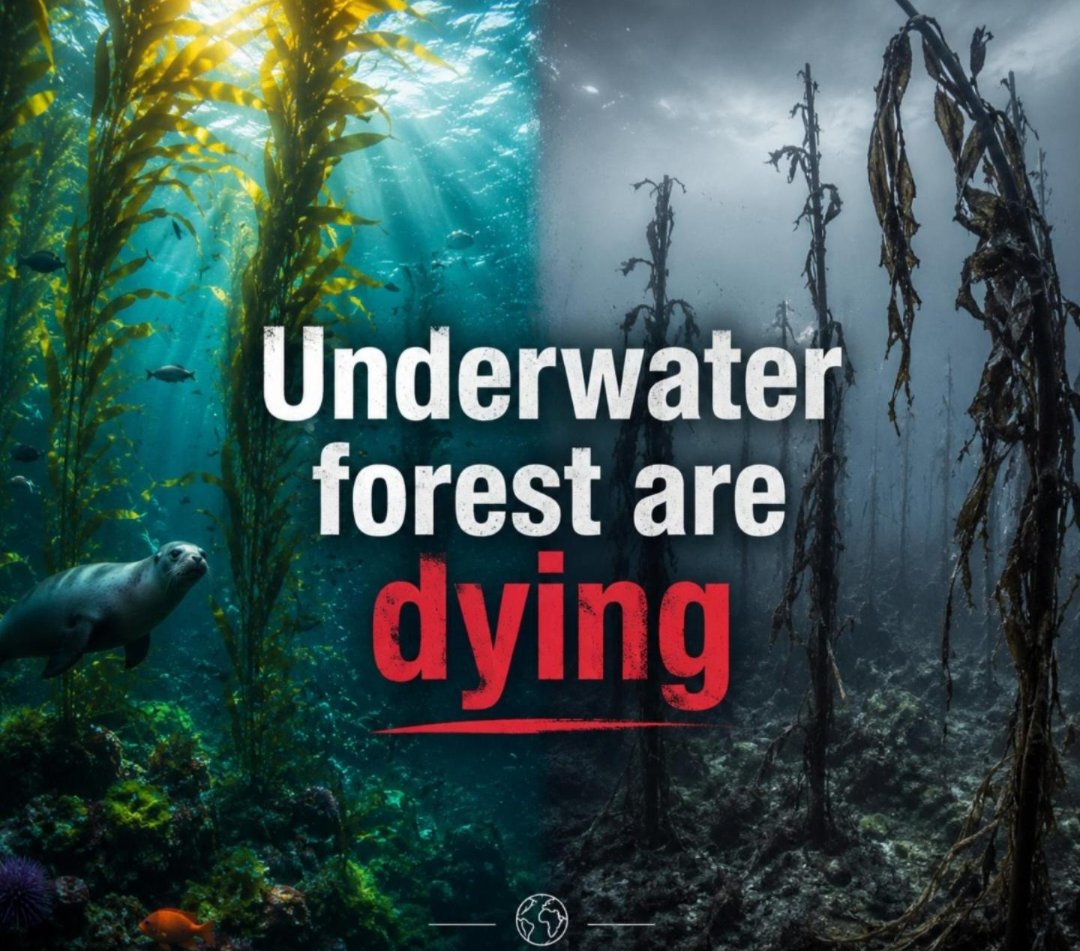
The ocean’s magnificent “floating forests” — Kelp Forests — are silently disappearing.
Across the world, some kelp ecosystems have declined by 60–99% as rising ocean temperatures and intensifying marine heatwaves disrupt these fragile habitats.
Kelp is far more than a marine plant. Often called the “rainforests of the sea,” these underwater forests provide shelter, food, and breeding grounds for countless species while supporting ocean health and playing a role in carbon absorption.
But this is not only a story of climate change — it is also a reflection of our relationship with consumption. A cycle of endless wanting, driven by the belief that external possessions can fill internal gaps, has created a pressure the planet can no longer sustain.
The crisis unfolding in our oceans is a mirror of the choices we make every day.
🌍 Protecting nature requires not only scientific and technological solutions, but also a deeper understanding of our desires, our consumption, and our connection with the living world.
#ClimateChange #OceanConservation #KelpForests #MarineEcosystems #OceanHealth #Biodiversity #ClimateCrisis #Sustainability #EnvironmentalAwareness #EarthCare #SaveOurOceans
You quoted half my sentence, ignored the other half, and called me a fool for it.
That's not a rebuttal. That's just bad reading with confidence.
The point stands — a real threat doesn't become fiction because a film depicts it. Feel free to address that whenever you're done performing. 🙂
Terrorists being fought long before Aditya Dhar and I was born doesn't invalidate the film's message.
If Pakistan's terror links are so well known that even Osama bin Laden was found hiding there, why is depicting that reality suddenly controversial?
Criticize the movie, the script, or the direction all you want. But a real problem doesn't become fiction just because a film talks about it.
Humiliate WHO exactly? Terrorists? Jihadis?
Brother, if YOUR first instinct is to defend the people who want to blow up this country — maybe log off and reflect for a bit.
Yes, Dhurandhar is a film. Yes, it has fiction. But it also mirrors a very real threat that India faces every single day. Some of us watched it and felt aware. Some watched it and felt nothing. That difference matters.
Calling out terror ideology isn't "belittling people" — it's called having a spine. 🇮🇳
India wants to be a $10 trillion economy.
But only 1 in 3 women is part of the workforce.
India's female workforce participation: 32.8%.
Vietnam: 69%. China: 59%. The world average: 51%.
We are not just behind.
We have built an entire civilisation around staying behind.
—
Dropping cash into a woman's bank account is not empowerment.
It's a bribe for her silence.
Real empowerment is a woman who never needed your money
because she was never stopped from earning her own.
—
The failure isn't economic. Economics can be fixed with policy.
This failure is older. Deeper. More personal.
It lives in the katha hall where a baba tells 10,000 women:
"A devoted wife is worth more than an educated one."
And 10,000 women write it in their hearts like gospel.
It lives in the Friday sermon where a maulana reminds a congregation:
"A woman's honour is in her veil, not her ambition."
And no one in the room thinks to disagree.
It lives in the family dining table where a daughter's job offer
is met with: "But what will people say after you're married?"
Generation after generation.
The cage gets repainted. It never gets removed.
—
The geography changes. The tragedy doesn't.
North Indian women work — in fields, at dawn, without wages, without credit.
It is called duty. It is never called labour.
South Indian women study, graduate, and shine —
then quietly vanish from the economy the morning after their wedding.
It is called sacrifice. It is never called loss.
Two India. One broken promise to its women.
—
So who carries the guilt?
The government — without question.
Not for failing to transfer cash, but for failing to transfer freedom.
Schemes that deposit cash don't dismantle mindsets.
You cannot run a welfare scheme on dignity.
Society — above all else.
For turning submission into spirituality.
For making a woman's smallness feel sacred.
Religious figures — who understood, better than anyone,
that a woman kept obedient is a woman kept dependent.
And built entire empires on that single, devastating insight.
And — gently, but honestly —
the women themselves.
Who must one day pick up the script they were handed at birth,
read it slowly,
and ask: "Did I write this? Or was it written for me?"
—
The most dangerous prison in the world
is the one where the prisoner decorates the walls
and calls it home.
India will not rise on the labour of half its people
while the other half is told that rising is a sin.
Not with better slogans.
Not with cash schemes.
Not with statues.
Only with truth. Only with freedom. Only together.
#IndianWomen #GenderGap #WomenEmpowerment #RealTalk #ViksitBharat #HalfOfIndia #India
@narendramodi@UN_Women@unwomenindia@WomenInPA@UjjawalJyotingo@CMMadhyaPradesh@MSJEGOI
Came back to Twitter after a long break. One thing hasn't changed — we reward noise and ignore substance.
False narratives trend for days. But a conversation about climate crisis, quality education, or civic responsibility? It barely survives an hour.
We want a transformed country — but not the discomfort of transforming ourselves.
We blame every politician, every institution, every stranger on the internet.
But when did we last hold ourselves accountable?
Progress isn't a spectator sport.
If you want a different India, start by being a different you.
#India #CivicResponsibility #ChangeStartsWithYou #LongestServingElectedPMModi #Bharathiraja
Nitin Gadkari & Hardeep Puri — two ministers, one catastrophic agenda — are hellbent on dismantling India's entire vehicle ecosystem with this E85 fantasy.
Let's be brutally honest. Sugarcane, the backbone of ethanol production, is one of the most water-guzzling crops on the planet. India is already bleeding its groundwater dry, farmers are in distress, and THIS is the grand solution these two have cooked up?
And while Puri stands at the podium preaching 'green energy', Gadkari's sons' companies — Cian Agro & Manas Agro — saw a jaw-dropping 2,100% stock surge and revenue explode from ₹18 crore to ₹523 crore in just one year. Coincidence? You decide.
The father sits in government making policies. The sons make the money. And Hardeep Puri provides the press conference.
This isn't energy policy. This is a carefully engineered racket — dressed in green, sold as patriotism, and signed off by the very people who profit from it.
India's roads. India's water. India's future — all being auctioned off for a boardroom balance sheet.
This growing sense of entitlement is unacceptable. If you ignore restricted zones, endanger public order, and then argue with enforcement personnel, you should face immediate and serious legal consequences. Laws are not optional, and authorities should stop rewarding bad behavior with endless patience.
"Climate change is a fabrication," says Patrick Moore.
But what kind of mindset refuses to acknowledge a problem simply because it is inconvenient?
Question the models. Question the policies. Question the predictions.
But when forests disappear, water tables fall, temperatures rise, and ecosystems deteriorate, denying reality is not skepticism—it is willful blindness.
True wisdom lies not in dismissing warnings, but in having the courage to face them.
#ClimateChange #Environment #Science #Sustainability #ClimateAction #PatrickMoore
"This is not shocking — this is the system working exactly as it was designed to.
That ₹10 lakh bribe was never just his. Corruption here operates like a supply chain — junior officers collect, seniors take their cut, ministers take theirs, and mutual complicity ensures nobody faces real consequences. They all know each other's secrets, and that's precisely what makes them untouchable.
This isn't one corrupt officer. This is a network protecting itself.
The bitter truth is — you cannot cleanse the roots by trimming the branches. Punishing a mid-level officer while the top remains untouched is nothing but political theatre, designed to pacify public outrage while the system stays perfectly intact.
And the most disheartening part? They count on our short memory. We trend, we react, we forget — and the cycle resets.
Until public anger stops having an expiry date, and citizens stay engaged beyond a single viral post — nothing will change. Absolutely nothing."
Let me be direct — comparing Bhagat Singh to those who seek to dismember this nation is not just historically illiterate, it is a matter of profound shame.
Bhagat Singh didn't walk to the gallows singing "Sarfaroshi ki tamanna" so that the land he loved could one day be carved into pieces. He was 23 years old when he smiled at the noose — not for religion, not for a separate homeland — but for a free, united India. Had he been alive today, the very idea of Khalistan would have dissolved in the fire of his conviction. Pakistan in its current form may not have existed either.
And comparing him to Amritpal Singh? That is where shame reaches its peak. Bhagat Singh was an atheist who rejected religion-based politics entirely. Amritpal wraps every move in religious identity. Bhagat Singh fought to UNITE India against a foreign occupier. Amritpal fights to DIVIDE the same free nation Bhagat Singh gave his life to build. Bhagat Singh never ran from the law — he walked into the courtroom with his head held high and became immortal. Amritpal fled disguised when authorities came. These two men are not two sides of the same coin — they are opposites of history.
On the Dalai Lama — the comparison collapses entirely. China did not liberate Tibet. It occupied it. The Dalai Lama is not seeking to divide a nation — he is seeking to reclaim one that was stolen.
You cannot invoke Bhagat Singh's name and demand separation in the same breath. You cannot quote the Gurus and work against everything they stood for. History is not a costume you wear when it suits you.
The turban may look the same. The cause could not be more different.
@IndianGems_ Madhya Pradesh is increasingly being seen as one of the most corrupt states in India. The situation has deteriorated to such an extent that it now appears to have surpassed even Bihar in terms of corruption and administrative failures.
@amlan_c@Hamp_Allen I know these are not Sikh voices. These are ISI-funded puppets, operating from foreign soil, using the Sikh faith as a shield for Pakistan's proxy war against India.
Real Sikhs are with India. They always have been. They always will be.
Before rewriting history, let's get the facts straight — it was terrorists who carried weapons into the Golden Temple, not the army. Operation Blue Star was a tragedy, and I condemn it wholeheartedly. But let's not forget who turned a sacred place into a fortress first.
If injustice is the conversation — where is that same outrage for the Kashmiri Pandits? An entire community was ethnically cleansed from their own homeland. They lost everything. Yet they never raised a flag for a separate nation. Why does selective grief only flow in one direction?
You say India 'suppressed' Sikhs — yet this very nation gave a Sikh man the Prime Minister's chair. A Muslim sat as President. No other country on this earth carries that kind of pluralism in its DNA. That isn't oppression. That is India.
The Punjab Regiment — one of the most decorated and battle-hardened units in the Indian Army — was built on Sikh blood, Sikh courage, and Sikh devotion to this land. That legacy doesn't lie.
And no matter what narrative is being pushed from foreign soil — in the heart of every true Sikh, India resides just as deeply as the words of Guru Granth Sahib Ji.
You can manufacture outrage. You cannot manufacture 550 years of shared history.