@ShivaKumar9158 That "I know this but cannot recall it" feeling is exactly what mock tests are for - it shows the difference between recognizing a topic and retrieving it. Revise those topics by explaining them out loud once.
@simply_rohan_ Close, one small fix: replication increases redundancy on purpose - copies of the same data on multiple servers, so one failing does not take the data down. High availability comes from that redundancy, not less of it.
@UTTKARSH911 That is the Luhn algorithm doing the check - double every second digit, subtract 9 if over 9, and the total must divide by 10. Catches typos instantly, but it only checks math, not that the card exists.
@Harshit_io777 The references part is the real unlock. Pasting two or three sites you like and asking for that spacing system and type scale gets you 80 percent there. Generic prompt in, generic page out.
@mollercodes Two parsers for one file is a quiet maintenance trap - the day the format changes, only one gets updated. A single parse into a shared AST or even plain JSON, then let each script read what it needs, kills that drift.
@sughanthans1 Auto-review before execution is the pattern that makes agents deployable beyond demos. The interesting question is what the reviewer model checks against - a fixed policy, or per-tool rules you can version with the code.
@Ray99Bimal Right - limits cap execution but say nothing about order. Fair scheduling is really about who waits when workers are scarce. A per-tenant virtual queue with round-robin dequeue gets you most of the fairness without separate pools.
Backend habit: return one consistent error shape everywhere - { error: { code, message } }. A mix of strings, bare status codes and one-off objects makes every client write special cases. Consistent errors are an API feature, not polish.
Express tip: error-handling middleware goes last and takes four params - (err, req, res, next). Any route calling next(err) lands there. One place to log, one place to shape what the client sees, instead of try/catch spaghetti in every route.
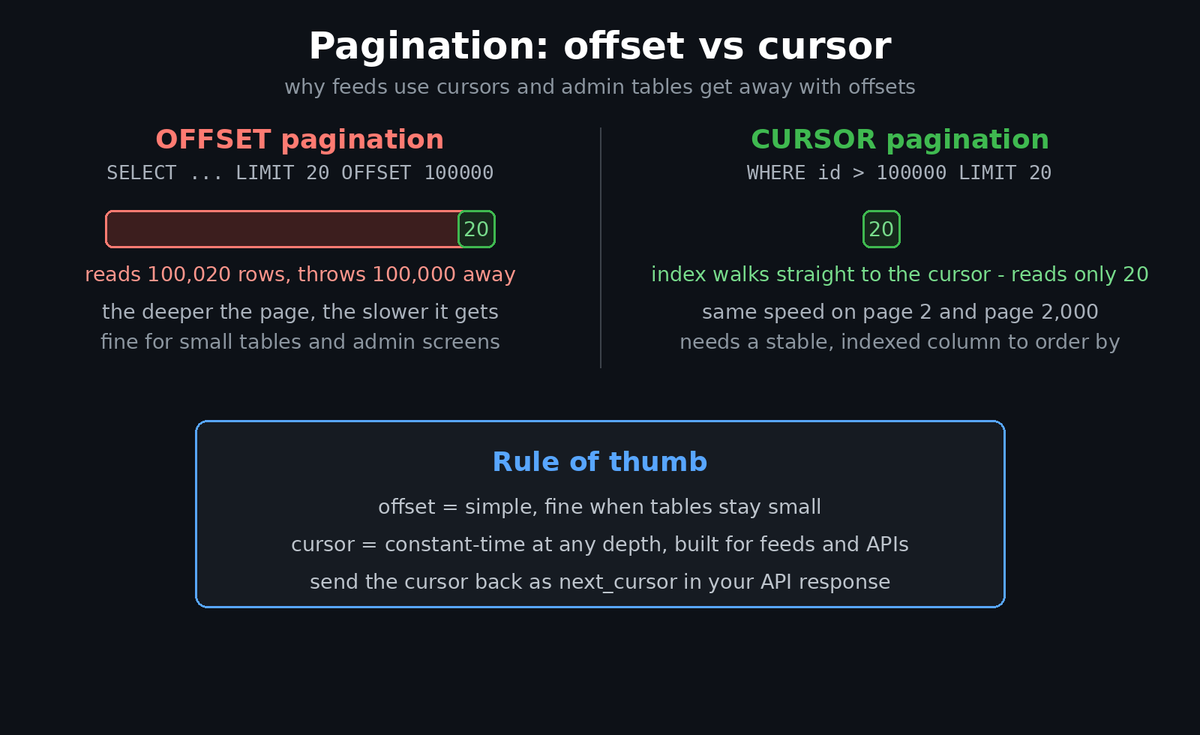
A pagination choice that matters at scale: OFFSET gets slower the deeper you page, because the database still reads the skipped rows. A cursor reads only what it returns. Offset for small admin tables, cursor for feeds.
@imdeepaktimsina The follow-up that surprises people: COUNT(DISTINCT col) also ignores NULLs. And if you ever see COUNT(1), it behaves exactly like COUNT(*) - the 1 is just a constant, not the first column.
@sparrowbrainz MERN with MySQL instead of Mongo for me - Express APIs are boring in the best way, and starting relational saves the migration when the data model grows up. Next.js when the frontend needs SEO.
@sparrowbrainz The AST gate is the right instinct - string matching always leaks. Parsing to an AST also gives you free wins later: query cost estimates and automatic LIMIT injection before anything hits MySQL.
@AliShazil_ One canvas on a sticky stage explains the smoothness. Mapping 1 unit to 1vh of scroll is a neat way to keep scenes proportional, and Lenis on top must make it feel buttery.
@zowhair That is the whole trick - anything that relies on memory gets skipped eventually. A cron job and a log file turn it into a habit instead of a hope.