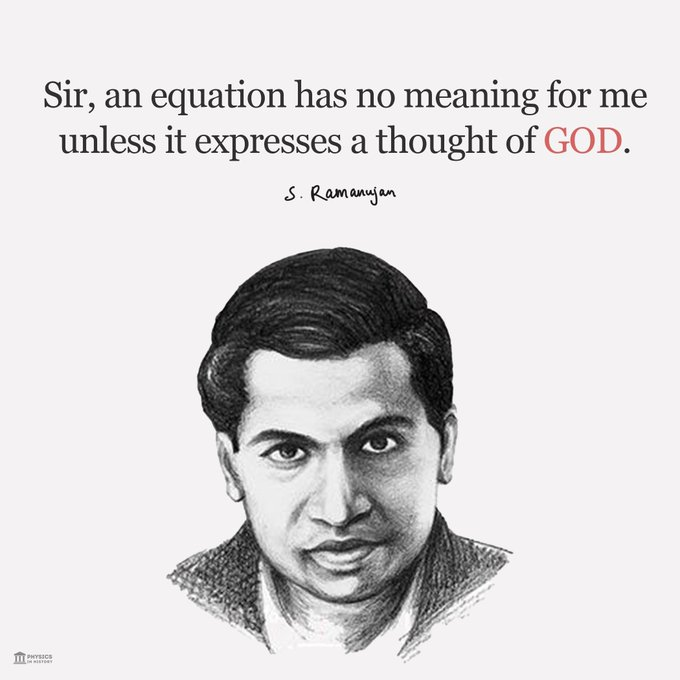
Srinivasa Ramanujan was an observant Hindu, adept at dream interpretation and astrology. Growing up, he learned to worship Namagiri, the Hindu goddess of creativity, who is also known as Namagiri Thayar or Namakkal. She is the consort of Narasimha, an avatar of Vishnu, who is depicted as a lion-headed man. Namagiri is said to bestow wisdom, knowledge, and artistic skills to her devotees.
e often understood mathematics and spirituality as one. He believed that an equation had no meaning unless it revealed the mind of God. He also said that Namagiri would appear in his dreams and place equations on his tongue, which he would later write down when he woke up. Some of these equations were so novel and complex that they baffled his contemporaries and mentors, such as G. H. Hardy. Even today, some of Ramanujan’s discoveries are still being explored and proved by mathematicians and physicists.
Ramanujan’s belief in the Hindu goddess was not a mere superstition or a psychological crutch. It was a source of inspiration and intuition that guided him to explore the hidden patterns and symmetries of the mathematical universe. He saw the divine feminine as the mind beyond the mind, the awakening that happens when awareness is raised to the highest possible state. He also followed the Visishtadvaita philosophy of Sri Ramanuja, which asserts that the individual soul is not separate from the supreme soul, but rather a part of it. Ramanujan’s faith in Namagiri was a manifestation of his non-dualistic worldview, where mathematics and mysticism were intertwined.
82 Grand Slams, 22 Roland-Garros appearances, and still that same desire to play and win.
Bravo @DjokerNole. Paris loves great champions, especially when they know how to dance 🐐
@Hublot
Happy Birthday Novak! 🎉
Wishing you a wonderful day filled with happiness, love, and celebration. May this year bring you continued success at Roland Garros and many more unforgettable moments on the court.
Enjoy your special day, Champion! 🏆🎂
I’ve been harping on the disciplines and tools for using AI lately. I find them to be a very effective approach. But I don’t want to leave you with the impression that a few simple disciplines and tools is sufficient.
As the AI’s build software, you — the software engineer — need to have a good mental model of what the AI is doing. You need to apply engineering insight to correct it when it takes a path you don’t like. You have to be an active manager in the design and architecture of the system. You have to be able to “see within“ without resorting to exhaustive code reviews. You have to form suspicions about what the AI is doing, and you have to probe and experiment to verify your suspicions.
1. Event Horizon: Represented by the red circle, this boundary marks the region around a black hole beyond which no information or matter can escape to the outside universe. It defines the limits of the black hole’s influence.
2. Singularity: Denoted by the central blue dot, the singularity represents the theoretical point of infinite density and gravitational pull within the black hole. All matter and energy drawn into the black hole ultimately collapse into this point.
3. Time: Indicated by the upward arrow, it highlights that within the event horizon, time inexorably moves towards the singularity. Any object crossing the event horizon follows this arrow's direction, unable to avoid eventual collision with the singularity.
4. Space: Represented by the downward arrow, it signifies how, within the event horizon, spatial dimensions become distorted. Movement within this region is no longer free in the usual sense but is inevitably directed towards the singularity.
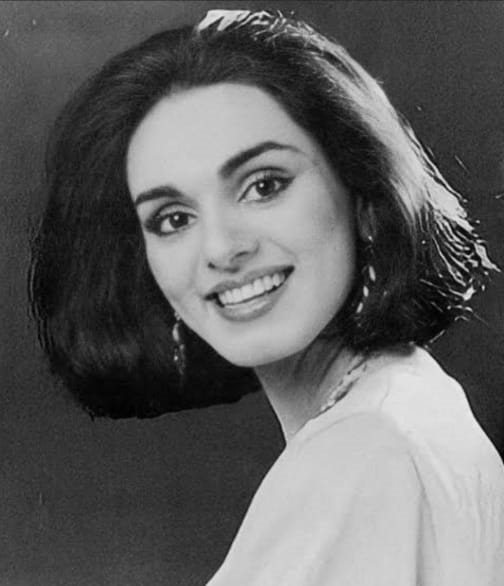
She was 22 years old, standing at an open airplane door with bullets flying—and she made a choice that would save 359 lives, but not her own.
September 5, 1986. Pan Am Flight 73 touches down in Karachi for a routine refueling stop. Passengers settle in. Children doze. No one suspects what's coming.
Then, in seconds, four armed men storm the aircraft. Screams. Chaos. Terror.
At the front of the cabin stands Neerja Bhanot, a 22-year-old flight purser with a warm smile and steady hands. In that instant, she could have frozen. She could have run. Instead, she acted.
She immediately alerted the cockpit crew, giving the pilots precious seconds to escape through an overhead hatch. That single act ensured the hijackers couldn't fly the plane to another country or crash it deliberately. Hundreds of lives were already saved—and the ordeal had just begun.
For 17 agonizing hours, Neerja became the calm in the storm. She moved through the aisles with quiet courage, hiding American passports so passengers wouldn't be singled out for execution. She cradled crying children, whispered reassurances to terrified families, and stood as a human barrier between the gunmen and the innocent.
She never thought of herself. Not once.
As night fell, the plane lost power. In the darkness, panic ignited. The hijackers opened fire.
Neerja was stationed at an emergency exit. The door was open. Freedom was right there. One step, and she'd be safe.
But as passengers rushed toward her, she didn't move. She stayed. She threw open the doors wider, pushing people out, shielding them with her body. And when three children stood frozen in fear, unable to move, Neerja did the unthinkable.
She covered them with her own body.
The bullets came. She took them. All of them.
Neerja Bhanot did not survive that night. But because of her, 359 others did.
Today, her name is spoken with reverence across the world. She was posthumously awarded India's highest peacetime bravery honor. A Bollywood film was made in her memory. Airlines train crew members using her example.
But more than awards or movies, Neerja's legacy lives in a simple, staggering truth: when faced with the ultimate choice—her life or theirs—she chose theirs. Without hesitation. Without doubt.
A 22-year-old woman who became immortal the moment she decided that strangers were worth dying for.
Heroism isn't always loud. Sometimes, it's a young woman standing at an exit, whispering, "Go. I've got you."
And then staying behind.
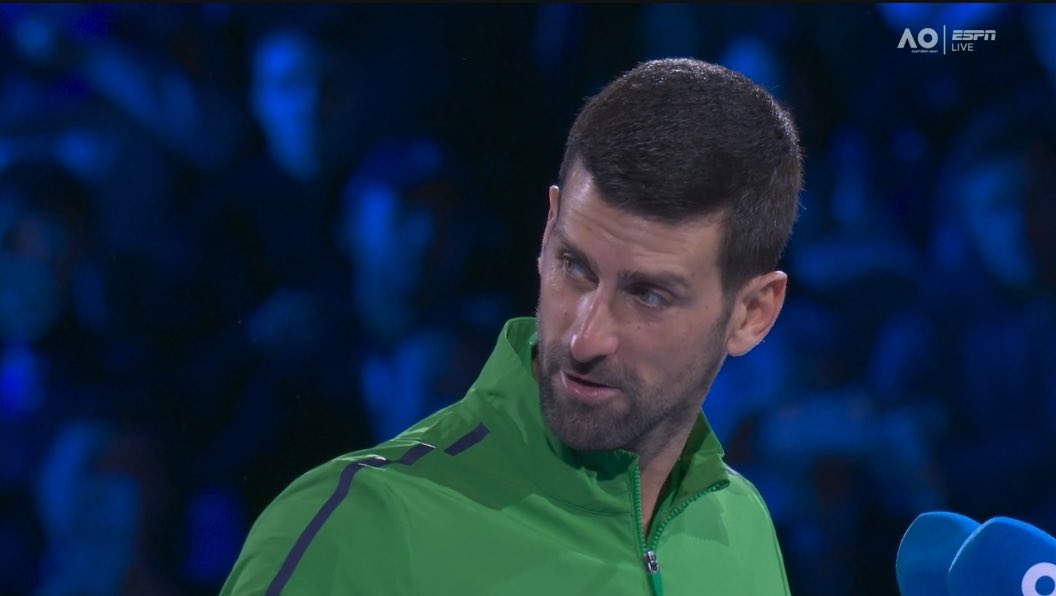
Novak Djokovic after losing to Carlos Alcaraz in the Australian Open final
“First and foremost of course congratulations Carlos. Amazing tournament… To your coach and to your family and your team.. what you’ve been doing.. the best word to describe it is historic, legendary.. so congratulations. I wish you best of luck for the rest of your career. You’re so young. You have a lot of time, like myself. I’m sure we’ll be seeing each other many times in the next 10 years” 😭😭😭😭