Elon Musk: “I don’t trust OpenAI, I started that Company as a nonprofit open source, I named the company OpenAI as open source now it’s extremely closed source maximizing profit
I don’t trust Sam Altman, I don’t think we wanna have the most powerful AI in the World controlled by someone who isn’t trustworthy”
You can really see someone’s level of thinking by the way they prompt.
Especially in a time when solutions have become instantaneous through AI, and the emptiness in cognition cannot be ignored.
More people should share their prompts , rather than solutions.
The peak years for startups much dependent on content have pased, they won't have postioning this is prevalent in the AI-era.
Question to answer:
"why should I sign up for this platform when I can just prompt?"
There will always be an interception.
https://t.co/F0CzYESVdk
This is INSANE, Anthropic ran its marketing with basically one person.
Austin lau, a non-technical growth lead, was running paid search, paid social, email, and seo solo.
Here’s the workflow:
> export ad CSVs into Claude Code
> AI flags underperforming ads
> agents generate new headlines + descriptions
> Figma auto-swaps copy across 100 ad templates
> MCP server pulls live Meta data
The results:
> ad creation went from 2 hours to 15 minutes.
> total marketing output grew 10×.
> conversion rates landed 41% above industry average.
One person doing what used to take an entire marketing team.
Edtech isn’t a bubble.
It boils down to what people gain: skills + community
held together by the story.
Where do you fit?
What are you becoming?
That’s why brands like Harvard or Apple work.
Where people see themselves in the narrative.
Most computer science programs give you content.
Some give you community.
@icamp is built on a different story:
You don’t just become an engineer.
You learn to think in systems.
Personalized across the globe,
regardless of your background.
Here is an interesting use case:
What if every AI output was audited, and stored on-chain?
Blockchain records.
AI verifies.
No edits. No black boxes.
From healthcare to finance, every decision becomes traceable.
Not only logging systems.
Rather, auditing intelligence itself.
AI is consolidating the market right now. Everything else, including blockchain, AR/VR, quantum, and mechatronics, is being pushed to the future. https://t.co/uvDFJXtrNf
Today, the Algorand Foundation made the difficult decision to reduce our workforce by 25%. This decision was not taken lightly and is in response to the uncertain global macro environment as well as the broader downturn in crypto markets.
These employees have been best-in-class contributors to this ecosystem and to the Foundation, and this was an incredibly tough decision. We are sincerely grateful to them, and we are, of course, committed to supporting them through this transition.
We believe that we now have a more sustainable alignment of Algorand Foundation resources with the protocol’s long-term business, technology, and ecosystem priorities. We remain fully focused on our mission of financial empowerment and the continued development and growth of the Algorand protocol, network, and ecosystem.
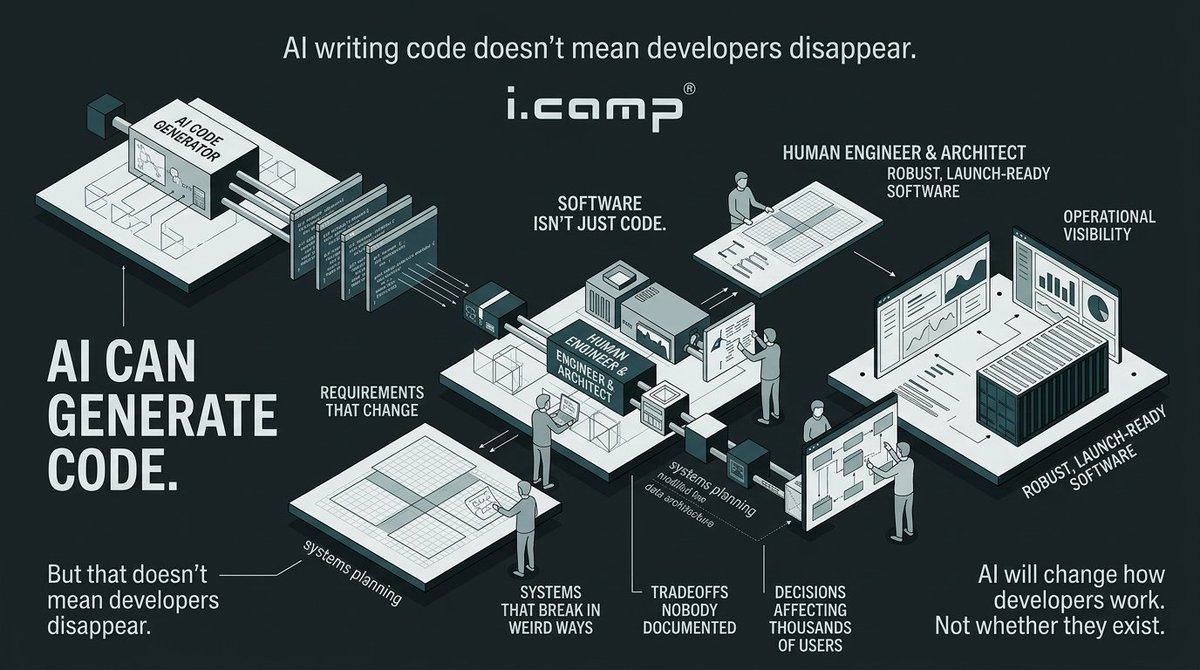
AI writing code doesn’t mean developers disappear.
AI can generate code.
That doesn’t mean developers disappear.
Software isn’t just code.
It’s requirements that change.
Systems that break in weird ways.
Tradeoffs nobody documented.
Decisions that affect thousands of users.
This is the kind of reality @icamp tries to prepare developers for.
AI will change how developers work.
Not whether they exist.
Who remembers Devin?
Weren’t all the software engineers supposed to be gone by now?
At @icamp, there’s discussions about what AI actually changes in computer science, and what it doesn’t.