CyberSec enthusiast | Aspiring Network Security Engineer 🕵️♂️ | Decrypting networks one packet at a time | Sharing bytes of knowledge, news, memes & musings.
👋 Hello & Welcome! I'm an aspiring Network Security Engineer documenting my entire journey from beginner to professional. No gatekeeping, just learning in public.
My mission is to achieve mastery in network and security fundamentals, integrate automation principles into daily tasks, and contribute to the future of network design in the age of Cloud ☁️ and AI 🤖.
On this feed, you can expect:
🔹 Clear explanations of core concepts (OSI, Subnetting, Routing etc...).
🔹 Home Lab builds & configuration troubleshooting.
🔹 Insights into the future of network management and design.
🔹 Honest struggles and lessons learned along the way.
If you are a beginner, let's learn together.
If you are an expert, your advice is gold.
Hit the Follow button 😃 and let me know your favorite networking command below! 👇
🚩 TCP Flags Explained Simply 👇
TCP communication isn’t just “sending data.”
These small flags control how connections are started, maintained, and closed across the network.
🔹 SYN (Synchronize)
Starts a TCP connection.
Used during the famous TCP 3-way handshake.
🔹 ACK (Acknowledgment)
Confirms that data was received successfully.
This is one of the main reasons TCP is reliable.
🔹 FIN (Finish)
Gracefully closes a connection once communication is complete.
🔹 RST (Reset)
Immediately terminates a connection when something goes wrong or the session becomes invalid.
🔹 PSH (Push)
Tells the receiver to deliver the data to the application immediately instead of waiting.
🔹 URG (Urgent)
Marks certain data as urgent so it gets prioritized.
Rarely used in modern networking.
🧠 Simple way to remember:
SYN → Start connection
ACK → Acknowledge data
FIN → Finish connection
RST → Reset connection
These tiny control bits are what make TCP communication:
✅ Reliable
✅ Ordered
✅ Connection-oriented
Without TCP flags, devices wouldn’t know when to connect, acknowledge, or disconnect properly.
Small fields. Massive importance. 🌐
Do follow for more such interesting concepts. 😃
#Networking #TCP #ComputerNetworks #CCNA #LearningInPublic
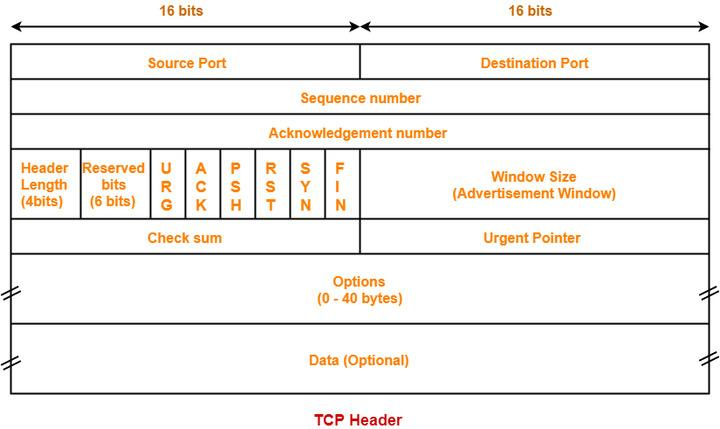
📦 The TCP header is small… but it controls almost everything in a TCP connection.
🔹 Source & Destination Ports
Help data reach the correct application
(Browser, SSH, HTTPS, etc.)
🔹 Sequence Number
Keeps packets in the correct order.
🔹 Acknowledgment Number
Confirms which data was received successfully.
🔹 Flags (SYN, ACK, FIN, RST)
Control the entire connection:
• SYN → Start
• ACK → Confirm
• FIN → Close
• RST → Reset
🔹 Window Size
Controls how much data can be sent before waiting for acknowledgment.
🔹 Checksum
Detects corrupted packets during transmission.
🔹 Options Field
Used for advanced features like MSS and window scaling.
And finally👇
📄 Payload/Data → the actual information being transmitted.
The payload is only one part of the packet ,
the TCP header is what makes communication reliable.
Without it:
❌ No ordering
❌ No acknowledgments
❌ No flow control
❌ No reliable communication
Tiny header.
Massive responsibility. 🌐
Do follow for more such interesting concepts. 😃
#Networking #TCP #ComputerNetworks #LearningInPublic #ITBasics
WebRTC uses a technique called NAT traversal.
Even though devices are behind private IPs, they first contact public STUN/TURN servers to discover their public-facing IP and port mappings created by NAT.
If possible, they establish a direct peer-to-peer connection using those mappings (UDP hole punching).
If direct communication fails because of strict NAT/firewalls, traffic is relayed through a TURN server.
So NAT normally hides private devices, but WebRTC uses NAT traversal techniques to temporarily create a communication path between them.
🤔 If the real world uses TCP/IP… why do we even study the OSI model?
Because the OSI model isn’t really about protocols.
It’s about understanding how communication is divided into layers.
TCP/IP is what the internet uses.
OSI is what helps humans understand it.
The OSI model gives networking a structured way to think:
🔹 Which layer handles routing?
🔹 Which layer deals with MAC addresses?
🔹 Where does encryption happen?
🔹 Why can ping work but a website still fail?
Without layers, troubleshooting becomes chaos.
That’s why even today:
• Engineers
• Security analysts
• Network admins
• SOC teams
still use the OSI model mentally while troubleshooting problems.
It turns a huge, complex network into smaller understandable pieces.
TCP/IP runs the internet.
OSI explains the internet.
That’s why the OSI model still matters. 🌐
Do follow for more such interesting concepts. 😃
#Networking #OSIModel #TCPIP #ITBasics #LearningInPublic
Huge Anthropic leak just dropped: the entire Claude Code CLI source is now public.
A misconfigured .map file in their npm package exposed a direct download link to the full unobfuscated TypeScript codebase from Anthropic’s own R2 bucket.
Discovered by Chaofan Shou (@Fried_rice), the dump is massive 1,900 files, 512,000+ lines including the complete tool system, 50+ slash commands, multi-agent coordinator, React/Ink terminal UI, IDE bridge, permission engine, and several unreleased features.
Full repo is live on GitHub(@nichxbt ):
https://t.co/BLxqDmwsB0
Clean mirrors are already up for easy browsing(@baanditeagle):
https://t.co/BN007COQzi
https://t.co/DYSytIEKZ4
It’s spreading fast, the entire dev community is already tearing through it.
🧠 VLAN ranges made simple (don’t memorize blindly)
All VLANs are not the same - they’re divided into ranges 👇
🔹 Normal Range VLANs (1–1005)
Used in most networks
Stored in VLAN database (vlan.dat)
VLAN 1 is default (used for management)
🔹 Extended Range VLANs (1006–4094)
Used in larger / enterprise networks
Configured in running config
More flexible, but requires proper setup
🔹 Reserved VLANs
• VLAN 0 → Priority tagging
• VLAN 1 → Default VLAN
• VLAN 4095 → Reserved
🧠 Simple takeaway:
1–1005 → Common & default
1006–4094 → Extended & scalable
VLANs aren’t just numbers , they’re part of how networks are organized and controlled.
Once you understand the ranges, configuration becomes much clearer. 🌐
Do follow for more such interesting concepts. 😃
#Networking #VLAN #CCNA #Switching #LearningInPublic