10 numbers every investor should know by heart:
6.9%
Real annualised return of stocks over 200 years. After inflation.
72
Divide by your return rate = years to double your money.
At 8%: 9 years. At 12%: 6 years.
40%
Of your total long-term stock return comes from reinvested dividends.
Spend them instead and you burn 40% of your compounding engine.
2%
Average annual inflation.
Over 30 years it cuts your cash’s purchasing power in half.
Over 50 years it destroys 73% of it.
10
The number of best trading days per year.
Miss them over 20 years and you lose half your returns.
Most fell during bear markets.
0.98
Correlation between S&P 500 and earnings growth over 30 years.
In the short term, sentiment rules.
In the long term, fundamentals always win.
4%
Safe withdrawal rate in retirement.
Historically lasts 30+ years without running out.
−14%
Average intra-year drawdown of the S&P 500.
Every year. Normal. Expected. Ignore it.
+36.4%
Average S&P 500 return in the 12 months after a midterm election year bottom.
The most reliable seasonal pattern in markets.
100%
Percentage of 20-year rolling periods that delivered positive real returns.
Every single one. In 150 years of data.
Save these.
They are worth more than most financial advice you will ever pay for.
"85% accuracy on Wall Street will get you 100% fired."
Brett Caughran (@FundamentEdge) has managed analysts at Citadel, D.E. Shaw & tiger cub funds.
His take on AI and the future of junior analysts:
"There's almost no better time to be starting a career as a fundamental investor. These tools let junior investors get to the juicy part of the investment process more quickly."
We cover:
- Why the junior analyst role is transforming faster than any point in the last 20 years — and why the juniors who adapt will reach the real work of investing years sooner
- The old grunt work that's already dead — and what's replacing it
- Why billion-dollar funds won't cut analyst headcount, but the job description is changing dramatically
- “Should I still learn Excel modeling?" — yes, because you can't debug what you don't understand
- Why creativity & tenacity are becoming the new differentiators over raw quantitative skill
- How multi-manager alpha factories scaled from $10B to $60B+ while sustaining double-digit returns — proof that more information hasn't compressed alpha
- Why reading a 10-K with pen and paper still matters even when AI can summarize it in seconds
- The most underrated skill in the best investors he's worked with: genuine curiosity
Thanks so much to Brett (@FundamentEdge) for coming on Odds on Open!
Highlights:
00:00 Intro
01:29 Frameworks for developing a differentiated variant perception
05:16 Financial drivers vs. narrative cycles: The Focus 5 framework
08:29 Analyzing the stock vs. business: Bayesian updating in public markets
12:52 AI as an intellectual power tool vs. consensus "alpha slop"
17:21 Accelerating the hunch-to-hypothesis pipeline with AI sniff tests
21:52 The evolution of junior analysts: From data entry to primary research
28:46 Why market microstructure and behavioral alpha prevent index efficiency
38:44 Training junior analysts: Earning the right to use power tools
48:28 LLMs as orchestration tools for human primary research
54:55 Teachable scientific process vs. revealed investment judgment
57:54 Common threads across Multi-Managers, Single Managers, and Tiger Cubs
59:49 Curiosity as a meta-skill and the art of system thinking
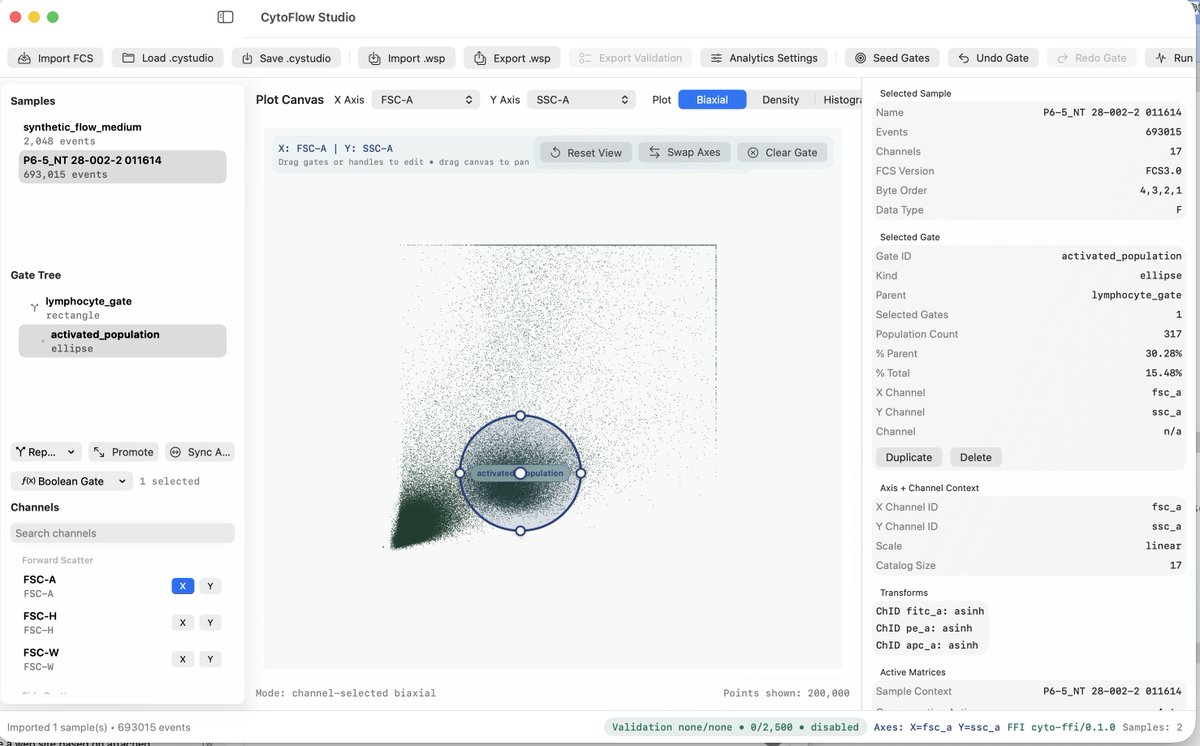
In just two days, using OpenAI Codex app GPT-5.4, I created a fully functional flow cytometry data analysis software, ~20,000 lines of code from scratch! This is a highly sophisticated and specialized biology software tool that every immunologist relies on. The best part is that I can continuously improve it and add new features that are not even available in comparable commercial software, which can cost thousands of dollars per user!
For those not familiar with what flow cytometry software is, here is the detailed explanation from Grok:
Flow cytometry analysis software is like a super-smart graphing calculator for biologists and doctors who study cells.
What the machine does firstImagine you have a sample of blood or tissue with millions of cells. The flow cytometer machine lines the cells up single-file like cars on a highway and shoots lasers at each one as it zooms by (thousands of cells per second). The lasers tell the machine things like:How big is the cell?
How “grainy” or complicated is it inside?
Does it have certain “flags” (proteins) stuck on it? (These flags light up in different colors, like red, green, purple tags.)
The machine spits out a huge computer file full of raw numbers — no pictures, just data.
What the software is forThe analysis software takes that messy pile of numbers and turns it into clear pictures and answers you can actually understand. Think of it as the “translator” or “artist” that draws the story from the data.With a few clicks you can see:Colorful dot plots or graphs that show different groups of cells (like “these blue dots are healthy immune cells, these red dots are cancer cells”).
Exactly what percentage of the cells are a certain type (e.g., “78% of the cells in this blood sample are fighting the infection”).
How strongly a cell is “glowing” with a certain color tag (which tells you how much of a protein it’s making).
Side-by-side comparisons of a patient’s sample before and after treatment.
The magic trick scientists use every dayThe most common thing they do is called “gating.” It’s like drawing a circle around a group of similar dots on the graph and saying, “Only look at these cells.” The software instantly counts everything inside that circle and gives you the numbers. You can keep drawing smaller and smaller circles to zoom in on very specific cell types — kind of like zooming into a crowd photo until you only see people wearing red hats and glasses.
It is hard to communicate how much programming has changed due to AI in the last 2 months: not gradually and over time in the "progress as usual" way, but specifically this last December. There are a number of asterisks but imo coding agents basically didn’t work before December and basically work since - the models have significantly higher quality, long-term coherence and tenacity and they can power through large and long tasks, well past enough that it is extremely disruptive to the default programming workflow.
Just to give an example, over the weekend I was building a local video analysis dashboard for the cameras of my home so I wrote: “Here is the local IP and username/password of my DGX Spark. Log in, set up ssh keys, set up vLLM, download and bench Qwen3-VL, set up a server endpoint to inference videos, a basic web ui dashboard, test everything, set it up with systemd, record memory notes for yourself and write up a markdown report for me”. The agent went off for ~30 minutes, ran into multiple issues, researched solutions online, resolved them one by one, wrote the code, tested it, debugged it, set up the services, and came back with the report and it was just done. I didn’t touch anything. All of this could easily have been a weekend project just 3 months ago but today it’s something you kick off and forget about for 30 minutes.
As a result, programming is becoming unrecognizable. You’re not typing computer code into an editor like the way things were since computers were invented, that era is over. You're spinning up AI agents, giving them tasks *in English* and managing and reviewing their work in parallel. The biggest prize is in figuring out how you can keep ascending the layers of abstraction to set up long-running orchestrator Claws with all of the right tools, memory and instructions that productively manage multiple parallel Code instances for you. The leverage achievable via top tier "agentic engineering" feels very high right now.
It’s not perfect, it needs high-level direction, judgement, taste, oversight, iteration and hints and ideas. It works a lot better in some scenarios than others (e.g. especially for tasks that are well-specified and where you can verify/test functionality). The key is to build intuition to decompose the task just right to hand off the parts that work and help out around the edges. But imo, this is nowhere near "business as usual" time in software.
The belief that AI agents will be “usable by everyone” is a cognitive mirage—like believing money printing can make everyone rich. Yes they’ll be widely accessible, but their real power extends far beyond that.