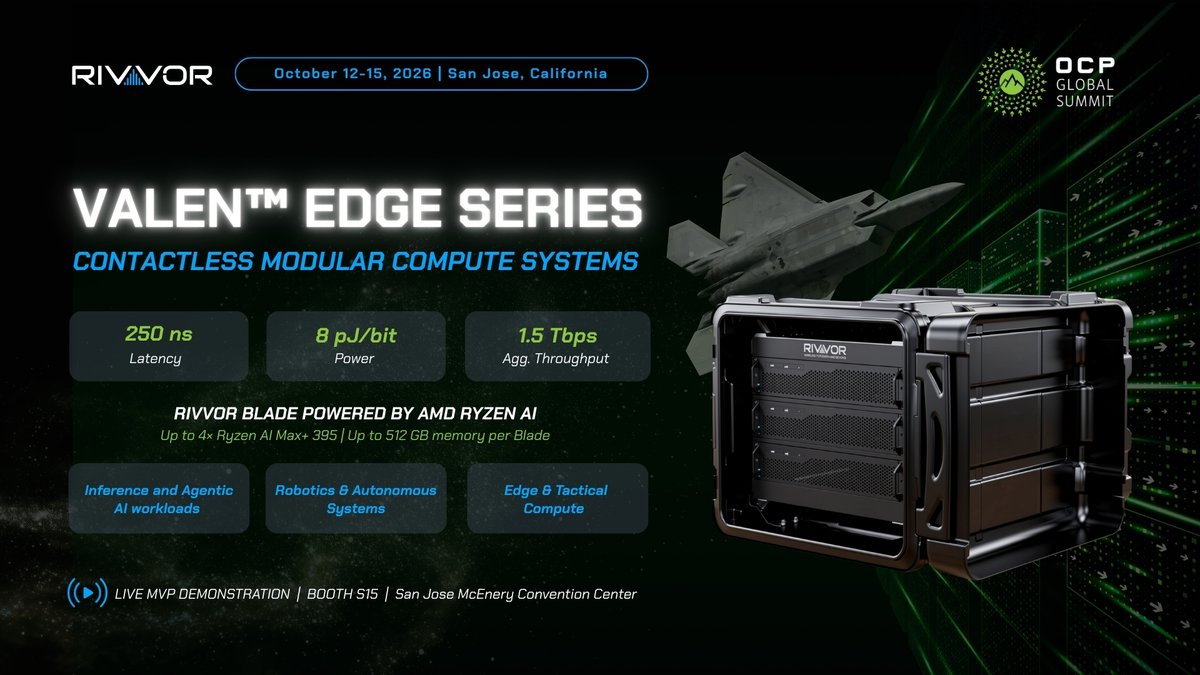
@AuraConvexity Current system: 8 pj/bit; ASIC: under 5 pj/bit.
We also beat them on weight, installation, serviceability, and dependability, and our technology was proposed as an additional fabric to combat tail latency that overwhelms leaf switches.
@OptionKing666 The InP substrate constraint compounds at cluster scale. Each rack-to-rack hop adds die area, cooling, and insertion loss. Cable density at that scale makes CPO harder than it appears. Sub-THz wireless fabric avoids that constraint entirely.
@AuraConvexity GloFo's SiPh backlog through 2027 reflects real AI-driven demand. The supply cliff also signals that photonic approaches face fabrication constraints at scale. Wireless sub-THz fabric sidesteps that bottleneck entirely.
@MRchen881 Moving KV cache to CXL-attached SSDs is a reasonable trade for context storage. The design question is what that path looks like in terms of tail latency at scale. SSDs are fast but HBM they are not.
@lightcoredc 1,400W per chip compounds fast. A dense rack of B300s means every passive element counts. The cable mass alone disrupts airflow in ways that become visible at high density.
@arnaudmercier The paper optimizes for power delivery efficiency. The harder problem at scale is what the cable plant does to airflow. At high rack density, the physical mass of copper cables is a thermal constraint most models don't account for.
@OptionKing666 NVL72 shipment acceleration validates rack-scale GPU density as the dominant AI compute architecture. The interconnect fabric required to sustain 1.8 TB/s crossbar performance at this density is where cable-free solutions become operationally advantaged.
@shzhv13 The scheduler sees the logical topology, not the physical one. What routing software can do is bounded by the physical interconnect underneath. If two GPUs are three hops apart, no scheduler can change that.
@TheValueist 1.6 Terabit client-side optics for scale-out is a meaningful signal. At those port densities, the cable plant becomes a first-order constraint. Rivvor's sub-THz wireless fabric eliminates that physical layer entirely for rack-to-rack connectivity.
@getinfotoyou The latency sensitivity in distributed training is real. Microsecond all-reduce requirements set a hard floor on interconnect latency. Sub-THz wireless fabric achieves comparable physical-layer latency to NVLink while eliminating cable plant constraints at rack scale.
@OptionKing666@f4bess The die size multiplier compounds when scaling CPO across a full rack. At 3-5x substrate area per port, mechanical and thermal constraints become fundamental, not just cost issues. That is precisely where the cable density problem in optical architectures hits hardest.
@carrioresearch The move to cross-rack memory makes sense. Single-rack HBM is already a constraint for large-context jobs. The interesting question at SC26 will be what the coherency overhead looks like across optical links at real AI workload scales.
Orbit is the best stress test for compute design we have. No grid. No cable crew. No tolerating downtime for a firmware push. If your system can't survive being designed that way, it probably has debt it hasn't paid yet. Defense figured this out. Data centers are starting to.
The assumption that rack topology is fixed after installation isn't a law of physics. It's an artifact of how expensive copper deployment is. If the connection isn't mechanical, you can reassign bandwidth as workloads shift. We've been building around a constraint that doesn't have to exist.
@NVIDIAAIInfra When the memory fabric and the compute fabric converge at rack scale, the interconnect becomes the whole story. NVLink Fusion expanding to NVHBM is a data point, not an endpoint. The real question is how far this architecture scales before the physics say otherwise.
@cerebras Yield at wafer scale is a routing problem as much as a manufacturing one. The redundancy fabric has to remap compute around defects without introducing variable latency. Cerebras has been solving this for years. The rest of the industry is just now taking it seriously.
@sssjeffpu 5GW of space compute by 2028 assumes the power generation side keeps up. The constraint is not the GPU, it's thermal rejection in orbit. Radiative cooling scales differently than terrestrial liquid cooling.
@SemiAnalysis_ Eliminating active cable cartridges at this density is a serious reliability win. Active copper at scale is a maintenance story, not just a cost story. The 84-layer PCB midplane doing passive signal distribution is a different architecture assumption entirely.