The man, the myth, the legend - Nimsdai didn’t just break records, he rewrote the rules of an entire industry, and his legacy will live on in every Nepali climber and altitude worker who now stands at the front instead of the back. Rest in peace, #Nimsdai.
Om Mane Padme Hum
India will host this year’s annual Indo-Japanese summit with a notable departure from tradition. Rather than meeting in New Delhi or Mumbai, Japanese Prime Minister Sanae Takaichi will travel to Assam early next month, accompanied by leaders of dozens of Japanese firms. The choice of the northeastern Indian state underscores both Tokyo’s interest in Assam’s largely untapped economic potential and Modi’s ambition to turn the state into an industrial and logistics gateway to Southeast Asia. https://t.co/05jByXD3kb
The West poured $50 billion into fast breeder nuclear reactors and abandoned every single one. India poured $900 million and just achieved criticality on the first commercially viable one outside Russia.
The US spent $15 billion. Gave up. Japan spent $12 billion. Their Monju prototype had one sodium fire in 1995 and never recovered. The UK spent $8 billion. Germany spent $6 billion. France, Italy, all walked away. Six of the richest nations on Earth concluded this technology was too hard and too expensive to pursue.
India started building in 2004 with an initial budget of $420 million. Twenty-two years, a dozen missed deadlines, and a cost doubling later, the Prototype Fast Breeder Reactor at Kalpakkam just sustained a controlled fission chain reaction. The reactor is now alive.
The reason India never quit is a constraint most people have never thought about. India has only 1-2% of the world's uranium reserves. For a country of 1.4 billion people trying to build energy independence, that's a death sentence if you're running conventional nuclear.
But India has 25% of the world's thorium. The single largest national reserve on Earth.
The problem: you can't just burn thorium the way you burn uranium. A physicist named Homi Bhabha designed a three-stage nuclear program in the 1950s specifically to solve this. Stage 1: burn natural uranium in heavy water reactors, collect plutonium as a byproduct. Stage 2: feed that plutonium into fast breeder reactors, where it breeds MORE plutonium AND converts thorium into fissile uranium-233. Stage 3: burn thorium directly at scale.
India just entered Stage 2. Seventy years after Bhabha drew it up on paper.
The math on the thorium endgame is wild. At current energy consumption rates, India's thorium reserves could power the country for over 700 years. Most nuclear nations are playing a uranium game with maybe 80-100 years of runway. India is playing a completely different game with a 7x longer fuel supply.
The West quit because uranium stayed cheap and sodium coolant is terrifying. It catches fire on contact with air. It explodes on contact with water. Russia's BN-600 had 27 sodium leaks and 14 sodium fires between 1980 and 1997. And Russia kept going anyway because Russia doesn't quit nuclear projects. India watched all of that and kept going too.
When you have 1% of the uranium but 25% of the thorium, the engineering difficulty stops being a reason to quit. It becomes the price of admission to a 700-year energy supply that nobody else can access.
Harvard University, to their eternal glory, has provided online recordings of hundreds of authors who have graced their stages over the past century.
We are talking Siegfried Sassoon (!), Dylan Thomas, W.H. Auden, E.M. Forster, and more.
Dive in!
https://t.co/MCxyF6RMev
India spent $24 billion on infrastructure in 2014. This year’s budget: $129 billion. Next year: $143 billion.
The speed is hard to picture. India is building 34 km of new highway every day, up from 12 km/day in 2014. Our highway network has grown 60%, from 91,000 km to 146,000 km. We want to hit 100 km per day. Metro rail has gone from 248 km to over 1,000 km.
I think energy is where the story gets under appreciated. On July 29, 2025, renewables powered 51.5% of India’s entire electricity demand for the first time. That was our COP26 climate pledge target for 2030. We hit it five years early.
Solar capacity was barely 3 GW a decade ago. Today, it’s past 140 GW, making India the world’s third-largest solar power producer. We added 38 GW of solar in 2025 alone, with 42.5 GW projected for 2026. Our domestic solar panel manufacturing capacity went from 38 GW to 144 GW in two years.
Total installed power capacity crossed 500 GW in September 2025. More than half now comes from non-fossil sources. And we’re building the world’s largest hybrid renewable energy park in Gujarat’s Khavda desert: 30 GW across 726 square kilometers of wasteland.
Nuclear is the next chapter. Current capacity is about 8 GW. The target is 100 GW by 2047. In December 2025, India passed a law allowing private companies to enter the nuclear power sector for the first time. Six major firms (Reliance, Tata, Adani, and others) have already submitted proposals for small modular reactor sites, basically smaller factory-built nuclear plants, across 16 locations. The government committed $2.4 billion to develop five indigenous designs by 2033.
Total infrastructure spend through 2030: $1.7 trillion. More than double what India spent in the previous seven years. Morgan Stanley projects infrastructure investment will climb from 5.3% to 6.5% of GDP by FY29.
Coal still runs about half the grid, and another 80 GW of coal capacity is planned. But the trajectory is clear. India is running the same infrastructure playbook China ran two decades ago, and the pace is accelerating each year.
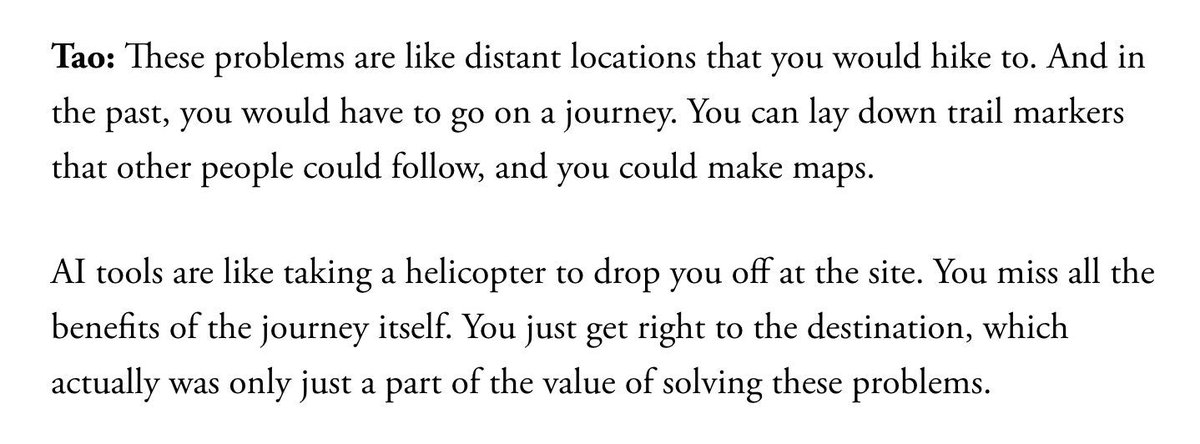
I love this metaphor from Terence Tao—widely considered the world’s greatest living mathematician—about one of the drawbacks of using AI to solve hard math problems. https://t.co/qOVNhfa2cC