pulmonary and critical care physician; medical administrator; end of life care advocate ; poetry and music; believer in the universal spirit that includes all
Dear friends, as promised, the citizens funded generics vs. branded drugs project is now published after 4 months in peer review. It was hardwork, but worth the effort because all of you helped us realize this important work.
You can read the full detaild paper here: https://t.co/jZhm8ZcPCq
Here is a simplified summary:
Do cheaper generic medicines work as well as expensive branded ones? It's a question that worries patients and even many doctors, who often quietly assume that a low price must mean lower quality. This doubt has real consequences in India, where medicines make up nearly two-thirds of what families spend out of their own pockets on healthcare — a burden that pushes millions into poverty and forces people to split doses or stop treatment altogether.
To put the question to a fair, independent test, our team at the Mission for Ethics and Science in Healthcare (MESH) carried out a fully citizen-funded study, paid for entirely by donations from ordinary members of the public, with no money or influence from any drug company.
We bought 131 samples of 22 commonly used medicines — covering heart disease, diabetes, infections, pain, acidity, and more — from seven different kinds of outlets across Kerala, including government stores like Jan Aushadhi, private generic chains, and premium branded pharmacies. Every sample was then coded, blinded, and sent to a top accredited laboratory for rigorous testing against the Indian Pharmacopoeia 2022 standards. What makes this study unusual is that very few before it have tested branded and generic versions from the same market side by side, included government-supplied medicines, and combined strict quality testing with a hard look at price — all at the same time.
The result was striking in its simplicity: every single one of the 131 medicines passed every quality test. 100%. It made no difference whether a pill was generic or branded, cheap or expensive — they were all equally good in their active ingredient content, their purity, and how they dissolve in the body.
Yet the prices told a completely different story. Generic medicines were, on average, 48.6% cheaper than their branded twins, and the most expensive brand cost up to 13.9 times more than the cheapest generic of the very same drug. Government Jan Aushadhi stores were the cheapest source for 18 of the 22 medicines tested, with potential savings running into thousands of rupees a year per medicine — for instance, over ₹16,000 a year on a single liver drug.
For doctors, this is reassuring, hard evidence that prescribing a quality-assured generic is not a compromise on care; it is the same medicine at a fraction of the cost. For patients, it means you can stay on your treatment without it draining your savings, which is exactly what keeps people healthier over the long run.
And this is precisely why independent, publicly funded projects like this matter so much for the future of healthcare in India: they answer the questions ordinary people actually have, free from commercial pressure, and they build the trust that programmes like Jan Aushadhi need to truly succeed. Affordable and high-quality are not opposites — in a well-regulated market, they go hand in hand.
More here: https://t.co/jZhm8ZcPCq
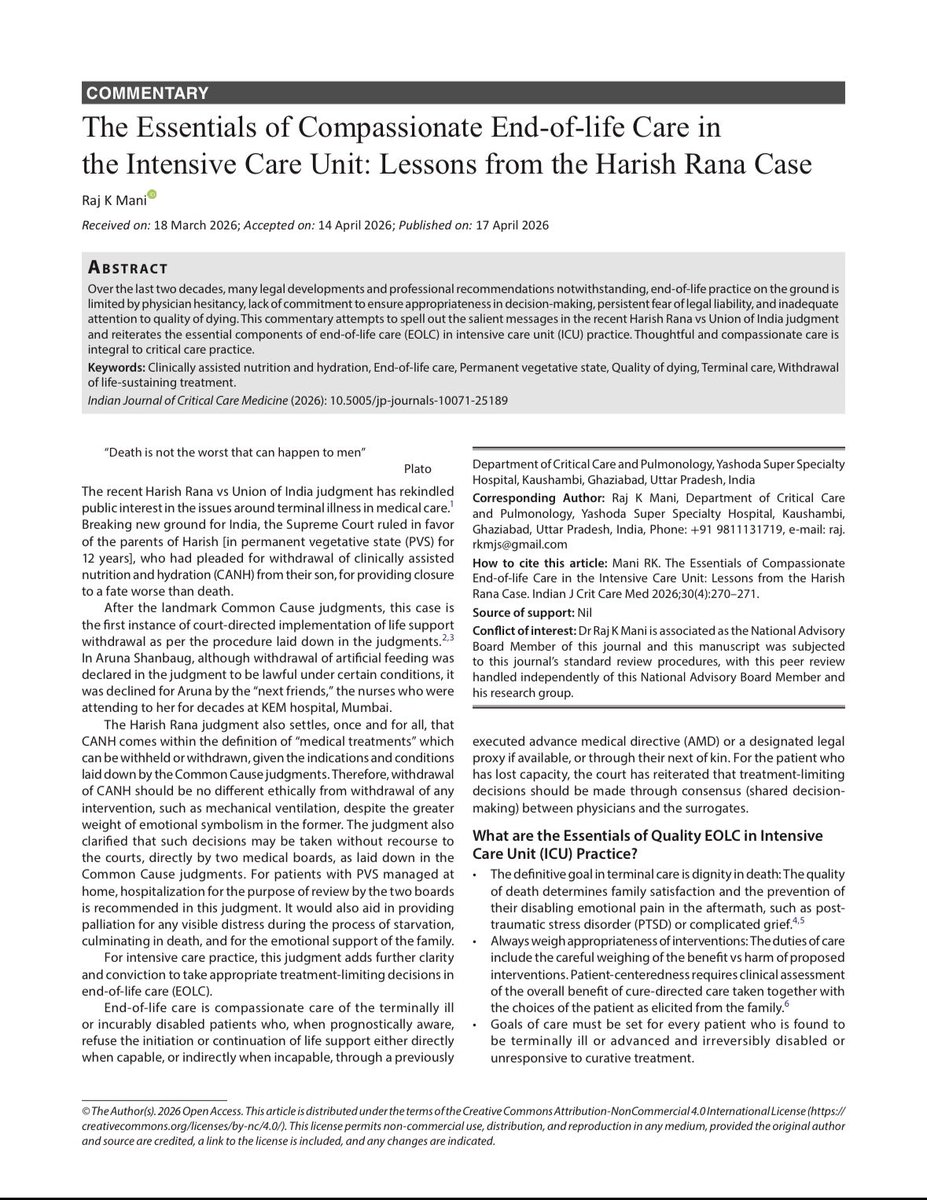
how to practice compassionate care of the dying on the ground in the ICU :
Mani RK. The Essentials of Compassionate End-of-life Care in the Intensive Care Unit: Lessons from the Harish Rana Case. Indian J Crit Care Med 2026; 30 (4):270-271.
DOI: 10.5005/jp-journals-10071-25189
how to practice compassionate care of the dying on the ground in the ICU :
Mani RK. The Essentials of Compassionate End-of-life Care in the Intensive Care Unit: Lessons from the Harish Rana Case. Indian J Crit Care Med 2026; 30 (4):270-271.
DOI: 10.5005/jp-journals-10071-25189
1970s. Imagine a village in the Sarguja district. Within weeks, healthy children & young men are bloating up. Their stomachs are distended like footballs (ascites), their skin turns a haunting shade of yellow, & they are vomiting blood.
The local tribes think they’ve been cursed. Rumors of a New Plague reach Delhi. International health agencies are on high alert, if this is a new virus, it could sweep through India’s malnourished (at that time) heartland like wildfire.
Dr. Badri Nath Tandon & his team arrive like a mathematical strike force. They notice something bizarre. The disease stops at a specific geographical line. On 1 side of a trail, everyone is dying. On the other, they are perfectly healthy. If it were a virus, it would have crossed the trail. If it were the water, the whole valley would be sick. Tandon realizes the killer is not in the air/the water, it is in the Jowar (Millet).
he team performs medical forensics on the grain stores. They find tiny, heart-shaped seeds mixed in with the millet. Crotalaria retusa, known locally as Jhunjhunia because the seeds rattle"in their pods.
The Toxins: Pyrrolizidine alkaloids.
Once ingested, these alkaloids travel to the liver. They cause the tiny veins in the liver to swell shut (Veno-occlusive disease). The liver literally suffocates from the inside out. The blood has nowhere to go, so it leaks into the stomach cavity, causing the horrific bloating.
There was no cure. The poisoning"had already happened. But they had to stop the next wave. Tandon & Ramalingaswami used Density Math. They realized that the Jhunjhunia seeds were slightly lighter/differently shaped than the Jowar.
They sat with the tribal women & showed them a specific Sieving & Winnowing technique. They turned a traditional kitchen chore into a life-saving chemical separation process. By the time the next harvest came, the plague vanished.
@umabannur@RoopGursahani@spkalantri There’s no such suit so far. The fear is notional. CPR is a medical intervention one is obliged to apply when medically indicated as per professional standards
@spkalantri Yes indeed, Dr Kalantri, very important to consider the appropriateness of CPR in a terminal patient. The standard of care in medicine is not to perform CPR when it is clearly non beneficial. In a 92- year old this is inappropriate. The focus must be on the dignity of death.
@spkalantri Atal Bihari was on extracorporeal ECMO for a significant period of time before he was finally declared dead. Lata Mangeshkar was intubated twice before she finally passed away and I am sure she would have received CPR as well. For Indian VIPs, torture before death is the rule.
@spkalantri Most Indian doctors have no training in End of Life Care, cannot recognise active dying and cannot communicate this effectively with patients and families. If someone close to you is terminally ill, if you do not access palliative care and if you put them into the ICU....
@RemaNagarajan This judgement together with the common cause vs UoI will mitigate the untold suffering of the vegetative patient and their families. It will give closure to a never-ending tragedy. Also shift the focus from pointless therapies to death in dignity in terminally illness
@riotsjain Very well said. This is the context for appropriate withdrawal and withholding decisions for life support in terminal illness and persistent vegetative state
Deeply saddened by the tragic loss of a young life in Noida.
Human life must be valued, and such a loss reflects a collective failure as a society.
It is heartbreaking to see a 27-year-old professional lose his life in circumstances that should never have existed. May his family find strength and peace during this very difficult time.
@oceanblue11oct Yes this is a scenario that gets played out repeatedly in the ICU. Open communication and candid prognostication are imperatives for professionalism. And the explicit communication of palliative care-only option is essential
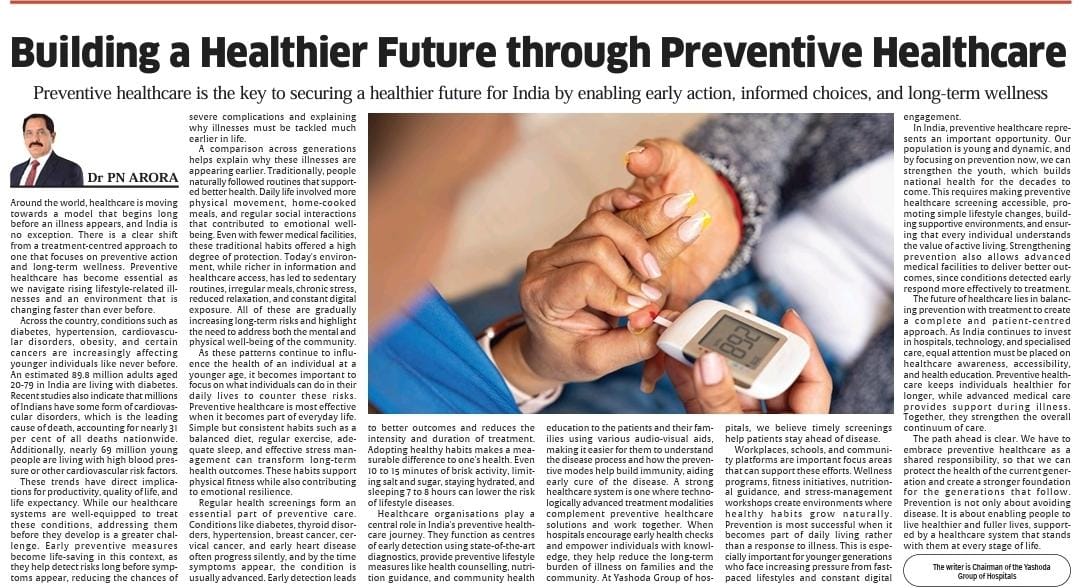
An estimated 89.8 million adults aged 20–79 in India are living with diabetes today, with millions more facing preventable lifestyle-related health risks.
In my recent article with @TheDailyPioneer, I shared how this underscores the need to place preventive healthcare at the centre of our approach. Early screenings, timely awareness, and consistent lifestyle choices can significantly improve long-term outcomes.
By identifying risks early, prevention supports a better quality of life and reduces the burden of advanced disease.
#healthcare #regularscreening #preventivehealthcare
The "current standard of care for septic shock" just published in ICM is an evidence based update. Current optimal management for septic shock involves prompt recognition, judicious use of fluids & vasoactive drugs, early appropriate antibiotic use, regular reassessment & more..
The ESICM Guidelines on circulatory shock and hemodynamic monitoring 2025 are just published in ICM https://t.co/g22zsk6rYT Honoured to be a part of developing this excellent resource with such renowned authors.
Three states with health indices almost as good as Kerala- Tamil Nadu, J&K, Himachal
What do they have in common?
Early policies focused on social justice, on reducing social inequity +public health
Not letting Delhi dictate health policies, doing what works best for their people
Platelets remain one of the most misunderstood parts of blood health.
In this video, Dr. Nivedita Dhingra, Director and Head– Hematology, Hemato-Oncology & Bone Marrow Transplant, breaks common myths with medical facts to help people understand what really impacts platelets.
#yashodamedicity #health #platelets #mythvsfact
Best practices in airway management in critically ill adults just published in ICM. Get an updated summary on airway management practices in this high risk group of patients : https://t.co/OyzLGYrQxo @audreydejongMD