If, when you say regulation, you mean the dead and clammy hand of the commissar—the gentleman who has never in his life built a single thing, drafting rules to govern a thing he cannot define, to be enforced by men who cannot read them; if you mean the form in triplicate, the impact assessment upon the impact assessment, the compliance officer who breeds, in the warm dark of the org chart, further compliance officers unto the third and fourth generation; if you mean the moat—the deep cold moat that the giant digs around his own castle and christens, with a perfectly straight face, public safety—the drawbridge he hauls up behind himself the very instant he is across, lest any hungrier and hungrier man should follow; if you mean the precautionary principle, which, had it governed our grandfathers, would have banned the wheel pending further study of the hill, and left us yet shivering and raw in the mouth of the cave, blessing its excellent ventilation; if you mean the European disease—that magnificent open-air museum of a continent, which produces in our time precisely two things in great abundance, and they are regulation, and the eloquent and well-footnoted regret of cultivated men explaining at length why they have produced nothing else; if you mean the license required to think, the permission slip for honest arithmetic, the king’s wax stamp pressed upon the forehead of every new idea before it may draw its first breath; if you mean the agency dispatched, with trumpets, to slay a single dragon, which arrives at the cave, surveys the accommodations, and moves in—and spends the ensuing century laying eggs and devouring the very villagers it was sworn to defend; if you mean the startup that perishes not of the market’s honest verdict but of the filing fee, the genius decamping by the next tide to a freer and warmer shore; if you mean the law that arrives, faithful as the swallows, exactly one whole epoch too late—helmeted, plumed, and magnificently armed—to regulate the stagecoach—then certainly, my friends, I am against it.
But—but, my friends—if, when you say regulation, you mean instead the humble steel guardrail upon the mountain road at midnight, the very thing you curse on the easy days and bless on your knees the one night the fog comes down; if you mean the brakes—for it is the brakes, and not the engine alone, that permit a sane man to drive fast and yet arrive alive—and the buttress, without which no cathedral was ever flung so high, but only in spite of which, but because of which; if you mean the meat inspector, who is the single homely reason a man may eat a sausage in this republic without first composing his last will and testament; if you mean the firebreak cut clean through the forest before the dry season of the burning, the smallpox cordon, the buoy that marks the channel, the rule of the road that lets ten thousand strangers hurtle past one another in the dark at fearful speed and arrive, by its quiet grace, every one of them home; if you mean the honest scale and the true weight, the reason a pound is a pound and a dollar a dollar from Natchez to Nome; if you mean the firm and decent wall between the counterfeit voice and the widow’s bank account, between the deepfaked candidate and the ballot box on the eve of the vote, between the loosed and loveless machine and the schoolyard it neither knows nor pities; if you mean the simple plank of law that says the strong shall not, in the gray dawn, feed the weak quietly into the furnace and sell the rising smoke as progress; if you mean, in the end, the one slender thread of trust without which no citizen will ever dare to use the marvelous thing at all—for where there is no rule there is no trust, and where there is no trust there is no commerce, and a miracle that no man dares to touch is no miracle, but only a handsome and expensive ghost—then certainly I am for it.
This is my stand. I will not retreat from it. I will not compromise one inch of it.
Happy to join Sean Speer on West of Centre today to talk about conservatives, Conservatives, and separation. https://t.co/l47S63zzpq
@WestofCentreCBC@Sean_Speer
Your periodic reminder that separatists have been contesting federal & provincial elections in Alberta for 50 years, typically getting 1% to 2% of the vote.
I’ve told separatists for years that Alberta won’t be strengthened by making empty threats to leave.
But here we are in a pointless, deeply divisive debate for months to come. What a shame.
@FiftyFootNest Yup. But Maritime provinces, claiming moral superiority, kept avowing not to exploit fossil fuel opportunities, which they could only afford to do because of transfer payments made possible by people who did exploit fossil fuel opportunities.
💯
Separatists are *shocked* by my suggestion that Canada could revoke Canadian citizenship from Albertans following a unilateral declaration of independence (UDI.)
They believe that Alberta would get to determine how Canada would respond to a UDI, and that Albertans would have a right to hold and transmit Canadian citizenship to the nth generation.
But at the same time, they would not grant Alberta citizenship to the ~50% or Albertans born outside the province, i.e. people who are Albertans by choice, not chance.
So half the Alberta population (myself included) would be ineligible for Alberta citizenship, but the separatists would get to keep their Canadian passport to travel and work in the rest of Canada visa-free.
How crazy is that?
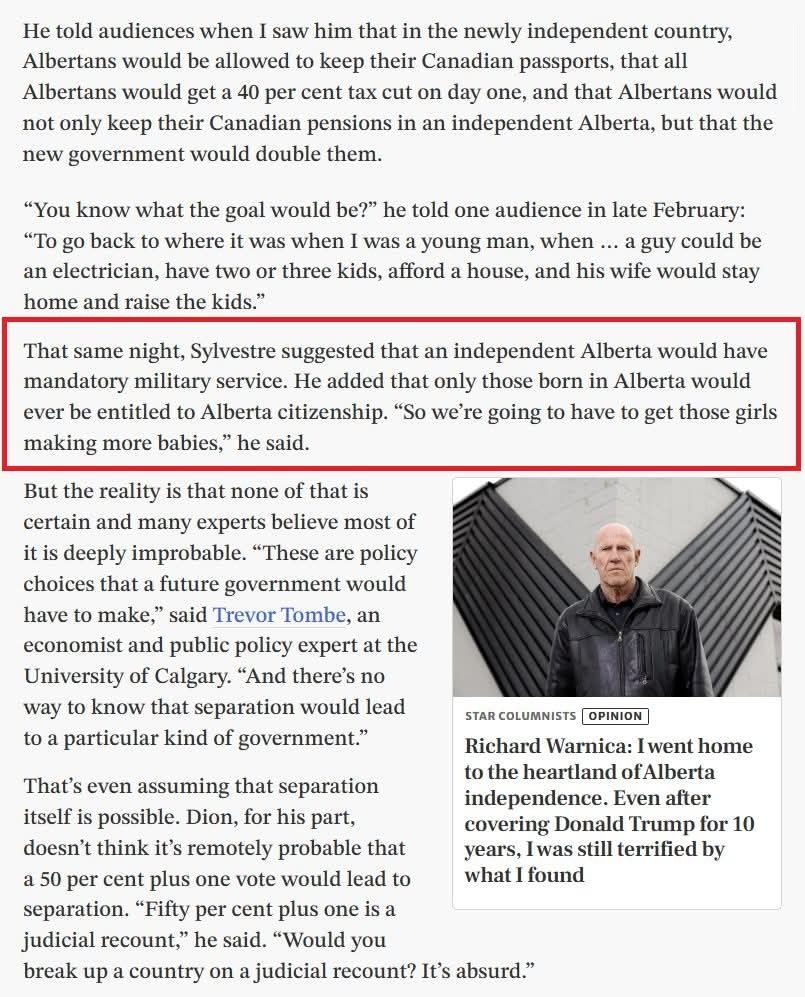
Albertans deserve to know exactly what some of the leading voices behind separation are advocating: mandatory military service, citizenship based on birthplace, and a vision of society that belongs in the past.
At a time when Calgary is attracting talent, investment, and opportunity from across Canada and around the world, the provincial referendum decision is giving oxygen to a movement that creates uncertainty, division, and risk.
Our city needs more homes, more jobs, more infrastructure, and stronger ties with the rest of Canada and the world. Instead, we're being dragged into a debate that threatens investment, undermines confidence, and distracts from the real challenges facing Albertans.
Calgary's future is as a growing, confident Canadian city. We must be focused on building that future, not legitimizing a movement that puts it at risk.
Alberta now has a government that says it's federalist, backed by a United Conservative Party that won't say it's federalist. Big trouble ahead. Column https://t.co/CH8e8KbORz #ableg#abpoli#canpoli#cdnpoli#yyc#yeg
Smith's struggle to wrest the UCP away from separatists has finally begun. Ministers, MLAs, firing off messages urging people to join up and oust the intruders. Column.
https://t.co/gXMDRw3ucl #ableg#abpoli#cdnpoli#canpoli#yyc#yeg
The abuse of section 7 by an activist judiciary is behind so many of the policy ills facing Canada.
Dave Snow has done Canada an incredible service in this analysis:
"Although there is growing scholarly and media attention to the expanding reach of section 7 (Fehr 2018; Stewart 2019; Hopper 2025; The Globe and Mail 2025), there has not yet been a data-driven analysis of how the Supreme Court has actually interpreted and applied the provision over time. This commentary fills the gap. It draws on an original dataset covering every Supreme Court decision between 1984 and 2025, offering a quantitative analysis of section 7 jurisprudence and its evolution over four decades."
Link to the @MLInstitute commentary below 👇
NEW COLUMN: Time to tackle shoplifting, before it turns into even more crime
Winnipeg's shoplifting crisis is shutting down businesses and we're all paying the price. Yet another 7-Eleven is closing due to shoplifting.
Some call it a "survival crime," but police data tells a different story: much of it is organized, profit-driven theft. And the costs don't disappear. They get passed straight to consumers, fuelling the very grocery inflation used to justify stealing in the first place.
The "broken windows" theory warns us where this leads: small crimes ignored become big crimes normalized. It also tells us what’s needed: real enforcement, real consequences for repeat offenders, and a culture that stops making excuses.
Stealing is wrong. Full stop.
https://t.co/hC1pmDkpaV
#cdnpoli #cdnpolitics
That 35% is higher than in previous polling. By making the referendum question non-binding, Smith has given license to soft(er) separatists to support leaving, since it's "safe" to do so in this first round.
Which makes the issue endure indefinitely. Great for investment!!
.@CBC, @MarcMillerVM, @RachaelThomasAB, @MLInstitute. So disappointed at CBC’s scandalous use of taxpayer money to try to humiliate and stigmatise private citizens who defend Sir John A. Macdonald and Canadian history more generally. As my letter details, I too was targeted.