@shantanugoel@almonk Besides this is had to map the tailscale user to be able to ssh as mentioned. It was about 5 minutes of work. But yeah not transparent.
After the Karnataka Government exposed over-blending of ethanol in petrol beyond the prescribed E20 limit, our Legal Metrology Department has begun inspecting Oil Marketing Company (OMC) terminals, where the blending is carried out.
At the IOCL Terminal, Devanagonthi, mass flow meters tested against a verified proving measure showed excess delivery of 14 litres of ethanol for every 3,000 litres, while motor gasoline was short-delivered by 4–6 litres. Both are beyond permissible limits. A show-cause notice has been issued under the Legal Metrology Act, 2009.
#EthanolBlending #OMC #noticed #IOCLTerminal #E20
Excellent piece
India shouldn't fall into data centre trap! A 200 MW AI data centre costs about $8 billion. It creates tem-porary construction jobs but, in the steady state, employs only 50-100 people
🐏🤝🦖
auto resume after restarts has been the most requested herdr feature for a while. we could have shipped a herdr-only version with per-agent hooks, but we didn't want to.
7501 gave every terminal and program one open protocol for status. resume deserved the same thing, so we waited for it and helped shape it with @superlogical
herdr will support it in the next update. now it's up to agents and other programs to adopt it, like they did with 7501. once they do, you restart and everything comes back where you left it!
Rex can now resume your programs through a server restart! This is based on a brand new terminal protocol we're also publishing today (OSC 7577) that we worked on in collaboration with @herdrdev with review from multiple terminal emulator and terminal program authors. Link: https://t.co/tuSlFViqeO
This means that ANY program can restart, not just agentic coding tools, and it doesn't require any special integration with any specific terminal or out-of-band protocol. It's plain old terminal escape sequences that are easily implemented by any program!
Rex is shipping with built-in support for Claude Code to start (we emit OSC 7577 in a session start hook), but hope that other programs will adopt this and enable restart.
Program restart in terminals is fundamentally unsafe, so a lot of effort was put into making this as safe as possible. Ultimately, the security of this lies in the terminal emulator.
For Rex, we have a highly flexible Lua-based configuration to opt-in to resume on a program-by-program basis. You can filter by program name, path, working directory, command-line flags, and more. You can also disable the whole thing with one line.
hello chat, we OCR'd every voter rolls PDF that the ECI put out of Uttar Pradesh.
the 2024 Lok Sabha roll, both SIR rolls and the 2027 draft.
6.8 lakh PDFs, mostly scans.
Now 54.8 crore rows, one table for each of the 403 constituencies.
Free to download, Link below.
1. This is truly new and innovative. Something like this has always been a goal for defenders
2. The big question is how effective this will be. There's no way to know without trying. I am looking forward to Security teams running experiments and sharing their findings with the community. In my experience, I've seen traditional ML models being used to auto-block attacks pretty effectively. Except those have all been custom-built and localized to particular use cases. The big promise here is that we may have a generic framework to solve this at scale.
3. Security teams will be gun-shy about adopting this because previous iterations of "detect attacks and block" have been hit-or-miss. Remember when WAFs were supposed to stop all kinds of web attacks? Yeah, that never happened (it did do some good in a narrow sense, though). Expect this to change when we start getting real-world examples of this working from early adopters ("crossing the chasm" framework will apply)
4. The " if this works, teams will be lazy and not patch" hot-take is moot. Every good engineering team understands the difference between incident response and vulnerability mitigation. This tool buys you time to patch, but will create collateral damage (e.g.: make a change that will block legit traffic) sometimes.
Security is more Swiss cheese and less silver bullet. This does not change that. It is a new, cool, potentially effective tool in the armor of Security teams
<insert mandatory line about "exciting times" and "what a time to be alive" >
Dario's spiel since GPT-2 has always been about hyping the dangers so that open models would be made illegal and *he* would stay in control.
He left OpenAI because he wasn't going to have control.
It's like the Ottoman Empire banning the printing press for Arabic so they would keep in control of the dogma.
It stops the population from freely accessing diverse knowledge.
It's a new form of medieval obscurantism.
Evidences of the NDA's illegal mandate is piling up.
Soon, it will be substantial enough to challenge their authority, both in the court and on the streets, with much more force!
Kudos to the brave journalists at @reporters_co.
ECI’s internal records show that for N Chandrababu’s win in 2024, the ECI recorded an impossibility after 6PM. Then did not investigate.
@VenkateshNSS and I report for @reporters_co.
In the third part of our election audit series, we take the audit to Andhra Pradesh -
https://t.co/P8pvmt4SkH
Congratulations to Deepinder Goyal for publishing a hypothetical paper on the gravitational theory of aging in a high impact journal. Only, there is nothing in it on gravitational theory of aging as indicated in the title.
This is the textbook example of of exploiting "science" and "scientists" towards initiating a scam. This is long, but you will really learn a thing or two.
I read this BS so that you dont have to. Here are my comments on this paper which showcases the lowest level of evidence in medical science and proves nothing, nor can claim to prove anything it states in the future.
But before I start, let me get this out of the way:
Neither author Satchidananda Panda nor first author Laura van Rosmalen are brain hemodynamics specialists; their established academic domain is circadian biology, photoperiodism, and metabolism (and the paper awkwardly weaves circadian blood-flow rhythms into the narrative to bridge their background). Panda's corresponding contact on the paper is listed as a personal Gmail address rather than his official Salk Institute email. Combining a billionaire founder (Goyal), his hardware engineer (Kumar), a paid scientific consultant from an adjacent field (Panda), and that consultant's student (Rosmalen) - while omitting the paid consultancy from the journal's disclosure - strongly indicates commercially driven authorship (to drive Temple wearable sales) rather than independent academic consensus.
[1] The paper admits there is no evidence proving that everyday standing causes harmful blood-flow drops in major part of the brain. yes, repeatedly.
[2] The authors have confused cause with effect and admit that lower brain blood flow in older adults does not automatically mean the brain is being starved - an aging, shrinking brain often simply needs less blood. Despite this admission, the rest of the paper still treats lower blood flow as a root driver of aging rather than a symptom of it.
[3] The theory blames Earth's gravity for aging the brain, yet the paper admits that removing gravity in space causes rapid muscle loss, bone loss, heart deconditioning, and enlarged brain ventricles - a hallmark of brain aging. When both normal gravity and zero gravity cause similar structural brain changes, gravity cannot cleanly explain brain aging.
[4] If upright posture and vertical distance between the heart and brain drove aging, horizontal animals like mice and dogs would dramatically outlive upright humans, and tall giraffes would age far faster than short mammals, yet humans are among the longest-lived terrestrial mammals. Moreover, the paper notes that cellular aging occurs across all species down to single cells, which have nothing to do with upright posture or brain circulation at all.
[5] The authors treat normal physiology as chronic injury (shows lack of expertise in the topic). The paper frames the normal 10–17% drop in brain blood flow upon standing as a damaging "Orthostatic Perfusion Deficit". At the same time, it admits that standing up is physically helpful because it lowers brain pressure. Authors cannot seem to make up their mind on this garbage hypothesis - which is untestable (see later).
[6] The paper points out that prolonged sitting lowers brain blood flow, yet also notes that older adults who regularly do moderate aerobic exercise - which is performed upright against gravity - show no significant age-related decline in brain blood flow. This indicates the real issue is physical inactivity, not gravity itself.
[7] Unfalsifiable circular logic - which makes this theory pseudoscientific. The hypothesis builds a closed loop where gravity reduces blood flow, which causes aging, which worsens blood flow. Whenever evidence contradicts the model - such as high blood pressure or normal aging adaptations - the authors hedge that it can be both helpful compensation and harmful pathology at the same time, making the theory nearly impossible to disprove.
[8] To promote wearable tracking, the authors suggests placing optical sensors over branches of the external carotid artery on the scalp/temple as a proxy for brain blood flow. However, the authors' own anatomy summary states that the brain is supplied by the internal carotid and vertebral arteries (not the external carotid, which feeds the face and scalp), and they admit surface optical devices cannot measure deep tissue perfusion. So Goyal effectively debunked his nonsense Temple device in this paper.
[9] The authors propose risky interventions and flawed animal tests. The paper proposes daily head-down tilting (30–70° inversions) to counter gravitational stress, even while warning it carries severe risks like stroke, glaucoma, raised brain pressure, and blood clots. Its proposed test of tilting naturally horizontal mice is impossible to replicate in humans because of the 25–30 cm heart-to-brain distance of standing nature.
[10] Non-existent isotope: Box 2 in paper states that PET scans using C-labeled water are the gold standard for measuring brain blood flow. Water contains no carbon; the actual tracer is O-labeled water. None of the authors understand chemistry.
[11] The authors have misapplied citations. To support tilting cages as a chronic gravity model in rodents, the paper cites Houpt et al. (2012), which is actually a study on rats tilting their heads inside a high-strength magnetic field.
[12] Nitish Kumar is publicly named by Goyal in Sept 2026 as one of the core four scientists who built and validated Temple's proprietary "Brain Flow" technology which has now being removed from the device's main website and which we know was a fraud technology.
[13] Major undisclosed financial conflict of interest. In a concurrent medRxiv preprint posted Sept 4, 2026 and revised Nov 18, 2026) validating the Temple wearable, the Competing Interest Statement explicitly declares: "Satchidananda Panda is a paid scientific consultant to Temple Pvt. Ltd."
[14] Undisclosed collaborative conflict of interest: Laura van Rosmalen is a postdoctoral researcher inside Satchidananda Panda's lab (working under a paid Temple consultant) and co-authored the same Sept/Nov 2026 medRxiv validation study of the Temple wearable - a study funded by Temple Pvt. Ltd. (grant f. no. 01/2026, dated Jan 29, 2026) in which Temple supplied the devices and returned processed data files.
[15] Additionally, the paper's Funding section lists only the Wu Tsai Human Performance Alliance and the Joe and Clara Tsai Foundation for van Rosmalen and Panda, omitting Temple Private Limited's concurrent research funding to their collaborative validation study and its employment/backing of Deepinder Goyal and Nitish Kumar. @ElsevierConnect
To summarize: Rather than reading like independent science, this paper reads like a sales pitch for Deepinder Goyal's ₹85,000 "Temple" wearable. It invents marketable metrics like "perfusion age" and argues that people need continuous tracking of brain blood flow using optical sensors worn on the head—even including an illustration in Figure 4C of a small sensor stuck to a woman's temple streaming live data to a phone, mirroring his exact product. The authorship raises further red flags: Goyal, a tech founder with no background in brain-circulation research, is listed as a co-author alongside his own company employee and two Salk Institute scientists who specialize in biological clocks rather than brain blood flow—one of whom works as a paid consultant for Temple, a financial tie disclosed in a separate study but left out of this paper. Published online on November 13, 2026—just days after Temple opened commercial pre-orders on November 1—the paper hands Goyal's unproven theory and pricey gadget a convenient stamp of academic credibility right as doctors were calling them out.
My advice to "truly humane" Indian billionaires with lot of money for research is to put it in for cancer research and promote institutional research into valuable topics that can change human lives. For example, a new study on a pill showed that it could help reverse Stage 4 pancreatic cancer.
https://t.co/LXtnrJoYWe
But people like Goyal are not truly humane. They are vultures in suits. The exploit science to make more money for themselves. It is really sad to see this happen.
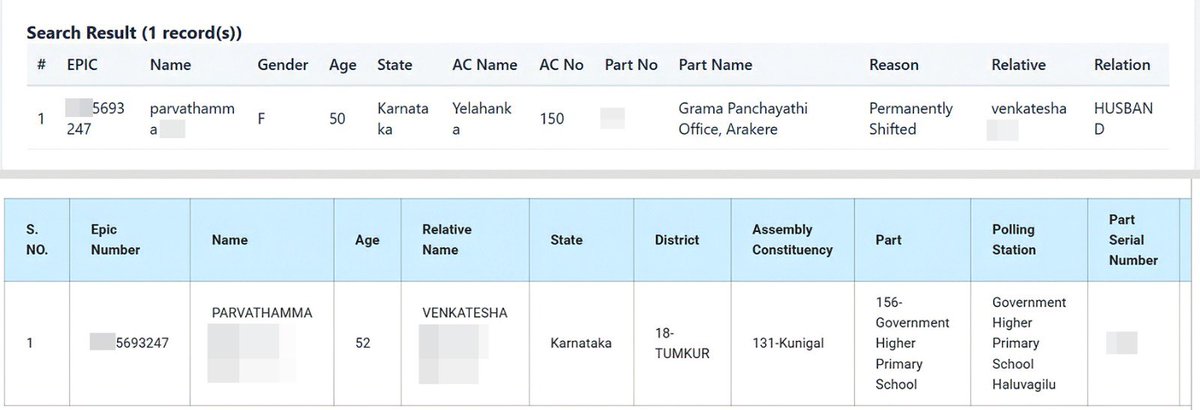
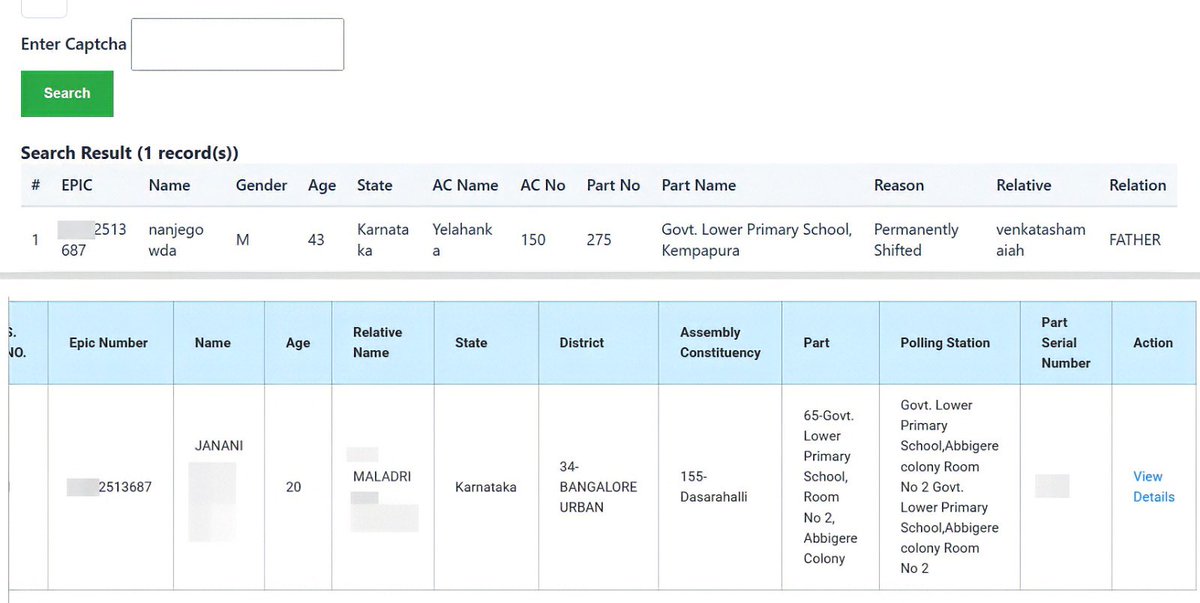
SIR: EPIC IDs of people who were deleted from the voter rolls (ASDD) during the SIR have been “reissued” to hundreds of other people in Bengaluru
https://t.co/RBLTE7vhzG
Meanwhile, over 1,600 people marked for deletion (ASDD categories) still figure in the final rolls with the same EPIC IDs
https://t.co/epUACSlqUh