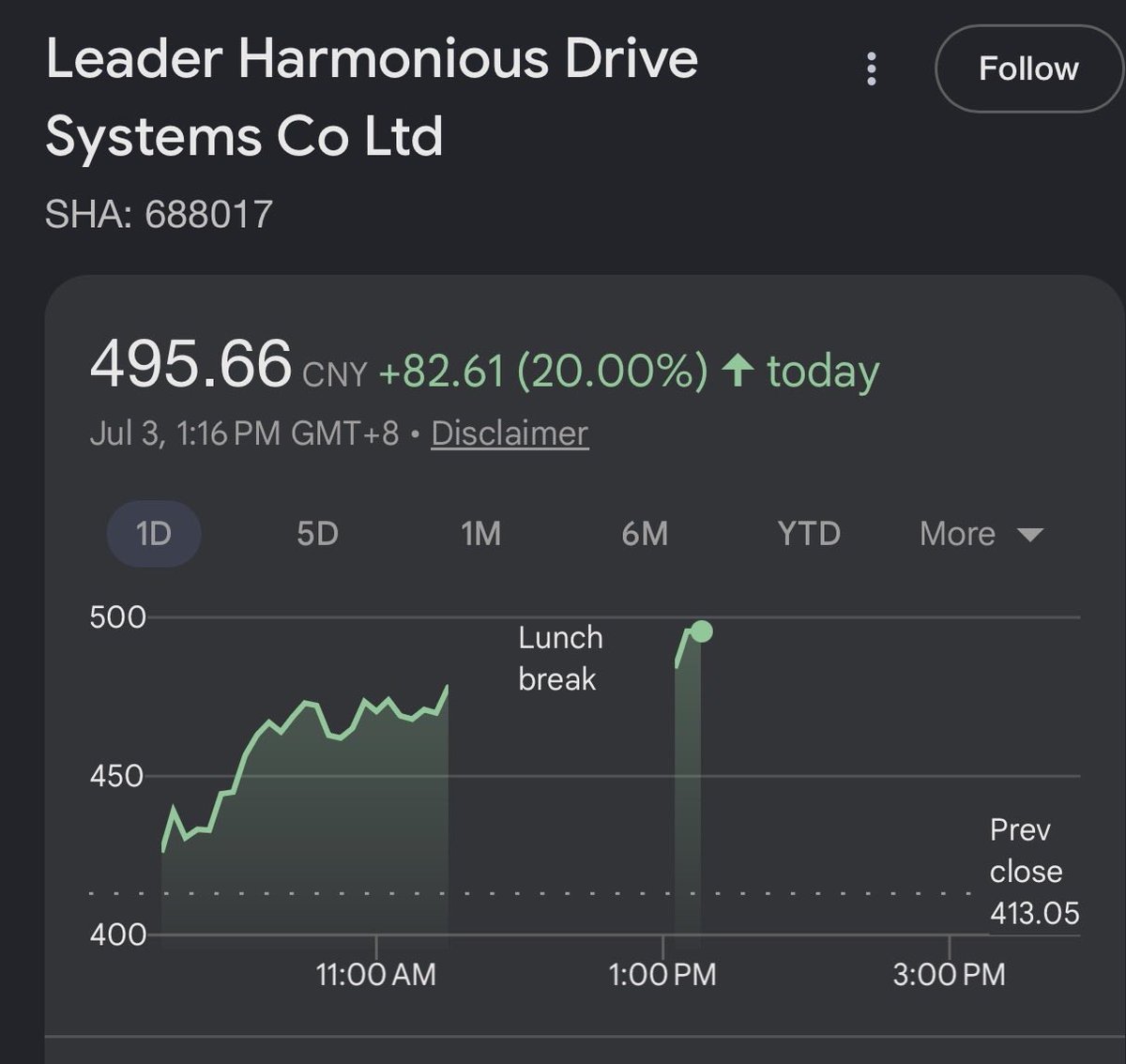
LeaderDrive (688017) is now at all time highs after hitting a 20% limit up today.
Looks like robotics sector excitement is palpable…
Largely driven by US and China’s frontier humanoid companies with $CCXI / Agility Robotics
As well as Unitree (STAR listing approved today) both going public.
Everyone talks about $VRT and $MOD when discussing AI data center cooling.
Don't overlook $AAON.
The company is quietly transforming from a traditional HVAC manufacturer into an AI infrastructure play through data center cooling.
This quarter:
- EPS beat: +64%
- Revenue beat: +30%
- Raised FY26 revenue growth guidance to 40-45% YoY
- Record backlog with improving margins
Technically, it's just as compelling:
- 18-month weekly base
- High-volume Power Earnings Gap (PEG)
- Strong institutional accumulation
As AI capex expands, the bottleneck is shifting beyond compute. Cooling and power are becoming just as critical as GPUs.
Ok seems like Robotics is gonna be the play of the next few weeks/months. Here are some good companies worth watching imo
Spread across the stack: the OS, the sensors, the brain, and the body.
$BB - QNX is the safety-certified operating system that runs underneath the robot, not the robot itself. Deterministic, ISO-certified software is hard to replicate, which is why it sits in autonomous cars, industrial automation and now physical AI. QNX did $72.3M last quarter, up 26%, royalty backlog near $1B, partnered with NVIDIA and Arm.
$CCXI ($AGLT post deSPAC) - The public vehicle for Agility Robotics and its Digit humanoid, merging with Churchill Capital XI at a $2.5B pre-money valuation. Digit is already deployed at Schaeffler, GXO and Toyota with 65,000+ operating hours and $300m in multi-year orders.
$OUST - Ouster builds digital lidar, the depth perception layer for robots, AVs and industrial automation. One sensor architecture scaling across multiple end markets.
$AMBA - Ambarella makes edge AI vision chips that give machines real-time sight without the cloud. The same silicon that powers ADAS now targets robotics, drones and autonomous systems.
$AEVA - Aeva builds FMCW 4D lidar that measures velocity per point, not just distance. That matters for machines that need to predict motion, not only map space. Still pre-scale on revenue, so execution is key.
$RR - Richtech Robotics builds service and humanoid robots for hospitality and logistics. Micro-cap and speculative, the lottery-ticket end of the basket. Real deployments but thin financials.
$TER - Teradyne owns Universal Robots (cobots) and MiR (mobile robots), on top of being a semiconductor test leader. The cleanest profitable robotics exposure here, with a chip-cycle tailwind underneath. However, robotics is still a minority of revenue.
$SYM - Symbotic automates warehouses with AI-driven robotics, anchored by Walmart. Real revenue at scale, rare for this theme. Customer concentration and lumpy deployments are the risk.
$SERV - Serve Robotics runs autonomous sidewalk delivery, backed by NVIDIA and Uber. Fleet expansion is the growth story. Their robots look kinda ass though.
$CGNX - Cognex is machine vision, the eyes of factory automation and robotic guidance. Established and profitable, levered to capex cycles. Less explosive, more durable.
Any other ideas?
IMO photonics theme + CW laser chokepoint is goated.
It's legit like markets have short term memory loss and forgot how $LITE went from $3B -> $65B+ from 2024 to now.
Because $NVDA caused EML bottlenecks, and forced architectural changes.
We're literally seeing the same thing today with CW lasers + 1.6T/CPO shifts with Nvidia signing LTAs everywhere.
Now, $AMD + other CSPs are hunting for remaining scraps with large LTAs for CW lasers + optical components.
GS Research's ~9-10x $154B optical TAM in 2028 and near $0 -> $91B CPO TAM in just 2 1/2 years.
Don't just magically disappear from a month of trading volatility.
$AAOI sitting at ~$13B, $SIVE sitting at ~$3B, and other CW laser players look strategically very valuable.
And next year I think we'll look back and say "Why didn't I learn my lesson the first time with EML from Nvidia and pick up CW laser adjacent names!"
Then there's likely gonna be some new mini trend 1-2 years from now like microled or quantum dot and we're gonna see the same thing repeat.
Think Sumitomo's projections with CW laser share + silicon photonics being majority / dominant architecture should be correct.
I'm personally just focusing on that bottleneck as you've seen with $SOI, $TSEM, $SIVE, and others.
Co-Founder of a16z (the biggest VC fund in the world) Marc Andreessen:
"People who want to build their careers should be spending every spare hour talking to AI: alright, train me up"
He says this is the habit that separates who gets paid and who gets replaced
In 1 hour 44 minutes, he explains why the people winning right now are training themselves on AI every spare hour
Open the model Ask it to teach you Practice Ask again Repeat daily
That is the new career ladder
Bookmark and watch the interview
The 25 year old who turned $0 into $300M+ says you need to start top blasting charts.
Brandon Hong thinks buying ATH breakouts is the highest probability trade you can take in any market.
"Any trending asset, doesn't matter what it is. It could be orange juice. It could be eggs. It could be Micron. It could be crypto."
"I think you just have to be a little psychotic. You have to be really dialed in, really objective, and you just have to have no emotions at all."
🚨 BREAKING
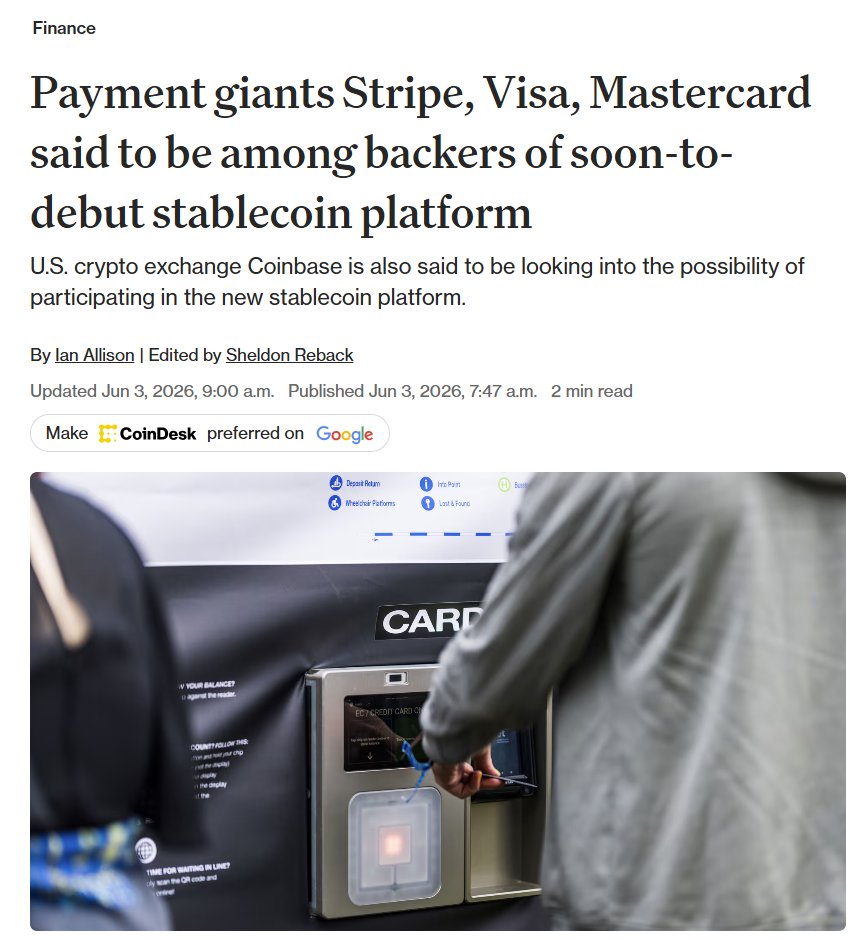
Payments giants are going all-in on stablecoins.
@Visa, @Mastercard, @Stripe, and possibly @Coinbase are reportedly backing a new stablecoin platform launching soon.
���� This comes as all three have made major stablecoin moves:
- Stripe's acquisition of @Stablecoin for $1.1B
- Mastercard's acquisition of @BVNKFinance
- Visa's expanded settlement support across 9 blockchains.
The race to own stable payments infrastructure is on.
Come hear from all three at @TheStablecon.
$SIVE basically took their entire revenue pipeline.
In the entire company’s history.
Then grew that by 77% in the first 3 months.
Thats by far the clearest indication of the inflection of the CPO supercycle.
It’s probably going to look exponential from here on out.
After two years of building under wraps, today we're announcing Casa – your personal property manager. We've raised $27M to redefine the homeownership experience from the ground up.
We believe your home is your most treasured asset, emotionally & financially. It shouldn't also be a second job.
Most homeowners are on their own – expected to have the time, expertise, and relationships to keep things running. Finding a plumber you can trust. Remembering when the HVAC was last serviced. Knowing what's actually wrong before someone shows up to fix it.
Casa gives every homeowner what used to be reserved for the few: a dedicated team that knows your home deeply, handles the work, and stays in your corner. We're enabling this by building a deep, technical understanding of every home we serve – something that's never existed before, across 100 million single-family homes in the country.
For $199/mo, membership includes:
- A complete inventory of your home, built using specialized hardware & software
- 1.5 hours of handyman time every month (and it rolls over)
- Unlimited Concierge requests to take on virtually any home project
- Custom, proactive care plans built specifically for your home
- Weekly package and donation pickups
- Scheduling and payments for your regular vendors
- Utility and property tax monitoring
…and we’re just getting started, with more benefits on the way to make the experience of owning your home as magical as it always should have been.
Available now in the SF Bay Area and Los Angeles. Reserve your spot everywhere else.
→ https://t.co/vTUSR000fC
Félix has processed $5B+ in cross-border remittances for 1M+ users across 9 corridors in Latin America, entirely inside WhatsApp.
Now, @FelixPago is adding Tempo to its settlement infrastructure for stablecoin payments.
Read the full story: https://t.co/xWNsQ3dMt4
The IRL connection economy is a $400B+ market.
And companies are racing to own it.
In the last 6 months, $800M+ in capital was deployed on "IRL" bets.
@Tinder invested $60M into a new Events feature for connecting matches in-person. They're pivoting to IRL and offering experiences such as speakeasies, raves, and pottery classes.
@222place: raised a $10.1M Series A to curate blind social experiences for Gen Z. Personality-matched groups sent to hyperlocal nightlife events.
@JagermeisterUSA launched BestNightsVC - the only venture fund in the world dedicated solely to nightlife and IRL connection. 16 portfolio companies across 4 continents.
@timeleft: dinner with 5 strangers, every Wednesday. €18M ARR. 6,500 dinners/week across 200+ cities.
Dion: members-only social app where the first move is buying someone a real drink, redeemed IRL. 10K members, 30K+ on the waitlist founded by @revekkapal.
Pie: Bonobos founder @dunn built an IRL friendship app. $24M raised. 130K+ MAU.
@weroad_official: group trips for 20-30 year olds who don't know each other beforehand. $150M valuation.
Matchbox: is an algorithm-powered matching platform for IRL events and has powered over 100,000 connections. founded by @liamjmcgregor (prev @MarriagePact)
New dating apps like Known @Celesteamadon, Cerca @MylesCerca, and Ditto @AllenWangzian are aiming to improve connection amongst young people.
Billion-dollar companies are paying $$$ for community and events leads:
- @AnthropicAI: Marketing Events Manager ($255k)
- @tryramp: Community Manager ($223k)
- @tryramp: Events & Culture Manager ($181k)
- @duolingo: Senior Community Manager ($193k)
- @NotionHQ: Community Programs Lead
Everyone knows the more time we spend online, the more valuable real-life connection becomes.
The question isn't whether IRL wins.
It's who facilitates it best.
I'm lucky enough to have a great doctor and access to excellent Bay Area medical care. I've taken lots of standard screening tests over the years and have tried lots of "health tech" devices and tools.
With all this said, by far the most useful preventative medical advice that I've ever received has come from unleashing coding agents on my genome, having them investigate my specific mutations, and having them recommend specific follow-on tests and treatments.
Population averages are population averages, but we ourselves are not averages. For example, it turns out that I probably have a 30x(!) higher-than-average predisposition to melanoma. Fortunately, there are both specific supplements that help counteract the particular mutations I have, and of course I can significantly dial up my screening frequency. So, this is very useful to know.
I don't know exactly how much the analysis cost, but probably less than $100. Sequencing my genome cost a few hundred dollars.
(One often sees papers and articles claiming that models aren't very good at medical reasoning. These analyses are usually based on employing several-year-old models, which is a kind of ludicrous malpractice. It is true that you still have to carefully monitor the agents' reasoning, and they do on occasion jump to conclusions or skip steps, requiring some nudging and re-steering. But, overall, they are almost literally infinitely better for this kind of work than what one can otherwise obtain today.)
There are still lots of questions about how this will diffuse and get adopted, but it seems very clear that medical practice is about to improve enormously. Exciting times!
Sequoia's thesis that the next $1T company will sell work, not software, is the most important reframe in AI right now.
The argument: if you sell a copilot, you're competing with every new model release. But if you sell the outcome — books closed, contracts reviewed, claims handled — every AI improvement makes your margins better, not your product obsolete.
The key insight most people miss: for every $1 spent on software, ~$6 is spent on services.
The entire SaaS playbook was about capturing the software dollar. The AI playbook is about capturing the services dollar — at software margins.
Not "AI for accountants." The AI accounting firm.
Not "AI for lawyers." The AI law firm.
The companies that figure this out won't look like SaaS companies. They'll look like services firms rebuilt on software infrastructure.
That's a fundamentally different company to build, fund, and scale. And most founders are still building copilots.