England vs Argentina.
Pundits pick favorites. Markets price them 📊
On semifinal 2 the two disagree. Which do you trust more, the narrative or the number?
Reply below.
Markets move fast. Opinions move faster.
This World Cup season - pick your side, enter in seconds, and cash out when odds shift. ⚽
https://t.co/4HQS60Sgsx
🇦🇺BitMart has secured an Australian Financial Services Licence (AFSL), further strengthening our global compliance framework.
This milestone enhances institutional-grade protections, including asset segregation, secure custody, and access to AFCA dispute resolution, while supporting the future expansion of RWA and traditional finance offerings for global users.
Read more 👇
https://t.co/Z9OO9IU3S4
Proud to announce that BitMart has secured the Australian Financial Services Licence (AFSL) under Australia’s new Digital Assets Framework, regulated by ASIC.
This milestone strengthens our banking relationships, compliance framework and reinforces our long-term commitment to the highest standards of consumer protection and regulatory excellence.
Regulation is not a constraint on innovation - it is the foundation for trust. The AFSL provides us a credible platform to build the next generation of tokenized real-world asset services across Australia and the broader APAC region.
Thank you to our team for making this possible.
The biggest sporting event on Earth has begun ⚽
48 nations. Billions of fans. Who takes it all?
You watch every match anyway. Now your predictions can pay.
Excited to have attended my first @beyondtechexpo in Macau over the past two days!
It was truly energizing to engage in so many insightful conversations with industry leaders. Our panel on “The Answer to Onchain Liquidity” at the Web2+3 Wealth Forum delivered a wealth of fresh perspectives on one of the most pressing challenges in our space today.
It was a genuine pleasure sharing the stage with Colin Lam - Head of RWA, @FinloopHK; Wish Wu (@wishlonger) - Co-Founder & CEO, @Pharos_Network; Chaeho Shin - CFO, @1inch; and Ivan Ivanov (@IvanUVC) - UVC Group.
Looking forward to the next one 🔥 🔥
80 hours of AI pair programming. Here's what context-mode saved me.
→ $487.20 in API costs. Opus pricing. Real money, not estimates.
→ 22.3 hours of re-explaining context after compaction. Time I got back to ship.
→ 268 sessions resumed from memory. The agent never asked "what were we doing?"
→ 47 preferences auto-learned. "use TS strict" once, remembered forever.
→ 14,847 events indexed. Searchable across every session, every project.
Without context-mode |████████████████████████████████████████| 6.2 MB
With context-mode |█░░░░░░░░░░░░░░░░░░░░░░░░░░░░░░░░░░░░░░░| 124 KB
98% of raw data never entered my conversation.
That's a 50× longer session. Same context window.
Multiply across a 13-engineer team:
$487 × 13 = $6,331/month saved
22 hours × 13 = 286 hours/month recovered
Open source. Local-first. No telemetry. No account. No SaaS lock-in.
https://t.co/6qDtMec1UO
Leopold Aschenbrenner is either the most important investor no one on Wall Street has heard of, or the most dangerous kind of genius: one who might actually be right.
In the 12 months following the launch of his hedge fund, Situational Awareness LP, he grew its disclosed U.S. equity exposure from roughly $225M to $5.52B 😳
He did it without owning a single share of Nvidia $NVDA, Microsoft $MSFT, Amazon $AMZN, Google $GOOGL, or Meta $META.
> His largest position was in a fuel-cell company.
> His second-largest was call options on a GPU cloud startup most investors had never heard of.
> His third-largest was call options on a chipmaker Wall Street had largely written off.
Here's his AGI investment thesis, the full portfolio breakdown, and the framework any investor, entrepreneur, or operator can steal right now: https://t.co/vvnv8J5vYl
THE COMPUTE CAPACITY BOTTLENECK
$GOOGL just admitted Google Cloud is leaving revenue on the table because it cannot build capacity fast enough with shifts the bottleneck to companies with the power, real estate & operational scale to deploy AI compute:
1. $NBIS building the AI-native cloud layer through vertically integrated GPU clusters & software optimized for training + inference. $NVDA just wrote wrote a $2B check & Nebius now has a $46B contracted backlog, anchored by ~$19B $MSFT deal & ~$27B Meta partnership through 2032.
2. $IREN building the renewable-powered AI compute layer by turning low-cost power into GPU cloud capacity. The pivot to AI cloud is now backed by a ~$10B $MSFT contract, 2.9 GW of grid-connected power expanding to 4.5 GW+ & targeted 140K GPU buildout that could drive $3.4B of ARR by year-end 2026.
3. $DOCN building the agentic inference cloud layer for developers & long-tail AI workloads. AI customer ARR is up 150% YoY to $120M, over 70% comes from inference services & $1M+ customer ARR is up 123% to $133M.
4. $CRWV building the dedicated AI cloud platform for frontier model developers. The company has ~$67B of contracted revenue backlog (nearly $88B including Anthropic) with major commitments from OpenAI & Meta.
5. $CIFR building the Google-backed AI data center layer through contracted power & hyperscale leases. Barber Lake has 300 MW fully contracted with Fluidstack (Google backstops $1.4B with a ~5% equity stake) and AWS signed a separate $5.5B 15-year deal for another 300 MW of capacity.
6. $WULF building the power-backed AI compute layer through long-term data center leases. Lake Mariner has 360 MW tied to Fluidstack backed by a $3.2B Google guarantee & new Abernathy JV adds 168 MW over 25 years representing $9.5B in contracted revenue with $1.3B of Google lease support.
7. $APLD building the purpose-built AI data center layer through its Polaris Forge 1 campus in North Dakota. The full 400 MW critical IT load is contracted to CoreWeave under ~15-year leases worth ~$11B in expected revenue with first 100 MW delivered in Q4 2025 & another 300 MW targeted through 2027.
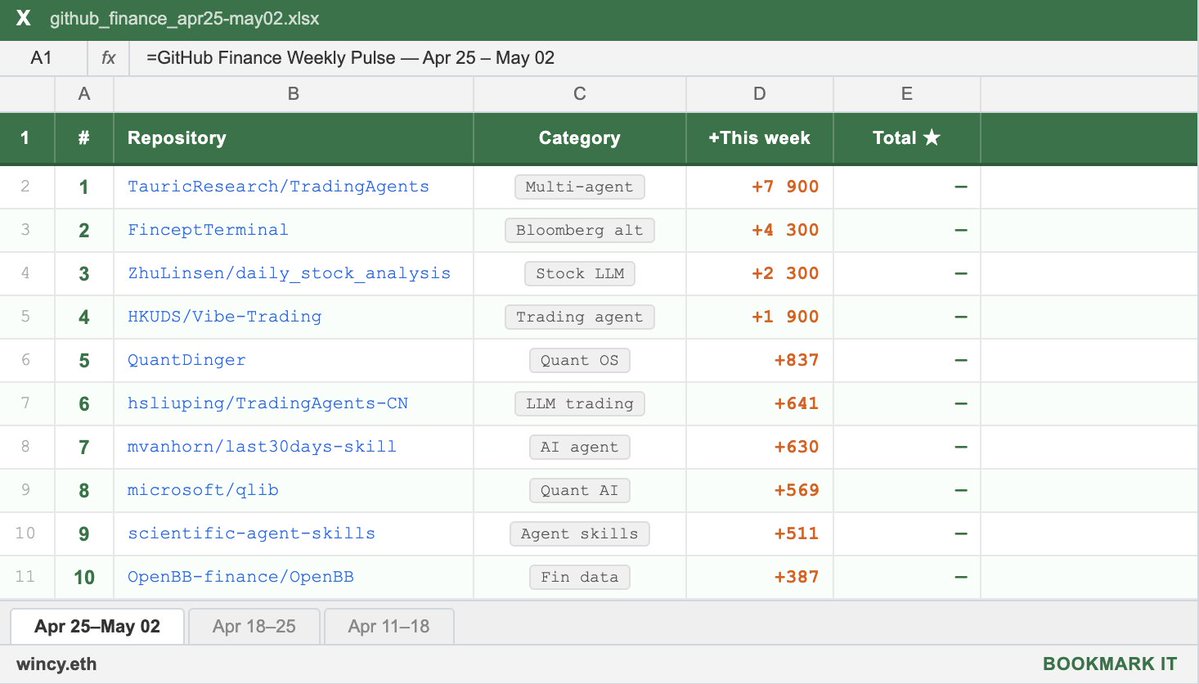
the fastest growing GitHub repos in finance this week:
1. TradingAgents (+7.9K ★)
multi-agent LLM trading framework from UCLA/MIT. fundamental analyst, sentiment analyst, technicals, risk manager with DeepSeek V4 thinking-mode support.
2. FinceptTerminal (+4.3K ★)
open-source Bloomberg alternative built in C++20 + Qt6. 37 AI agents in Buffett/Munger/Lynch/Graham style. real-time trading with 16 broker integrations. internal MCP + AI quant tabs.
3. daily_stock_analysis (+2.3K ★)
LLM stock analyzer for US, A-share and H-share markets. auto-builds a daily decision dashboard with entry/exit levels. pushes to WeChat/Telegram/Discord/Email via GitHub Actions.
4. Vibe-Trading (+1.9K ★)
personal trading agent. natural language - strategy - backtest - export to TradingView/MT5. your own AI trading desk in one pip install.
5. QuantDinger (+837 ★)
self-hosted AI quant OS. research markets, generate Python strategies, backtest ideas, run live trading. crypto, stocks via IBKR, forex via MT5. one Docker Compose, your infra, your data.
6. TradingAgents-CN (+641 ★)
Chinese fork of TradingAgents. fully localized for A-share markets, Chinese data sources, and domestic LLMs.
7. last30days-skill (+630 ★)
AI agent skill that researches any topic across Reddit, X, YouTube, HN, Polymarket and the web in the last 30 days. plug it into any agent.
8. qlib (+569 ★)
Microsoft's AI-oriented quant investment platform. end-to-end: data - alpha - portfolio - execution. the most serious open-source quant infrastructure out there.
9. scientific-agent-skills (+511 ★)
ready-to-use agent skills for research, science, engineering, analysis, and finance. plug into any agent framework. covers bioinformatics, cheminformatics, and now Hugging Science.
10. OpenBB (+387 ★)
open-source financial data platform for analysts, quants, and AI agents. stocks, crypto, options, derivatives, fixed income шт one platform. integrates with AI agents via MCP.
this is the best ai investment thesis ever written
everything leopold predicted has happened AND he told us what to invest in via his fund situational awareness
so far he’s turned $220M into ~$5B+
funds latest filing comes out soon 👀
10 INSANE GITHUB REPOS THAT REDUCE CLAUDE CODE TOKENS BY UP TO 90%
1. RTK (Rust Token Killer)
Filters terminal output before feeding it into context. Can reduce by 60-90% with commonly used dev commands.
https://t.co/kh91RSOrzN
2. Context Mode
Offloads Playwright or GitHub tool outputs to SQLite, passing only clean summaries to the conversation. 98% reduction.
https://t.co/0EqE3dVMvL
3. code-review-graph
Uses Tree-sitter to build a local knowledge graph of the codebase. Claude only reads the necessary parts, achieving 49x reduction for large monorepos.
https://t.co/DOPOe5cziu
4. Token Savior
An MCP server that references code by symbols instead of entire files. 97% reduction with code navigation, zero external dependencies.
https://t.co/bSqnxAhOng
5. Caveman Claude
Makes Claude speak in caveman-style tone to cut output tokens by 65-75%. Maintains technical accuracy.
https://t.co/I8CrVzft33
6. claude-token-efficient
Just place a CLAUDE.md file to keep outputs concise. No code changes needed, ideal for verbose sessions.
https://t.co/BjmKi48bqe
7. token-optimizer-mcp
MCP server with caching, compression, and smart tool control. Compresses repeated tool outputs for 95%+ reduction.
https://t.co/g2e8yLnQqI
8. claude-token-optimizer
Reusable setup prompt collection to optimize projects. Save 90% of tokens in just 5 minutes.
https://t.co/Uhon1dk0mo
9. token-optimizer
Discovers ghost tokens that silently devour context. No quality degradation even after compaction.
https://t.co/TThGzBptZJ
10. claude-context (by Zilliz)
MCP that brings the entire codebase into context with BM25 + vector search. ~40% reduction with equivalent search accuracy.
https://t.co/CbOeaHXODg
Save this for later🔖
Wild story unfolding around the KelpDAO hack funds frozen on Arbitrum.
Quick context: in April, Lazarus Group (DPRK-linked) hacked KelpDAO for $292M via a LayerZero bridge bug. Some of the stolen ETH flowed through Arbitrum, and Arbitrum's Security Council froze $71M before the attacker could move it further.
The industry mobilized to recover. Aave, KelpDAO, LayerZero, EtherFi, and Compound co-authored a proposal asking Arbitrum DAO to release the frozen ETH to a multisig that would compensate hack victims. The vote is passing.
Then this week, a plot twist. Lawyers showed up with a restraining order. But not on behalf of the KelpDAO victims.
The plaintiffs are Han Kim and two other groups - family members of people killed in DPRK-backed terrorist attacks years ago. They hold combined ~$877M in unpaid US court judgments against DPRK. North Korea never paid. They have been hunting for any reachable DPRK asset for over a decade.
When Arbitrum's frozen ETH was publicly identified as "DPRK money," they saw a target.
Their argument: this is DPRK property, we have $877M in judgments against DPRK, give us the money.
The counter-argument: DPRK does not actually own this ETH - they stole it. The real owners are the KelpDAO hack victims. The old terrorism creditors are trying to grab money that was never really DPRK's.
Arbitrum is now caught in the middle. The industry wants to release funds for hack recovery. NY court is saying "do not move anything until we resolve this." If multisig signers transfer the ETH while the restraining order is active, they become personally liable.
This is the first real test of DAO funds against competing US court claims. The precedent set here will shape how every future DAO incident response handles legal pressure.