The welfare state is eating America -- now 6 times bigger than the defense budget.
In Rome the political promises outran production. Inflation bought time, at the expense of collapsed production that accelerated the fall.
US homebuyers are quitting.
There were an estimated +51.3% more home sellers than buyers in July, the 2nd highest level on record.
This percentage has doubled over the last 2 years.
By comparison, an all-time high of +51.8% was recorded in December 2025.
This comes as the number of active homebuyers fell -2.5% MoM, to 966,752, the lowest on record.
At the same time, the number of sellers declined -0.3% MoM to ~1,462,921, the lowest reading in a year, but the decline was far smaller than the drop in buyers.
As a result, ~80% of major US metros are now buyer's markets, led by Miami, where sellers outnumber buyers by +154%.
Further downward pressure on home prices is likely coming.
According to the Bank for International Settlements (BIS), AI bubble investment now exceeds:
• Canal mania of the 1830s
• UK railway mania of the 1840s
• US railway mania of 1873
• Electrification mania of the 1920s
• Dot-com mania of the 1990s
BREAKING: The wealthiest 1% of US earners now own 50.1% of US equity and mutual fund holdings.
To put this into perspective, their ownership stood at 40.1% in 1990 and 39.6% in 2001.
At the same time, the next 9% wealthiest households own 37.3%, and the middle 40% own just 11.7%.
By comparison, the bottom 50.0% of earners hold just 1.1%.
As a result, the top 10% of earners now own ~87.4% of all equity and mutual fund assets.
Asset owners are the only winners in this economy.
Why The Shadow Banking System Could Trigger The Next Major Crisis
Please ❤️like, bookmark🔖, and 🔁share with fellow investors
In this Short video, Danielle @DiMartinoBooth and @AdamTaggart discuss why the shadow banking system—not traditional banks—could become the source of the next major financial crisis.
*
Private credit may have disappeared from the headlines, but that doesn't mean the risks have disappeared with it.
In this discussion, the focus shifts beyond private credit itself to the much larger theme—the shadow banking system—and why it could become the next major source of financial instability.
*
Companies have raised a record $251 billion through equity sales in the first half of the year.
That surge has also drawn renewed attention to private equity, which sits at the center of the private credit ecosystem.
The concern isn't simply the size of private credit—it's whether the underlying private asset valuations are realistic.
*
A key issue is the feedback loop between private and public markets.
Many public companies own private investments, and gains from those holdings can boost reported earnings.
If those private assets are being valued too aggressively, investors have to ask whether the "E" in the P/E ratio is as solid as it appears.
Inflated valuations can support stronger earnings, higher stock prices, and more capital raising, creating a cycle that works well until confidence begins to crack.
*
Although fears around private credit have faded in recent months, Danielle argues that the market has simply moved into an "acceptance phase," not a resolution phase.
The structural problems remain, but investors have largely stopped talking about them.
*
Meanwhile, non-bank financial institutions now control roughly $258 trillion in assets, representing more than half of global financial assets and exceeding the size of the traditional regulated banking system.
Unlike banks, these institutions operate with far less transparency and oversight, making it much harder to assess the true level of risk.
*
At the same time, higher interest rates continue to pressure borrowers.
Public company bankruptcies are already running about 40% higher than a year ago, suggesting financial stress is building.
If publicly traded companies are struggling under today's financing conditions, the health of private companies—where financial information is far less accessible—remains a major unknown.
*
Danielle rates concern about private markets at roughly a 7–8 out of 10 now.
The combination of opaque valuations, rising bankruptcies, higher-for-longer interest rates, and the enormous size of the shadow banking system creates a meaningful systemic risk.
While this doesn't guarantee another financial crisis, it highlights an area that many investors may be underestimating simply because it has faded from the daily news cycle.
#privatecredit #privateequity
💡 Get access to my notes with the key takeaways from this interview with Danielle @DiMartinoBooth by visiting my Substack (link below) ⬇️
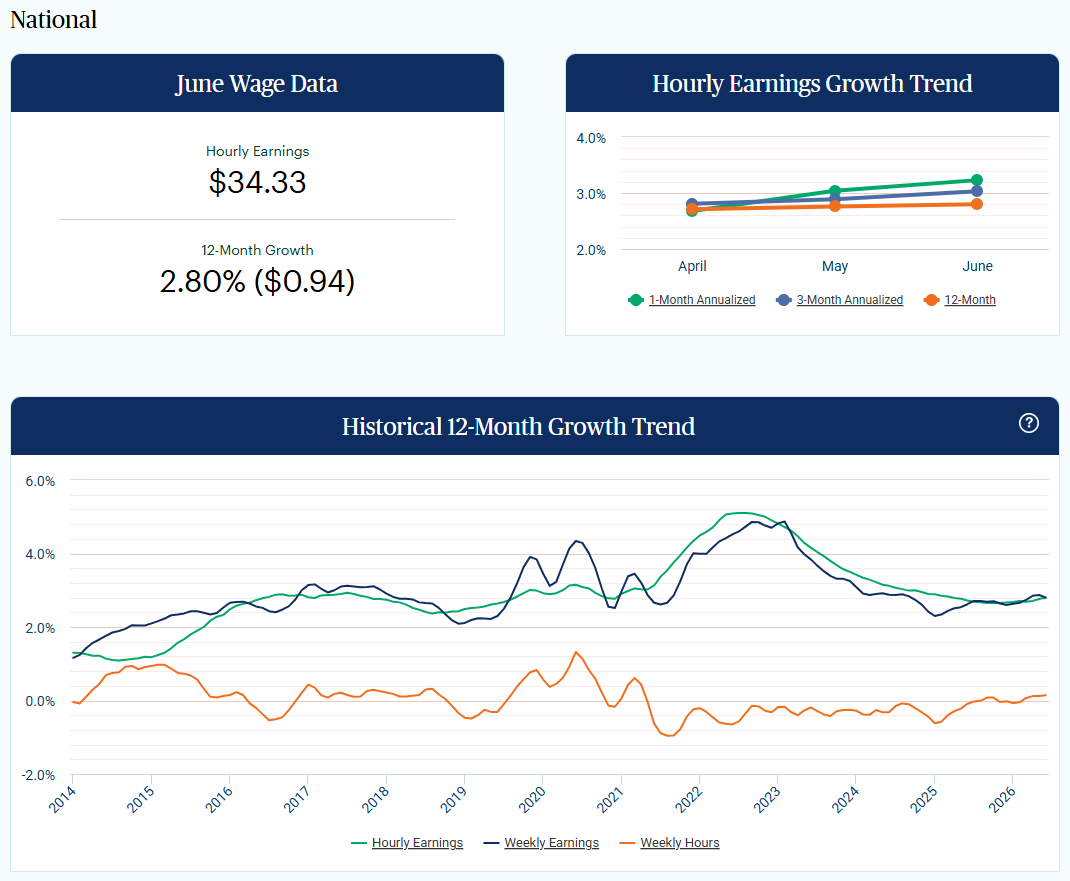
Paychex: job index remained below key 100-threshold in Jun but has improved for 4 straight months, now higher than it was a year ago - the first annual increase since Mar '22; on the wage front, weekly paychecks were up 2.80% Y/Y, down marginally from May:
US households are "fighting" inflation with debt:
Total consumer credit surged +$25 billion in March, to a record $5.14 trillion.
This marks the largest monthly increase since March 2025.
Revolving credit, which includes credit cards, jumped +$10 billion, to $1.34 trillion, the highest since November 2024.
This was also the biggest monthly increase since February 2024.
Non-revolving credit, mainly auto and student loans, rose +$15 billion, to a record $3.80 trillion.
As a result, total consumer credit has now surged +$1.05 trillion since the 2020 pandemic.
US consumers' debt levels are skyrocketing.
BREAKING HOUSING NEWS: AS OF THIS EVENING, FLORIDA NOW ACCOUNTS FOR 1 IN 7 OF ALL HOMES AVAILABLE FOR SALE TODAY IN AMERICA
14.6% of all US homes available for sale today come from the state of Florida. This is more than the entire west coast combined
Florida accounts for 8.1% of all US housing stock yet their share of for sale supply is 1.8x that
We already know Florida is home to the highest share of fire sellers
There are submarkets in Florida where more than 1 in 20 of all homes are available for sale
Will be posting this Florida submarket analysis soon
Stay tuned...
Another record has been set.
The US stock market cap-to-GDP ratio is up to a record 238%.
This comes as the stock market's value surged to an all-time high of $75.7 trillion, far exceeding the ~$31.8 trillion size of the US economy.
This ratio has surged +38 percentage points since the March 30th bottom in the S&P 500.
This metric is also now +90 percentage points above the 2000 Dot-Com Bubble peak of ~148%.
Since the 2008 Financial Crisis, the US stock market has grown at 5x the rate of the underlying economy.
Asset owners are winning more than ever.