Our work on “Equivariant Reinforcement Learning for Clifford Quantum Circuit Synthesis” is finally on arXiv!
https://t.co/QZE2jTarIz
Check out our in-browser demo, vibe-coded in WebAssembly:
https://t.co/aHpcBs9LJT
TLDR: Our RL agent, equipped with a bespoke neural network which respects the symmetries of the symplectic stabiliser tableau, can effectively synthesise **optimal** Clifford quantum circuits in terms of gate count.
The model generalises across unseen tableaus of varying sizes, and on examples that are out-of-distribution.
@ruminaik There's a growing community interested in categorical approaches to probability as an alternative to measure theory. It's natural to ask how far these approaches can go. This paper shows that with the right setup, they can encompass substantive topics in modern MCMC.
A categorical account of the Metropolis-Hastings algorithm
https://t.co/JMGq88u5rs
Joint work with Andi Wang.
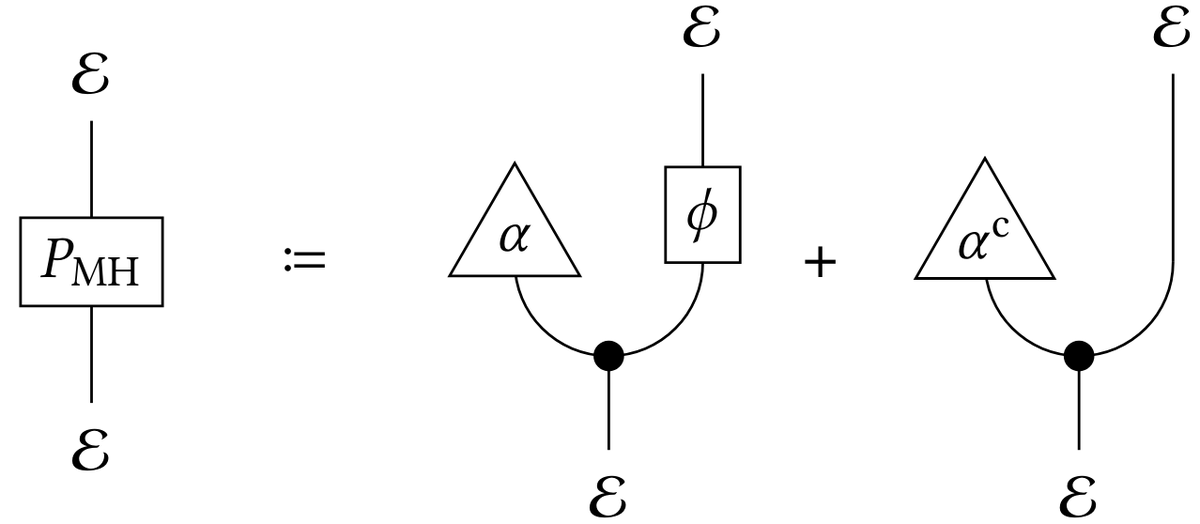
We give algebraic (i.e. measure theory-free) necessary and sufficient conditions for an abstract Metropolis-Hastings-type sampler to be reversible wrt a given target.��
@ruminaik Thanks for your comment. Building on arXiv:2012.14881, which gave sufficient conditions, we also give necessary conditions for reversibility and skew-reversibility of a general MH-type sampler.
That said, our motivation is broader than these specific technical results:
With this additional structure, we can formulate an abstract version of an involutive-style MH kernel and give conditions under which it is reversible. When instantiated in terms of measure theory, we recover the results of Andrieu et al. (https://t.co/xNh7HOVP6Z).
We also study CD categories enriched over commutative monoids. This provides an expressive setting for reasoning about:
* Substochastic kernels
* Probability values
* Finiteness and sigma-finiteness
* (Pointwise) absolute continuity
* Singular measures
* Lebesgue decompositions
I still have positions available for a January 2026 intake - get in touch ASAP! Later intakes are also possible (please get in touch to discuss).
For more information, and details on how to apply, please see: https://t.co/VP7e7YAGNB
I'm looking for talented and ambitious PhD students to join me at Nanyang Technological University Singapore to work on safe and robust AI systems!
Full scholarships covering tuition and a stipend are available, and are open to local and international students alike.
We develop methodology with precise guarantees under minimal assumptions, with large-scale safety-critical applications in mind.
We also develop better tools for describing and reasoning about AI systems, using category theory, programming languages theory, and proof assistants.
A meta-point of this paper is that category theory has utility for reasoning about current problems of interest in mainstream machine learning. The theory is predictive, not just descriptive. 🧵(1/6)
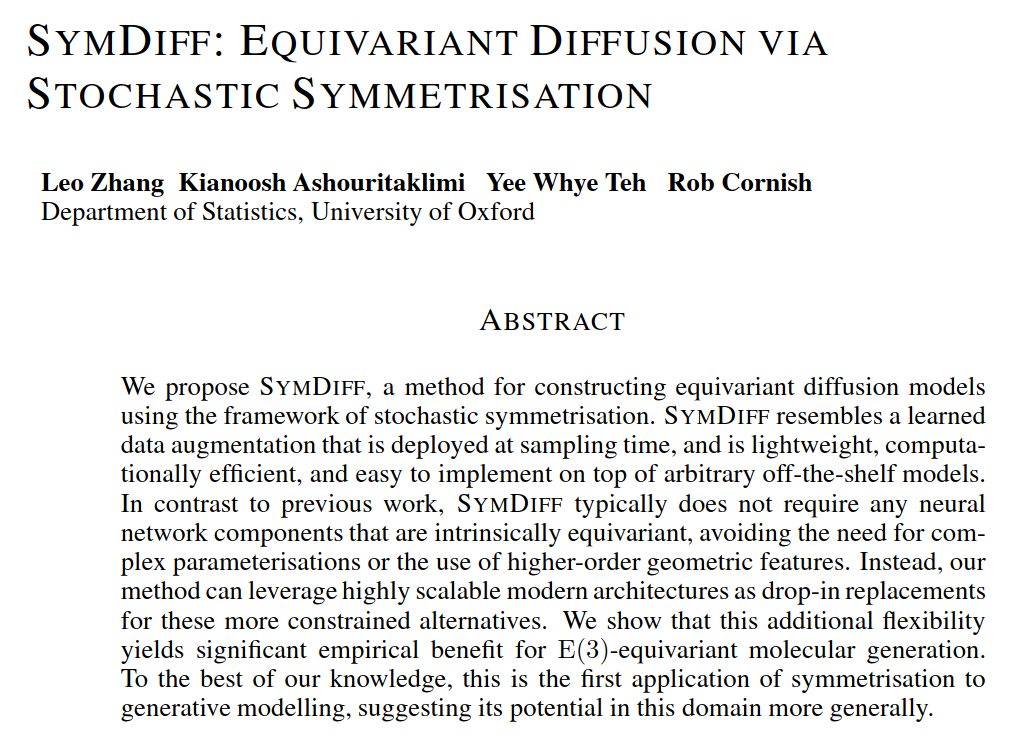
In our new paper (accepted at ICLR!), we propose the first framework for constructing equivariant diffusion models via symmetrisation
This allows us to ensure E(3)-equivariance with just highly scalable standard architectures such as Diffusion Transformers, instead of EGNNs, for molecular generation
Joint work with @kiaashour@yeewhye@rob_cornish
(1/9)