Still looking for a project this weekend?
Try out the #Ardunio based @OttoDIY roboter controlled with @yakindu state machines published on @Hacksterio
https://t.co/LVhU7Vrug7
Statecharts are on the front page of Hacker News (again), with a link to David Harel's seminal paper: https://t.co/kB02QIkv1x
And the comments are (surprisingly) not terrible: https://t.co/CY3dEv8o2B
Nothing to see here just a 20 story tower casually flying into space and then landing itself upright.
What a marvellous feat of engineering! @SpaceX@elonmusk
🤖 Birth of a new Otto robot 🤖
Little inventors 👧👨 are on vacation 👍🛠! Junior Maker Lab build and test the robot 🤖 Otto 🙏
Will Otto be on vacation internship schedule? Any weekly workshops next year? Mystery https://t.co/8EpVBMTfeg
Here are some longer clips not used in our Kickstarter campaign video. It demonstrates Bittle's dynamic performance better. We are still fine-tuning the parameters of the servos.
Please share our campaign page to make Bittle a better dog! 😘
https://t.co/BcP087mMvW
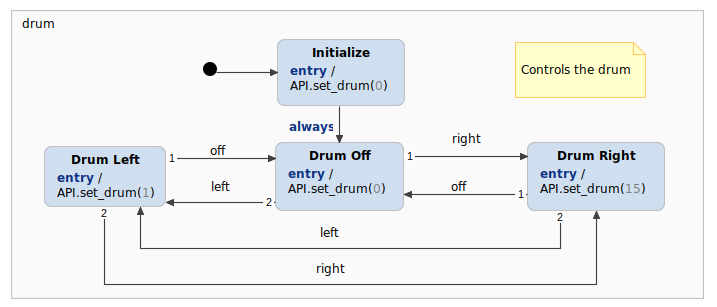
@mgutheil @yakindu For example, this is is the drum, which is imported by the "main state machine". The main state machine can raise the off, right or left event.
This is a huge advantage, as you can easily reuse state machines!
@mgutheil @yakindu Yes, they really do help to simplify the statechart.
With multi state machines, you're able to import other state machines and use them as types. Thus, you can declare "state machine" variables.
Soo, you can raise in events on or react on out events from other machines.