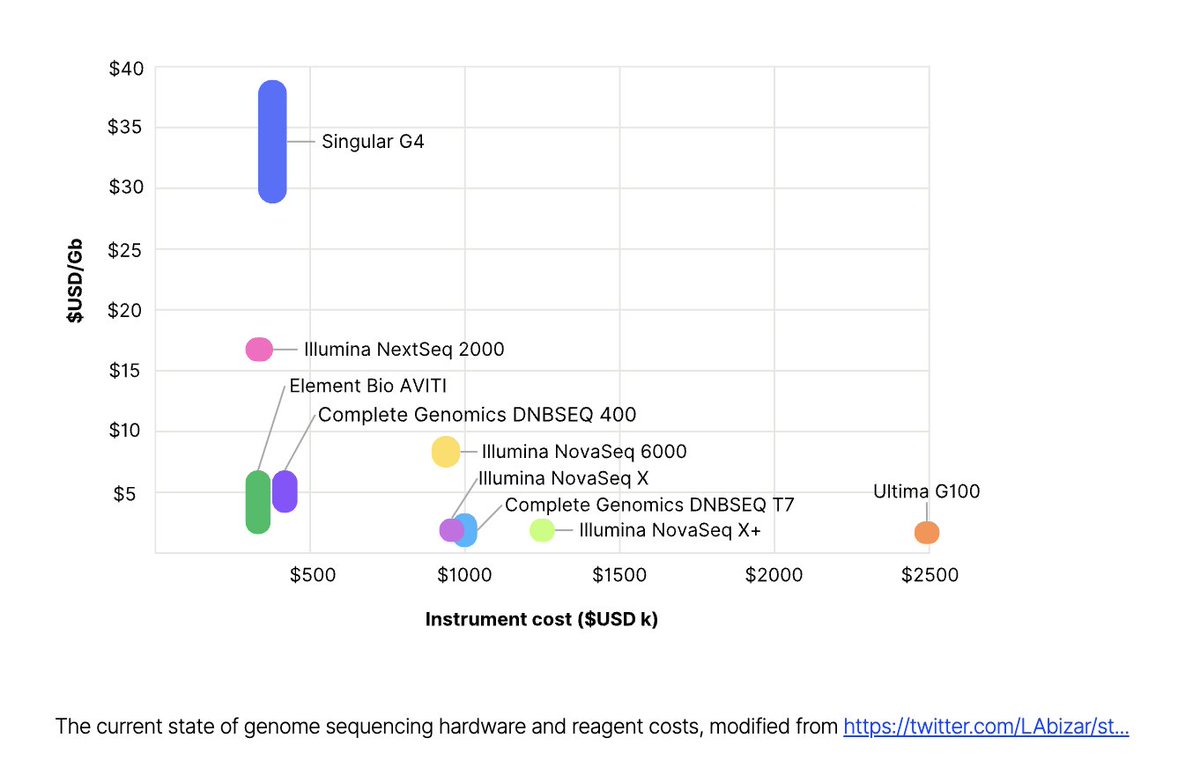
Some more chatter on @UltimaGenomics recently, partly to try and argue that the quality is worse than @illumina $ILMN SBS sequencing, and then take a reverse argument and say that ppmSeq has no merit. Some comments...
New blog post! "What happens when genome sequencing data is ‘too cheap to meter’?"
Some speculation on the coming changes in the genomics industry as sequencing costs resume their decline
https://t.co/mlPJq96Fjx
Congratulations to @AUG_University and Praxis Genomics who completed the gap-fill process for their PLA codes for hematologic malignancy analysis by #OGM at a rate of $1,863!
This approval is an amazing step forward for reimbursement and accessibility of clinical OGM testing!
@AdrianoAguzzi Given the background, it does not sound like you have a balanced dataset in terms of positives and negatives. I recommend a precision recall plot https://t.co/w6KYjkyzIG
@GregLarssen Additionally, most clinical labs don’t currently have extraction methods capable of isolating high molecular weight DNA since its not required for NGS or in situ techniques. The biggest barrier to acceptance still lies in the reimbursement landscape however, not marketing IMO.
Really highlights the need for robust IT infrastructure and intuitive interfaces ranging from EHRs, all the way down to the level of a single diagnostic test. Especially those as informationally diverse and dynamic as NGS testing.
Great preparation for my first @AMIAinformatics conference listening to @FYInformatics. Insightful conversation about common multidisciplinary challenges clinical informatics harbors and also helpful career development content.
As a Bioinformatician venturing into development/engineering in a pathology setting, these challenges are unsurprisingly not foreign to me. Diagnostic testing is becoming increasingly complex, as are the interpretation of the results.
@RobertVisse@GregLarssen This raises the question where are these emerging technologies in their journey to clinical adoption and is more development of the technology needed before an all out push for clinical markets? I think OGM has the least resistance with traditional cytogenetics paving the way.
@RobertVisse@GregLarssen The more the technology is used in a clinical setting, the more the resulting biomarkers can be correlated with clinical outcomes to facilitate drug development, provide unique diagnostic value, etc. Essentially a exponential level of adoption once that line is crossed. \3
@BrianDilkes Excellent point. Third party recruiters. My initial response is essentially 'sequencing data is sequencing data' but perhaps that may not be enough for recruiters without a deep background?
As a PhD who has worked in plant genomics & transcriptomics using NGS, I'm often told by job recruiters I need experience with human datasets. I feel as if my skills should be easily translatable, but are human datasets distinct enough to nullify my experience?
Great discussion at the @FLGenomics 'Exploring the Current Sequencing Landscape' event today! Natalie Thorne (@MelbGenomics) raised a great point by describing the current state of commercialized post-sequencing analyses as 'non-modular'.