@MasseyCarl61869 @FatSakHead @princesleeper@StephenKing Proof by assertion, sometimes informally referred to as proof by repeated assertion, is an informal fallacy in which a proposition is repeatedly restated regardless of contradiction and refutation.
@AshleyLeahy@ImtiazMadmood You mean like the one in the 1947 UN resolution, which was accepted by the Israelis but not by the Arabs, who responded by a full-scale war?
@reznavajo@JSheltzer This notion is so obvious to test. Do previous prizes support it? Last year: ”for his discoveries concerning the genomes of extinct hominins and human evolution" 🤔
@CharlieZxi1@jonathanstea No. It's just that they do spend their lifetimes doing so. (Along these lines: you can read a paper on aviation. Will you understand it? Can you then land a plane?)
@YourFriend_zone @kajakallas Oppenheimer is just being a stellar blockbuster, and yet you somehow mange to come up with this particular whataboutism? (Also, maths is not quite a strength of yours, is it)
@niswarth@jonathanstea The vast majority of microbes are not even pathogenic. In a future, where science is not stifled by the anti-science idiocracy movement, highly precise (e.g. CRISPR-based) molecularly-targeted therapeutics can be developed against the rest
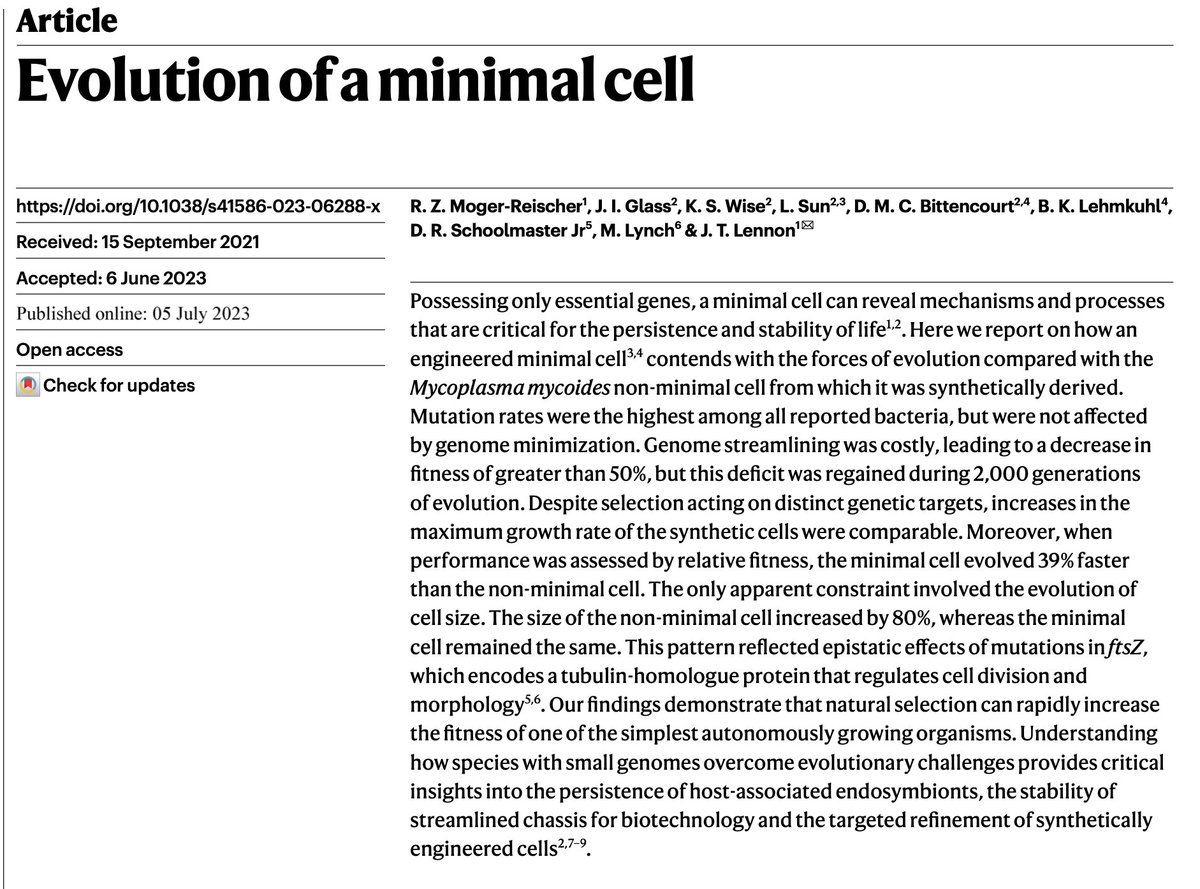
A mind-blowing paper has come out today in @Nature
In 2016, JC Venter Institute scientists trimmed a bacterial genome to its barest minimum required for life to synthesize what they called a "minimal genome" (https://t.co/Rk8oZJ0bUj).
Today, a group of scientists from Indiana University reports how that minimal genome evolved over 2000 generations in comparison to the non-minimal genome.
The authors found that even when you reduce a bacterial genome to its absolute minimum where every nucleotide matters, the genome undergoes mutational events generation after generation as much as the non-minimal genome. One simply cannot stop the evolution.
Just over 300 days of evolution (equivalent to 40,000 years in humans) the minimal cell has gained everything it lacked in fitness on day one in comparison to the non-minimal cell.
When comparing the evolved traits between the minimal and non-minimal cells, the scientists found something striking. The evolutionary process increased the cell size of non-minimal cells but not that of the minimal cell. But that is not the striking part.
The scientists were able to identify the key mutation that resulted in cell size evolution. And it turned out that the mutation that helped the non-minimal cells to grow bigger is the same that helped the minimal cells to stay smaller. Growing bigger had a survival advantage for non-minimal cells and not growing bigger had a survival advantage for minimal cells. So, the mutation had a context-dependent effect. This just demonstrates that the evolutionary effects on traits have no absolute direction. All that matter is what is beneficial for the organism's survival.
The conclusion of the paper is metaphorically a quote from the Jurassic Park movie:
“Listen, if there’s one thing the history of evolution has taught us is that life will not be contained. Life breaks free. It expands to new territories, and it crashes through barriers painfully, maybe even dangerously, but . . . life finds a way". (https://t.co/UlxRlb86CT)
https://t.co/zA9OAqSoAu