When I was Muslim, man, this verse used to mess me up.
Jesus on the cross saying, “My God, my God, why have you forsaken me?”
As a Muslim, I used to think: how does God feel forsaken by God? That sounds like weakness. That sounds like a prophet in pain.
But then I dug deeper.
And I realized Jesus was not speaking randomly. He was quoting Psalm 22.
That entire Psalm, written by King David centuries before Christ, is a prophecy about the crucifixion:
“They pierce my hands and feet.”
“They divide my garments among them.”
“All who see me mock me.”
In Jewish culture, quoting the first line of a Psalm pointed people to the entire passage.
So Jesus was not crying out in confusion.
He was declaring fulfillment.
He was saying: “This is that.”
And at the same time, He was carrying the full weight of sin, shame, abandonment, and suffering for humanity.
Every moment humanity has cried out, “God, where are you?” Christ stepped into that pain Himself.
That is not weakness.
That is intentional.
That is prophecy unfolding in real time.
That is the King bleeding on purpose so humanity could be brought near to God.
That is the Gospel.
“If Jesus was God, why did He sleep?”
When I was Muslim, I read this as weakness. “See, He got tired like any man.”
He slept in the boat so you’d understand the storm was never in charge. He was.
Here’s the scene that flipped it for me. Mark 4. A storm so violent seasoned fishermen are screaming for their lives. And Jesus? Asleep on a cushion in the back. Mark 4:38.
I used to read that as weakness. “See, He got tired like any man.” Yeah. He did. Fully human, really exhausted, genuinely asleep.
But watch what happens next. They wake Him in a panic, and He stands up and says four words to the hurricane: “Peace! Be still!” And the sea goes flat as glass. Mark 4:39.
Catch it. The only one asleep in that boat was the only one who could command the storm. His humanity was so real He slept through a tempest. His deity was so real the tempest obeyed His voice.
That’s the whole mystery in one boat: fully man, exhausted and asleep, fully God, and the wind knows His name.
“What sort of man is this, that even winds and sea obey Him?” Mark 4:41.
He slept as a man.
He woke as God.
And He’s in your boat too.
12 Quotes That Will Change the Way You View and Attend Holy Mass
1. When the Eucharist is being celebrated, the sanctuary is filled with countless angels who adore the divine victim immolated on the altar. ~ St. John Chrysostom
2. The angels surround and help the priest when he is celebrating Mass. ~ St. Augustine
3. The best time to ask and obtain favors from God is the time of the Elevation." ~ St. John Bosco
4. The celebration of Holy Mass is as valuable as the death of Jesus on the cross. ~ St. Thomas Aquinas
5. St. Teresa was overwhelmed with God’s Goodness and asked Our Lord “How can I thank you?” Our Lord replied, “ATTEND ONE MASS.”
6. My Son so loves those who assist at the Holy Sacrifice of the Mass that, if it were necessary He would die for them as many times as they’ve heard Masses. ~ Our Lady to Blessed Alan.
7. When we receive Holy Communion, we experience something extraordinary – a joy, a fragrance, a well-being that thrills the whole body and causes it to exalt ~ St. John Mary Vianney
8. There is nothing so great as the Eucharist. If God had something more precious, He would have given it to us. ~ Saint John Mary Vianney
9. Be eager to go to Mass on weekdays also, even if it costs a sacrifice. Our Lord will reward you with His Blessings and make you succeed in your undertakings ~ St. Don Bosco
10. When we have been to Holy Communion, the balm of love envelops the soul as the flower envelops the bee. ~ St. John Mary Vianney
11. It would be easier for the world to survive without the sun than to do without Holy Mass. ~ St. Pio of Pietrelcina
12. If we really understood the Mass, we would die of joy. ~ Saint John Mary Vianney
Copied from Catholic Warrior
“Be patient with everyone, but above all with yourself. Do not be disheartened by your imperfections, but always rise up with fresh courage.”
~ St. Francis de Sales
When I was Muslim, Eid al-Adha was my favorite holiday.
Every year: the sacrifice. A lamb or goat slaughtered to commemorate the day Allah ransomed Abraham’s son with a substitute.
And the Quran’s own words haunted me for years after I left.
Surah 37:107 goes “And We ransomed him with a GREAT sacrifice.”
Great? An animal caught in a bush is “great”? Rams are not rare. There is nothing great about a ram… unless the ram is pointing at something.
Go back to the original account. Genesis 22. Isaac asks his father, “where is the lamb?” And Abraham answers with one of the most loaded sentences in the Bible:
“God will provide FOR HIMSELF the lamb.”
Not “God will provide A lamb for us.” God will provide HIMSELF the lamb.
And it happens on a mountain in “the region of Moriah,” the exact region where the Temple would later stand (2 Chronicles 3:1), walking distance from a hill called Calvary.
Stay with me now…
Abraham even names the place “The LORD Will Provide,” and Genesis adds: “on the mountain of the LORD it WILL BE provided.”
Future tense. The story itself says the real provision hadn’t happened yet.
Two thousand years later, John the Baptist sees a man walking toward him and says the sentence Isaac’s question had been waiting for:
“BEHOLD, the Lamb of God who takes away the sin of the world.”
There’s the great sacrifice.
Islam slaughters an animal every year and calls the substitute “great” without ever asking what it was a substitute FOR.
The ritual survived. The meaning didn’t.
I found the Lamb.
PRAISE THE LORD, I’M FREE
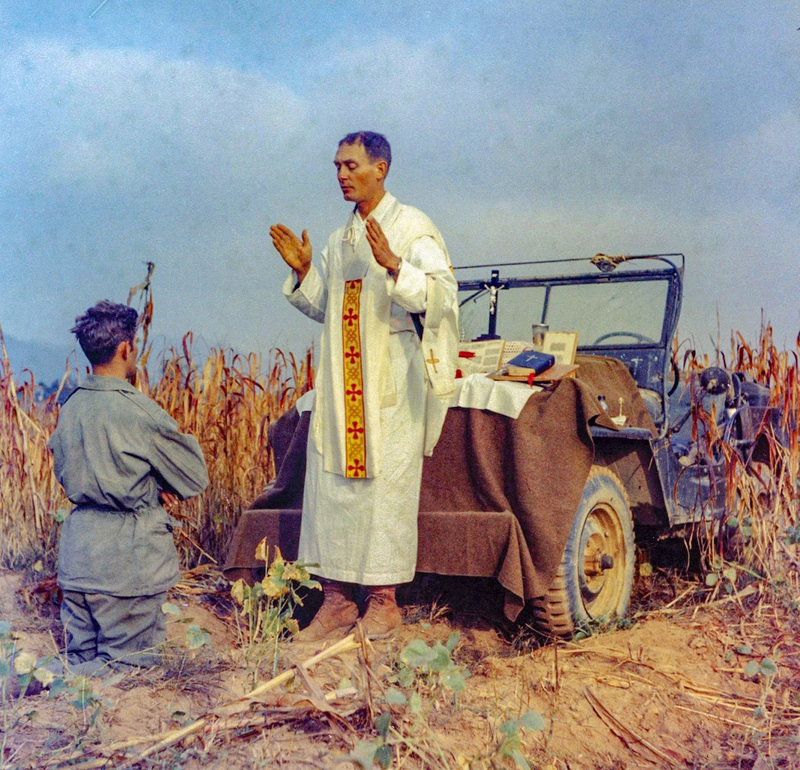
The bravest man in the prison camp did not carry a rifle. He carried a Mass kit and a stolen sack of food, and the Communists were more afraid of him than of any soldier there.
Father Emil Kapaun was a Catholic priest from a tiny farm town in Kansas. Soft spoken, humble, the kind of man who probably should have spent his life doing quiet parish work. Instead he put on an Army uniform and became a chaplain, and he ended up on the front line in Korea in the fall of 1950.
At the battle of Unsan his unit got overrun by a massive Chinese assault. Men were told to pull out and save themselves. Kapaun refused to leave. He walked back and forth through the incoming fire, unarmed, dragging wounded soldiers out of the open, giving last rites to the dying, carrying men on his back. When the position finally fell he could have slipped away. He stayed with the wounded who could not move, knowing it meant capture.
Then came the moment people never forgot. A Chinese soldier stood over a wounded American sergeant named Herbert Miller, about to execute him where he lay. Kapaun walked straight up, pushed the enemy soldier aside, picked the wounded man up off the ground, and carried him away. The enemy was so startled by the sheer nerve of it that they let it happen. Miller lived the rest of his life because a priest refused to let him be shot.
What he did in the prison camp over the next seven months might be the most incredible part. In a filthy, freezing camp where men were dying of starvation and dysentery every day, Kapaun became the heart of the place. He snuck out at night to steal food for the sick. He boiled water in secret to keep men from dying of disease. He gave away his own tiny rations. He washed the filth off dying soldiers with his own hands, and he led prayers out loud in defiance of guards who beat him for it, keeping hope alive in men who had every reason to quit.
The Communists hated him for it, because faith was the one thing they could not take from those prisoners as long as he was breathing. Eventually the beatings and the starvation and a blood clot broke his body. When he got too sick, the guards hauled him off to the death house, a filthy room where they dumped men to die alone. He forgave his guards on the way out. He died there in May 1951 at just thirty five years old.
Sixty two years later they gave him the Medal of Honor. His fellow prisoners, the ones who lived because of him, spent their whole lives telling the world what he did. His body, long lost in an unmarked grave, was finally identified and brought home in 2021. And the Catholic Church is now on the road to declaring the humble priest from Kansas a saint.
“The Catholics pick the very best chaplains - young, virile, active and patriotic. The troops look up to them. I’ve only met one or two Protestant chaplains worth their ration cards.”
- USMC Lt. General Chesty Puller
In the Pacific Theatre of WW2, a Protestant chaplain approached Col. Puller, complaining that many Marines were converting to Catholicism.
Later, while the Marines were out on patrol, Puller found that same chaplain at the battalion HQ. He told him,
“Your place was with the fighting men. You remember our little talk about Protestant boys joining the Catholics? They see those priests doing their duty and see you evading it. I can’t work up much sympathy for you.”
There were so many converts that mothers in the US wrote letters to the front, concerned that their sons would join the Catholic Church. Puller wrote back that if the Protestant chaplains had the guts to go where the Catholic chaplains did, where the bullets were flying, maybe their sons wouldn’t be converting.
Chesty Puller, a lifelong Episcopalian, had great respect for the Catholic chaplains of WW2 and even sent his own children to Catholic school after the war.
Debido a las últimas controversias sobre cismas y excomuniones, de las que ya mucho se ha hablado, quiero aprovechar y refrescar el ambiente para contarles algo que muchos católicos quizás no saben.
¿Sabían que, además de la Iglesia Romana, existen otras 23 Iglesias orientales?
Sí, ya sé lo que te estás preguntando, y te lo respondo: son 100 % católicas, en plena comunión con el Papa y con la Santa Sede.
No son "otra religión", ni "otro tipo de cristianos", ni otras denominaciones. Son tan católicos como tú y como yo; simplemente tienen un origen cultural y geográfico diferente.
Te explico de forma sencilla.
Lo que cualquier católico conoce como "la Misa", con sus partes, sus cantos y sus respuestas, es en realidad el Rito Romano. Pero, simultáneamente, mientras el cristianismo crecía en Roma durante los primeros siglos, ya había florecido en Jerusalén, Antioquía, Alejandría, Constantinopla y Mesopotamia, donde cada una tenía sus propios obispos.
Con el crecimiento del cristianismo, estas liturgias se fueron homogeneizando y poniendo por escrito.
Cada Iglesia, con base en la tradición apostólica, fue organizando su propio patrimonio litúrgico que, con el tiempo, dio origen a los distintos ritos que hoy conserva la Iglesia católica. Cada una posee su propia liturgia, espiritualidad y disciplina, heredadas de los primeros siglos del cristianismo.
Te menciono algunas:
Los católicos maronitas conservan la tradición de la sede de Antioquía, donde el mismo apóstol Pedro predicó y fué obispo, y nunca rompieron la comunión con Roma.
Los católicos bizantinos celebran la Divina Liturgia de San Juan Crisóstomo, desarrollada en Constantinopla a finales del siglo IV en lo que hoy es Turquía.
Los caldeos conservan una liturgia antiquísima proveniente a la evangelización de Santo Tomás en Oriente de acuerdo a la Tradición.
Los católicos coptos conservan la tradición cristiana nacida en Egipto, fundada por San Marcos Evangelista en Alejandría, y mantienen una de las liturgias más antiguas de toda la Iglesia.
Y así existen muchas más, pero te mencioné algunas de las más grandes...
Ahí encontrarán sacerdotes con vestimentas diferentes, idiomas litúrgicos antiguos, cantos distintos e incluso sacerdotes casados. Y, aun así, todos profesan la misma fe católica, celebran los mismos sacramentos y están en comunión con el mismo Sucesor de Pedro.
Por eso, no todo en la Iglesia católica es el rito romano; tampoco todo es la Misa Tridentina o el Novus Ordo.
Eso es la catolicidad: unidad en la fe y en nuestro Credo, no uniformidad absoluta en las tradiciones con "t" minúscula.
A continuación, te dejo parte de la plegaria eucarística del rito maronita, recitada en arameo, el idioma de nuestro Salvador, para que puedas apreciar el contraste con el rito romano, contemplar la riqueza litúrgica de la Iglesia católica y descubrir la belleza que hay en nuestras diferencias.
Míralo hasta el final, no te vas a arrepentir.
John 21.
One of my favorite details in the New Testament:
When the disciples find Jesus making breakfast, he is cooking over a charcoal fire.
The word for charcoal fire—anthrakian—is only used one other time in the NT: When Peter warms his hands as he denies Jesus.
1/2
When I share Jesus with a Muslim today, I'm not trying to win a debate.
Because I remember what it felt like to be on the other side.
Behind most objections isn't ignorance. It's fear.
Fear of losing family. Fear of losing community. Fear of being alone. Fear of stepping into the unknown.
As a Muslim, I didn't need another debate champion. I needed someone who could stay steady while my entire world was shaking.
Someone whose peace was stronger than my questions.
There came a point where I wasn't wrestling with theology anymore.
I was wrestling with two decades of identity.
Islam taught me that my worth came through performance. Jesus showed me grace, peace, and love that I could never earn.
That's what changed everything.
So if you want to reach Muslims, don't just send debates, articles, or arguments. Be living proof of the Gospel. Let them see the freedom, joy, and peace that only Christ can give.
Jesus didn't just change my beliefs. He rescued my soul.
And I promise you, He is worth it.
Follow me for more Christian apologetics, Maranatha content, Muslim evangelism, and bold Gospel truth.
“If Jesus was God, why did He cry?”
When I was Muslim, I used to smirk at the shortest verse in the Bible. A crying God? Weak.
“Jesus wept.” John 11:35. Two words. It should bring you to your knees.
Then I actually read WHERE He’s standing.
At the tomb of His friend Lazarus. And here’s the part that undoes me: He’s about to raise him. In sixty seconds He’ll shout that dead man back to life. The victory is already loaded.
And He weeps ANYWAY.
He didn’t have to. The happy ending was already in His hand.
But He looked at the grief around Him — the sisters, the mourners, the sheer wreckage that death makes of everything — and He entered it. He let it hit Him. God, with tears running down His face, at the graveside of someone He loved.
The God of Islam was too majestic to weep. I was proud of that. Until I met a God who was strong enough to.
“We do not have a high priest who is unable to sympathize with our weaknesses.” Hebrews 4:15.
Whatever you’re burying right now — He’s not watching from a safe distance.
He’s the God who weeps at gravesides.
And then empties them.
Now you and me get to rejoice forever with our Lord Jesus Christ.
NEW: Bishop Frank Caggiano (Diocese of Bridgeport) on the SSPX:
My dear friends in Christ,
It is with deep sadness that I write to you concerning recent events involving the Society of Saint Pius X, commonly known as the SSPX. On July 1, in Écône, Switzerland, the Society consecrated four new bishops without the mandate of the Holy Father and against his expressed will. In response, the Holy See issued a decree on July 2 declaring that the bishops involved have incurred the penalty of excommunication.
Of particular importance for us in the Diocese of Bridgeport is the clarification that accompanied that decree. The Holy See has made clear that the clergy of the Society are now to be regarded as schismatic. This means that, from this day forward, the sacraments they celebrate are illicit and, most significantly for the faithful, the confessions they hear and the marriages at which they preside are considered invalid by the Church.
I know these words are difficult to hear, especially for those among us who have worshiped, whether regularly or on occasion, at liturgies celebrated by priests of the Society. Over the years I have come to know some of these families. I have been moved by their love for the beauty of the sacred liturgy, their devotion to our Catholic tradition, and the seriousness with which they seek to raise their children in the faith. My heart goes out to them at this painful moment, and I want them to know that they remain very much a part of our diocesan family.
I also wish to offer a word of reassurance. This excommunication does not fall upon those who have simply attended these liturgies out of a sincere desire to worship and who have never intended to reject the authority of the Holy Father or the teaching of the Church. What the Church now asks is straightforward: knowing the situation as it now stands, the faithful of the Catholic Church can no longer take part in the liturgies of the Society, for to do so knowingly would be to share in a separation from the Successor of Peter.
And so, I invite home those who previously worshipped with the Society. The reverent worship that has drawn those faithful remains very much alive in our own parishes. The traditional Latin Mass (the Vetus Ordo) continues to be celebrated in our diocese at Saint Mary Parish in Norwalk, The Oratory of SS. Cyril and Methodius in Bridgeport and The Oratory of the Sacred Heart of Jesus in Georgetown, in addition to the celebration of Holy Mass in its ordinary form throughout our diocese. In these sacred places you will find not only the beauty you cherish but the fullness of communion with the universal Church and with our Holy Father, Pope Leo XIV. As the ancient saying reminds us, “Where Peter is, there is the Church” (Ubi Petrus, ibi Ecclesia).
I am also grateful to share that our Holy Father has made provision for any priest or member of the faithful of the Society who desires to return to full communion. Our diocese stands ready to welcome them with open arms and great tenderness. Anyone who wishes to walk this path, or who has a personal question about his or her own situation (for instance, regarding a marriage or a confession), is warmly encouraged to speak with a priest of the diocese, who will offer guidance with patience and care.
Please join me in praying for all who are affected by these events, for the clergy and faithful of the Society, and for the unity of Christ’s Church. Let us pray as well for our Holy Father, Pope Leo XIV, as he carries the heavy burden of shepherding and unifying the flock entrusted to him.
May Mary, Mother of the Church, watch over all her children and draw them ever closer to the heart of her Son.
Sincerely yours in Christ,
Most Reverend Frank J. Caggiano
Bishop of Bridgeport
Like many others, I have been alarmed by the success of certain politicians in our country who identify as extreme socialists or communists.
This is not a matter of classical liberals triumphing over standard-issue conservatives; this is the victory of people who stand athwart the fundamental principles that undergird our country.
There are many reasons why I detest Communism, but I want to draw attention to just one issue of supreme importance.
Karl Marx said that the first critique is the critique of religion. He meant that, before a complete re-working of the politics and economics of a society can take place, religion has to be taken down.
This is because religion, as he saw it, is the “opium of the masses,” a drug taken to dull our sensitivity to the suffering caused by economic exploitation. As long as the suffering populace is lured into complacency by fantasies about God's providence and the promise of eternal life, they will never rise up and throw off their chains.
But there is a second reason why the elimination of religion is of paramount significance for Marx.
Communism aspires to be a totalizing system, involving the government's control over education, entertainment, communication, politics, and especially economics.
What stands resolutely athwart this ambition is religion, which declares that all of these societal expressions are finally under the judgment of God. So, if you want Communism to succeed, religion has to be stamped out.
If you doubt me on any of this, I would encourage you to read the recent histories of China, Russia, Cuba, Nicaragua, Vietnam, Cambodia, and Venezuela. Revisit those histories and tell me I'm wrong about the attack on religion.
Might I encourage my fellow believers in God not to be complacent in the face of this very troubling development in the American body politic?
In a recent interview, Archbishop Vincenzo Paglia, former grand chancellor of the John Paul II Institute on Marriage and Family Life, confirmed the worst suspicions that many of us had.
He admitted that the changes he made at the Institute during the Pope Francis years were designed to initiate a "very profound" reform of the idea of the natural law.
Instead of absolute moral norms grounded in a keen understanding of the basic goods, he and his colleagues were proposing a moral theory rooted in historical discernment of subjective and cultural experience--not an "armchair theology" but one operating "within history and within people's lives."
This, of course, is the language of trendy postmodernism, and it is dangerous indeed.
Allow me to illustrate the principle with one example. Is slavery wrong?
Intrinsically wrong? Wrong no matter what public opinion polls say about it, no matter what the current consensus on it might be? I imagine any decent person would say yes.
But that yes is predicated upon precisely what the tradition calls the natural law and the basic goods. There are some values so fundamental that acts repugnant to them are by their very nature wicked.
If you want a highly articulate presentation of this idea, go to St. John Paul II's Veritatis Splendor.
If we say that this is just "armchair theologizing" and that morality is a function of ever-shifting cultural and experiential data, then why couldn't slavery be justified?
One of the very smartest persons that ever lived, the philosopher Aristotle, thought it was; extremely bright and morally upright persons in our country, well into the 19th century, thought it was permissible.
Who is to say whether the consensus might shift back again? Who is to say that "lived experience" might come to justify it?
What any truly coherent moral program requires is the very thing that Archbishop Paglia and his colleagues were endeavoring to eliminate, namely, absolute moral norms.
Ridding ourselves of these in the name of freedom or pastoral sensitivity actually renders moral discourse dysfunctional, just as relativizing the basic principle of logic would render any rational conversation impossible.
The Archbishop's interview, frankly, reminded me of the discussions I had at the Synod on Synodality with some of my German colleagues. Under the rubric of the development of doctrine, they were eager to relativize or radically change the principles undergirding classical morality. If this was and is truly the game, we have ventured onto perilous seas.
Link to the article below.
Everyone's talking about what @Pontifex said about Sheen today, but I'm looking at his sex realism in this talk:
"The Scout method puts the person at the centre, caring for all aspects of their relationships and human richness. Your Association’s pedagogical choice is expressed, in this regard, in educating in separate sections for boys and girls, so as to devote specific attention to each group. Exploring in this way the fundamental characteristics of being a woman and being a man is a preparatory step towards an authentic and conscious encounter with the other, which can foster mutual growth."
AI Theology has not yet developed its Trinitarian Theology.
St. Ephrem, ladies and gentlemen, on this Trinity Sunday:
"Take as your symbols: the sun for the Father,
light for the Son,
heat for the Holy Spirit.
Though he is only one in being
we see him in trinity.
Who, indeed, can grasp the inexplicable?
He who is unique is also multiple: one is formed of three
and three of one –
What great mystery! What manifest wonder!
The sun is distinct from its shining
even while adhering to it,
for its ray is also sun.
Yet no one speaks of two suns
even though, here below,
the sun's ray is also sun.
No more do we say there would be two Gods.
Our Lord himself, is he not God?
He is also raised above all creatures.
Who can show how or where
the sun's ray and its heat are joined,
free as they are?
Neither separated nor confused,
united and yet distinct,
free but bound: O wonder!
Who, by studying them, can master them?
Yet do they not seem
so simple, so uncomplicated?...
Whereas the sun remains whole above,
its brilliance and heat are a clear symbol
for those of us below.
Indeed, its shining has come down to earth
and remains in our sight
as though clothing our flesh.
When our eyes close like those of the dead
at the time of sleeping, it leaves them
who will later awake.
But how light penetrates the eye
no one knows.
Even so was it with our Lord in the womb...
Even so, our Saviour
put on a human body in all its weakness
that he might come to sanctify the world.
Yet, when the sun's ray returns to its source,
it has still not been separated
from the one who gave it birth.
It leaves its heat to those below
as our Lord left the Holy Spirit
to the disciples.
Consider these images within the created world;
as for the Three, allow yourself no doubt
lest you be lost!
I have clarified for you what was obscure:
how Three form but One,
A Trinity composing one single essence!"
—Saint Ephrem (c.306-373), deacon in Syria, Doctor of the Church
I am so glad that you asked this question. This is one of my favorite things to witness.
So, I was away from the church for about 20 years, and that is a lot of sin to atone for. Fornication, leading others astray, denying the Holy Spirit, committing blasphemies. Heck, at one point I even desecrated a Bible and uploaded it to YouTube.
So what I wound up doing was taking one of those examination of conscience booklets, and after doing the suggested meditations and prayers, I put a little X next to every sin that I could recall committing — and this thing looked like a grocery list by the end.
So I contacted the local priest and explained my situation — that I was returning to the Catholic Church after being away for such a long time, and that I would appreciate having a private confession period.
And so Father John, my priest, arranged to open the confessional to hear my private confession one day during the week.
Obviously, I was really nervous. I hadn't been to confession in nearly two decades, and I scarcely even remembered how to do it. So, I am very glad that I had that examination of conscience booklet that gave me explicit instructions on how to do it.
So I went into the confessional, got on my knees, and said, "Bless me, Father, for I have sinned; it's been nearly 20 years since my last confession."
Then I just rattled off the list.
After I was done, I was of course very nervous. What was this man going to say? And how many hours of community service was I going to have to do in order to make up for all the debauchery in my life?
He said to me, "That was a very good confession...." and then told me of God's love and mercy, and how through Christ's sacrifice on the cross I am washed of my sins...
And then he said, "For your penance, I would like you to attend Mass tomorrow and receive the Eucharist." I think you referred to it as Penitential Communion.
And then he told me, "Welcome back" and "Go in Christ's peace."
Obviously, that had a lasting effect on me — and I will spend the rest of my life trying to become worthy of that mercy. I know I can't get there alone, but through the grace of God and the body of Christ.
And that's it.
Grateful to @Forbes for telling our story. Catholic AI is necessary. If you feel the same way we do, please help spread the word. Together, with the guidance of the Holy Father, we can ensure the most powerful tool ever created is used to help bring people to Christ. For His glory!