You’re very welcome! I wanted to share a little more about what I’d eventually like to see from $IREN. Obviously, management has a much better understanding of what’s happening behind the scenes than I do, and so far, I think they’ve made all the right calls, especially by not rushing to contract all their capacity and benefiting from better pricing and financing terms.
Right now, bare metal AI cloud is probably the best and fastest way to ramp up the business and get as much value out of every GW as possible without becoming an AI lab themselves.
Think about it. Apart from the much longer leases and lower risk, with colocation you still need to finance and build the data center, but you only generate revenue from the infrastructure itself. If customers are willing to prepay 90% of your GPU capex, you can also capture the economics of the compute layer with very little additional upfront capital of your own. Why wouldn’t you take advantage of that in the current market?
I’d like to see them take full advantage of this AI boom and turn as many of their assets into cash flow generating assets as quickly as possible. Once they’ve achieved that scale, I’d like to see a mix of revenue from different business segments, including colocation and potentially other cloud and enterprise software services, taking elements from the business models of $DLR, $EQIX and perhaps $ORCL.
For reference, DLR and EQIX are currently trading at around 9x and 9.6x sales, respectively, while ORCL trades at around 4.5x sales and ~17x earnings.
Having a mix of these businesses could bring more stability and predictability to their cash flows while reducing their dependence on GPU economics. By then, we can start valuing each business segment based on its own growth, earnings and cash flow multiples.
I also have some other ideas about what they could do, more on the technological and physical side, but I’ll keep those to myself for now. I’d first like to see them generate enough cash flow to even start thinking about those opportunities. That’s more of a 2028 discussion.
I think this is how $IREN could eventually become a real powerhouse, but the diversification of the business is more of a 2029/30 discussion for me.
The goal is to use today’s exceptional AI economics to build a business that doesn’t depend on them in the future, as supply and demand will eventually find a better balance.
First, let’s get as much out of this AI boom as possible.
Greetings from Toronto!
Thanks, appreciate it! It largely depends on how far forward the market is willing to look and what multiples it’s willing to pay. Right now, $IREN trades at 5-6x its current $1 bln ARR or a little over 1x the $4+ bln ARR targeted for Jan/Feb.
I think $5-6 bln ARR by June is reasonable. By then, we should also have more clarity on a customer for Sweetwater, as customer requirements are needed for the internal design of the data centers. The market might already be looking at eoy 27 ARR by then.
Assuming 500m shares outstanding to account for potential dilution, a more depressed valuation of 4-5x June ARR would give us a share price of $40-60. If sentiment turns bullish again and the market realizes how much more compute we need, 8-10x would give us $80-120.
I also expect the need for further dilution to gradually disappear as cash flows from existing contracts ramp up. So rather than having a fixed price target, I’d work with a valuation range and adjust it as the business develops
@FuboLibs@fingaz_1122@egregious_poop@anteksiler@andyfazliu_@tryramp That’s exactly my point. OpenRouter doesn’t capture all enterprise usage, but neither does Ramp. I’m not claiming my data represents the entire market, I’m questioning how strong their claim is when the available data is contradictory
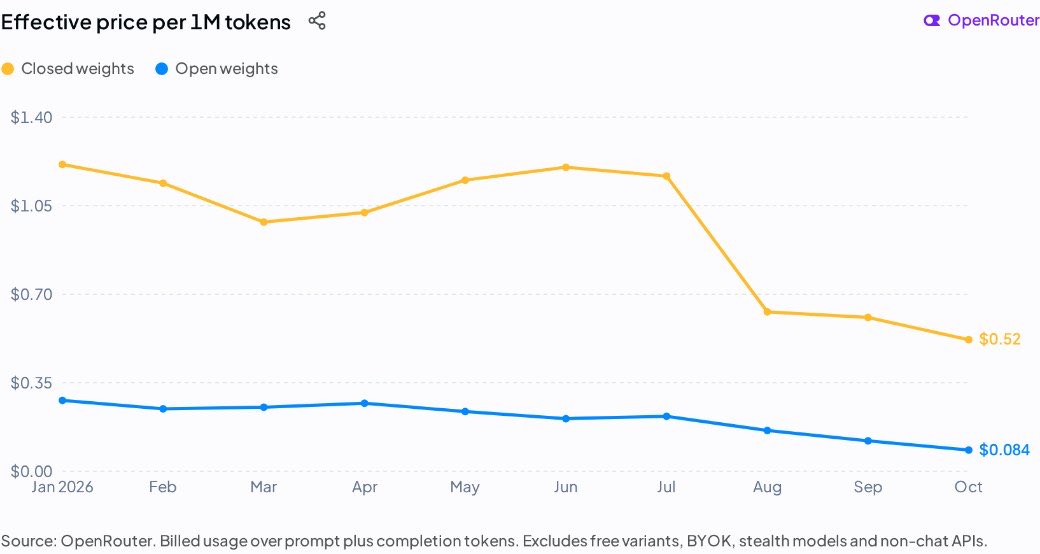
@brandonjcarl@garrytan@OpenRouter Token consumption more than tripled between July and October, and weekly volumes have continued to grow strongly over the past six weeks. Do you have data showing that the combined inference and compute efficiency gains have outpaced that growth over the same period?
Contrary to what @tryramp says, this chart shows token consumption growing exponentially. If consumption growth more than offsets falling token prices (which it did), that’s exactly what Jevons predicts. Even without considering that, the fact that they don’t capture all enterprise spending alone makes it a bold claim to say Jevons is broken
@KASM_Capital QQQ launched in March 1999, conveniently excluding basically the entire 1990s bull market. Put the same rule to the underlying $NDX and you’ll find that the exact same -5%/+5% reversal occurred near major market bottoms in both 1997 and 1998
@WaferBull@pequityresearch The gear might be a little overkill for conventional workloads, but that doesn't mean it can't be repurposed. There are plenty of use cases for data centers beyond AI. The obsolescence of compute hardware doesn't imply the obsolescence of the underlying infrastructure
That's the beauty of the bootstrap model. It doesn't necessarily depend on renewals. The idea is to get the initial investment back with a payback period of ~3 years, now closer to ~2 years under more favorable contract terms, and use the excess cash flow to fund further expansion within those first 5 years, while retaining infrastructure with a 20 year useful life. If AI demand were to decline significantly, $IREN could explore the $DLR or $EQIX route and transition towards a more traditional colocation business. AI remains central to my investment thesis, but I don't see it as a prerequisite for long-term success. And if AI demand continues to grow, you're potentially looking at a generational company
True, that’s not a given. We have no idea what demand will look like in 5 years when the contract expires, how technology will evolve or how much compute it will require. But what I can tell you is that the contracts right now provide one hell of a bootstrap to future growth. That’s what you’re buying. And even if AI demand goes down the drain, the land, power and data center infrastructure still have value beyond AI
@WaferBull@pequityresearch $MSFT and $JNJ are the only two triple A rated US public companies, so if half your backlog is tied to one customer, you really couldn't ask for a safer anchor
@alphacharts365 The lower trendline makes sense, but the upper one is pure hindsight bias. Draw it using peaks in the late 60s and 80s, and price would have blown right through the upper trendlines
1/ Everyone take a deep breath. Texas data centers aren't going anywhere. The Texas governor has very limited authority to stop them. Calls for a pause or moratorium must be approved by TCEQ—the permitting authority of Abbott appointees. Here's how Texas permitting really works👇
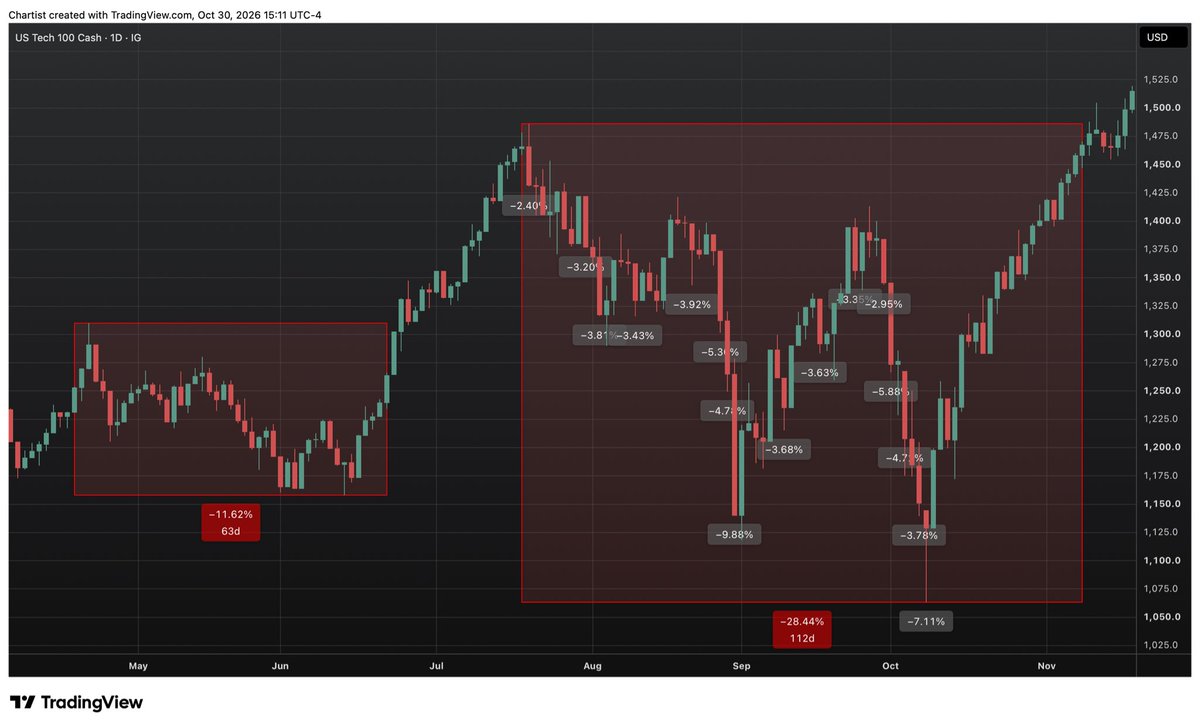
If this drawdown has you screaming Dotcom, you would’ve been bearish for most of the late 90s.
From 1996 onward, Nasdaq saw worse pullbacks than this. In 1998 it dropped almost 30%, recovered and then kept running for another 18 months.
This isn’t even close to extreme yet.
https://t.co/YEQt6fdvFK
A reminder of how volatile strong bull markets can be.
The Nasdaq had plenty of 10%+ pullbacks in the late 90s and some took months to make a new high.
A reminder of how volatile strong bull markets can be.
The Nasdaq had plenty of 10%+ pullbacks in the late 90s and some took months to make a new high.
@JK872103 It identifies potential turning points where momentum starts shifting and a reversal becomes more likely. They’re generally good buying zones