The Swedish government told her she owed 102% of her income in taxes. She was 68 years old, a children's book author, and held no political power. Yet, by writing a simple fairy tale, she helped topple a government that had ruled for 44 years.
Stockholm, 1976.
Astrid Lindgren opened her mail to find a tax assessment that defied logic. As Sweden’s most beloved author and the creator of Pippi Longstocking, her books had taught generations of children about courage, independence, and standing up to bullies. Now, she had to face a broken system of her own.
She read the document carefully, did the math, and realized the truth: due to a quirk in the law that combined regular income tax with self-employment fees, her marginal tax rate had hit 102%.
It was not a typo, nor was it a rounding error. One hundred and two percent.
If she paid what they demanded on her extra earnings, she would owe more than she actually made. She would literally go into debt for the privilege of working.
At 68 years old, she could have hired expensive accountants to quietly find loopholes and protect her wealth. She could have done what many powerful people do when systems overreach—safeguard her own position and leave everyone else to figure it out alone. Instead, she picked up her pen.
In March 1976, she published a satirical fairy tale in Expressen, a major Stockholm newspaper. It was called "Pomperipossa in Monismania" (Pomperipossa in Money-mania). It told the story of a successful author who loved her country and worked hard, only to discover a tax system designed to punish honesty and success.
The story was witty, precise, and impossible to misread. Pomperipossa was Astrid; Monismania was Sweden.
The ruling Social Democratic Party—which had governed Sweden for over forty consecutive years—was furious. Prime Minister Olof Palme went on the defensive, dismissively claiming in public that Lindgren was a wonderful storyteller but a terrible mathematician.
Astrid didn't back down. She stood by her numbers, and soon enough, the Ministry of Finance was forced to admit that her math was completely correct.
She began appearing on television and speaking out publicly, pointing out—with the calm, steady patience of someone used to explaining things to people who aren't listening—that a tax system taking more than 100% of a person's earnings wasn't progressive. It was absurd.
That September, Sweden held its national elections. For the first time in forty-four years, the Social Democratic Party lost power. While political analysts pointed to several contributing factors, like economic stagnation and inflation, everyone acknowledged that Astrid Lindgren’s tax revolt had fundamentally shifted the national conversation. She had made it safe to question a system that once seemed untouchable, giving a voice to frustrations millions of people felt but hadn't known how to articulate.
The new coalition government reformed the tax code, cutting the most extreme rates, and Astrid quietly went back to writing children's books.
But she never stopped paying attention. In the 1980s, when Sweden debated a new animal protection bill, she noticed loopholes that would still allow for cruel factory farming practices. She wrote articles, lobbied politicians, and testified before Parliament well into her eighties. In 1988, Sweden passed some of the strongest animal welfare laws in the world. It was widely nicknamed "Lex Lindgren" (Lindgren's Law) because everyone knew she was the driving force behind it.
Astrid Lindgren passed away in January 2002 at the age of ninety-four. Sweden honored her with a state funeral attended by the Royal Family and the prime minister, while thousands lined the streets of Stockholm.
But her true legacy lives on far outside of official ceremonies. Every child in Sweden still reads her books, every debate about fair taxation still references Pomperipossa, and animal welfare advocates across Europe still look to Lex Lindgren as proof of what is possible.
She never ran for office, nor did she ever build a formal political movement. She had no credentials in economics or public policy—just an extraordinary gift for storytelling. But she had spent decades writing about Pippi Longstocking, a girl who refused to follow rules that didn't make sense, stood up to bullies, and never shrank herself to make others comfortable.
Astrid Lindgren simply chose to live her life exactly like the hero she created. When authorities insisted that nonsense made sense, she refused to pretend along with them. And because she spoke up, the world listened.
Ojo!
Sólo en esta semana fueron detenidos:
- 8 carabineros en Atacama por falsificación
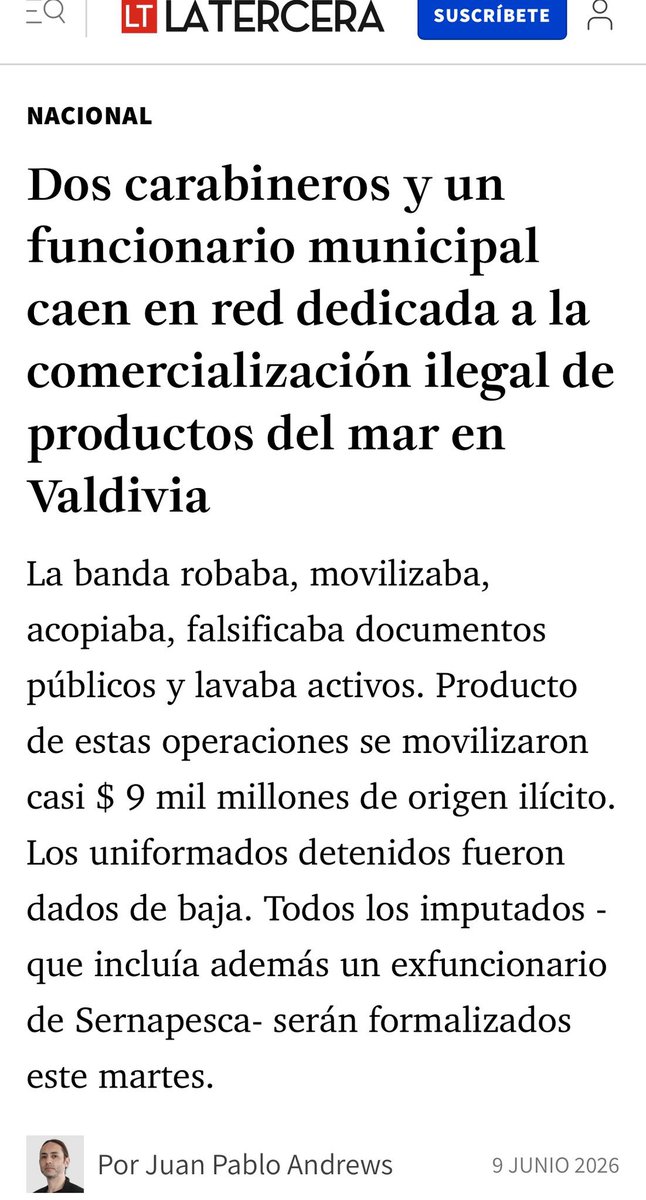
-2 carabineros en Valdivia por comercio ilegal productos del mar.
-5 gendarmes en Coquimbo por tráfico de drogas.
-6 carabineros en Talca por robos.
Ministro Arrau esto es de máxima prioridad!
Sin ninguna intención de infringir los derechos de autor, reservados a sus creadores originales. CRÉDITO PARA SU AUTOR. Espectacular video de colección. ¡ Una Belleza ! La madre naturaleza es Sabia Disfrútenlo.
In 1964, Charlie Watts married Shirley Shepherd while the Rolling Stones were just beginning to shake the world.
Everything that followed — stadium tours, screaming crowds, decades of excess that swallowed nearly everyone around him — never once pulled him away from home. Fifty-seven years together.
No affairs. No scandals. No moment when the wildest band in rock history claimed the quietest man in it.
While his bandmates made headlines for all the reasons rock stars usually do, Charlie Watts simply played his drums and went home.
He lived in rhythm, on stage and off.
He died on August 24, 2021. Shirley lived sixteen more months without him. Sixteen months — and then she was gone too.
A close friend said it simply: Charlie played the heartbeat for the greatest rock band in the world, but Shirley was the only heartbeat he ever truly listened to.
In a band built on chaos, rebellion, and living without rules, he spent fifty-seven years proving something radical.
The most quietly revolutionary thing a man in his position could do was love one woman and mean it completely.
No fanfare. No headlines. No spotlight required.
Just love. Steady. Constant. Unwavering.
It was the kind of devotion that outlasted fame, noise, and every storm the world could throw at him.
And that, perhaps, was the true rhythm of his life.
Les apparences peuvent être trompeuses.
À la fin du XIXe siècle, un couple descend du train à Boston avec l'intention de visiter l'université de Harvard. Leur tenue est simple : elle porte une modeste robe de coton, lui un costume peu raffiné.
Sans rendez-vous, ils se présentent au secrétariat du président de l'université, mais sont accueillis avec méfiance. Le secrétaire, les voyant si humblement vêtus, les prend pour des paysans et estime qu'ils n'ont rien à faire à Harvard.
"Nous voudrions parler au président", dit timidement l'homme.
"Désolé, il est très occupé", répondit froidement le secrétaire.
"Nous attendrons", rétorque calmement la femme.
Espérant qu'ils se lasseraient et partiraient, le secrétaire les a ignorés pendant des heures. Mais le couple ne bouge pas. Finalement, impatiente, elle décida d'en référer au président, espérant qu'une brève rencontre les convaincrait de partir.
Mécontent, le président les reçoit d'un air sceptique.
La femme explique : "Notre fils a fréquenté Harvard pendant un an et y était très heureux, mais il est malheureusement décédé dans un accident. Nous aimerions faire quelque chose en sa mémoire.
Le président, impassible, répond : "Nous ne pouvons pas ériger une statue pour chaque ancien étudiant décédé. Nous finirions par transformer le campus en cimetière.
"Nous ne voulons pas de statue", répond la femme, "nous pensions faire don d'un bâtiment à Harvard".
Le président, incrédule, regarde leurs vêtements et rit avec condescendance : "Un bâtiment ? Savez-vous combien coûte un bâtiment ? Ici, à Harvard, nous avons dépensé plus de sept millions et demi de dollars pour nos installations !"
La femme est restée silencieuse pendant un moment, puis elle s'est tournée vers son mari et a murmuré : "Est-ce que cela coûte si peu de construire une université ? Pourquoi ne pas fonder la nôtre ?"
Le mari acquiesce.
Sans rien ajouter, le couple s'est levé et a quitté Harvard.
Ce couple s'appelait Leland et Jane Stanford, et quelques années plus tard, en Californie, ils fondèrent l'université Stanford, dédiée à la mémoire de leur fils bien-aimé.
Aujourd'hui, Stanford est l'une des universités les plus prestigieuses du monde, au même titre que Harvard.
Moralité :
Juger quelqu'un sur ses apparences peut s'avérer une erreur colossale.
EL MANUAL DEL CUERPO QUE NADIE TE ENTREGÓ:
1. No puedes dormirte ⟶ Parpadea rápidamente durante 60 segundos. Los ojos se cansan, el cerebro los sigue.
2. Dolor de espalda por estar sentado ⟶ Aprieta los glúteos durante 30 segundos. La columna se realinea por sí sola.
3. Ojos cansados por las pantallas ⟶ Mira a 6 metros de distancia durante 20 segundos. La tensión se libera de inmediato.
4. Manos temblorosas por ansiedad ⟶ Presiona las yemas de los dedos con fuerza. El sistema nervioso se calma.
5. Dolor de cabeza detrás de los ojos ⟶ Presiona la lengua contra el paladar. La mandíbula se relaja, el dolor se desvanece.
6. Sensación de náuseas ⟶ Presiona con firmeza en el interior de la muñeca. La señal de náuseas al cerebro se interrumpe.
7. Los hipos no paran ⟶ Contén la respiración, traga dos veces, exhala lentamente. El diafragma se reinicia.
8. La mente se queda en blanco a mitad de frase ⟶ Mira hacia arriba y a la izquierda. La recuperación de la memoria se acelera al instante.
9. Zumbido en los oídos después de un ruido fuerte ⟶ Cubre tus oídos con las palmas de las manos, golpea suavemente la parte trasera del cráneo. El zumbido se desvanece en segundos.
10. Mandíbula tensa por estrés ⟶ Lengua plana contra el paladar. La mandíbula no puede mantenerse contraída.
11. Mareo al levantarte ⟶ Aprieta los muslos antes de ponerte de pie. La presión arterial se mantiene antes de que baje.
12. No puedes dejar de toser ⟶ Presiona el pulgar en el punto del pulso de la muñeca. El reflejo de la tos se debilita rápidamente.
13. Rodillas doloridas después de estar sentado ⟶ Camina hacia atrás durante 30 segundos. La compresión de la rodilla se libera en reversa.
14. Ojos parpadeando ⟶ Presiona suavemente sobre el párpado cerrado durante 10 segundos. Casi siempre es estrés o deficiencia de magnesio.
15. Despertar a las 3 de la mañana todas las noches ⟶ Tu hígado está sobrecargado. Reduce el azúcar, el alcohol, las comidas tardías. No es insomnio. Es tu cuerpo pidiendo ayuda.
Se acuerdan de Bellotita? Ella nunca fue adoptada y nosotros nos hicimos cargo. Hoy es una perrita feliz y muy querida, aunque sigue sin dejarse tocar por nadie. Ahora necesita una cirugía en su dedo espolón y estamos juntando fondos para ayudarla. ¡Toda ayuda suma! 🐾❤️🙌🏼
Dicen que hace más de 1000 años, el estratega más brillante de la antigua china diseñó este acertijo específicamente para evaluar la inteligencia de los niños
#Quilpué#Chile
Chicos este es un caso social muy complejo,don José vive de su pensión la cual no le alcanza para cubrir las necesidades de sus 5 perritos,no tiene red de apoyo, hay días q no comen ni él ni ellos,apelo a tu bondad para la compra de alimento$31mil cuesta el saco👇
Nombre de hombre que empiece con F…
que NO sea Fabián, Fabio ni Federico.
El señor dice que NO EXISTEN más.
¿Te atreves a demostrarle que está equivocado? 😏
🐾🇨🇱 Nuevo integrante en la Primera Compañía de Bomberos de #Nancagua.
Tras compartir su búsqueda y no aparecer ningún dueño, el perrito fue adoptado oficialmente por los voluntarios y bautizado como “El 38”.❤️
@carolinapinoc@PerrosPlazaHuem@CarolinaSequel@cleivamoris