Reece Martin (@rm_transit) on zonal architecture.
"Cars are filled with tons of electronics, brakes and sensors and everything, and it would all go back to one central computer and then back out.
Zonal architecture flips that. Instead of one giant computer, you have a bunch of smaller computers throughout the car. Instead of running cables from every brake to the front, you send them to the local computer, it's processed locally, and then goes back."
"That's what enables self-driving. Now you have better control over all these different elements of the vehicle, and you don't have to worry about communication speeds between this computer and this component."
"People think of Tesla and they think of EVs, and it's like, no... They've done like 15 things that are incredibly innovative, and the only thing people think about is EVs and maybe a bit of self-driving."
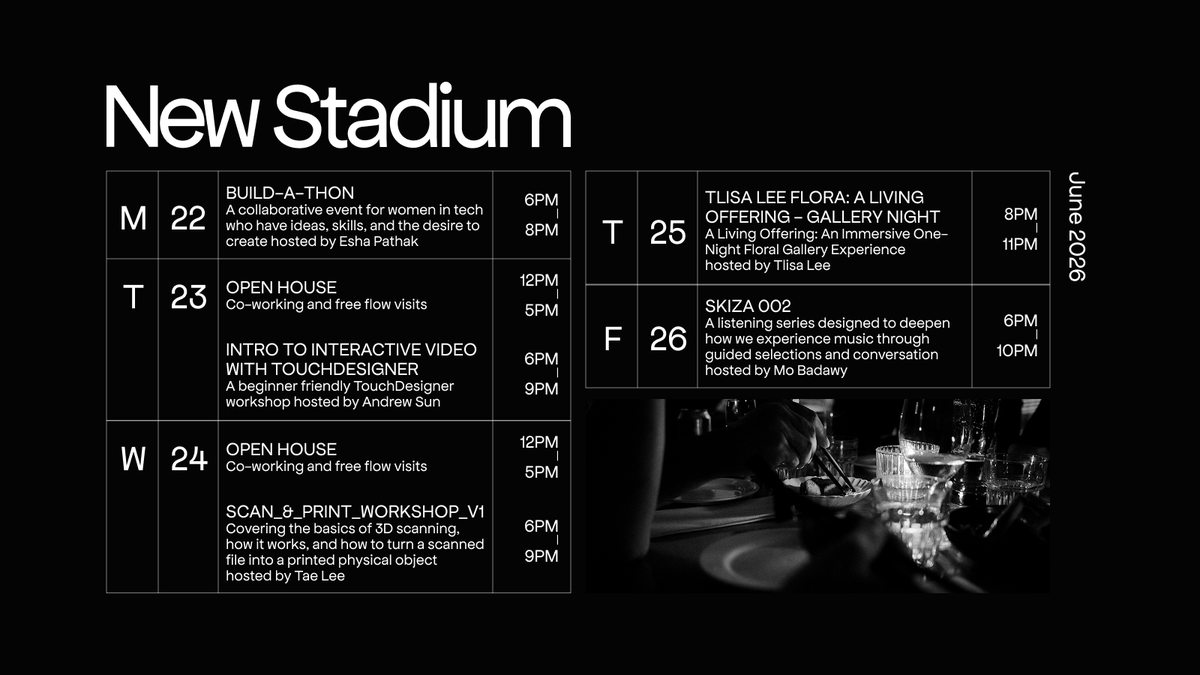
A different discipline every day this week.
Build-a-thon, a beginner TouchDesigner workshop, the basics of 3D scanning and printing, an immersive floral gallery night, and a guided listening session to close out the week.
Open house on Tuesday and Wednesday.
Links below.
announcing 'MARKET' for Falcon GX
your home for the latest & greatest falcon projects
discover new aesthetics for your brand
remix projects to make them your own
your journey to designing different starts here
On April 29th, New Stadium hosted the inaugural SESSION, a design and research initiative led by Final Research.
Opening the series, Darius Ou presented Hyper Press, his most comprehensive talk yet on 3D-printing entire books.
Darius is a Singapore-based graphic designer whose practice focuses on typography, motion design and graphic lore. He runs Hyper Press, a research initiative and body of work exploring the intersections of 3D printing, graphic design and publishing, producing 3D-printed books, objects and texts.
He is a recipient of the ADC New York Young Guns 21 award and the Tokyo Type Directors Club Annual Award 2026.
On April 29th, New Stadium hosted the inaugural SESSION, a design and research initiative led by Final Research.
Opening the series, Darius Ou presented Hyper Press, his most comprehensive talk yet on 3D-printing entire books.
Darius is a Singapore-based graphic designer whose practice focuses on typography, motion design and graphic lore. He runs Hyper Press, a research initiative and body of work exploring the intersections of 3D printing, graphic design and publishing, producing 3D-printed books, objects and texts.
He is a recipient of the ADC New York Young Guns 21 award and the Tokyo Type Directors Club Annual Award 2026.
announcing MIDI in Falcon GX
immerse yourself in a futuristic way of designing
dial in your designs with knobs, sliders & faders
explore new visuals, interactions & experiences
Reece Martin (@RM_Transit) on knowing when to close the chapter on a body of work.
"People always tell me to keep making videos, keep doing this. That's the point: I don't want to continue. It's a chapter, and it needs to end for it to be a cohesive whole."
"People create beautiful works and they don't know when to stop, and it makes everything feel less valuable. It was a good thing. Why not just let it be a good thing instead of dragging it out forever?"
"There are things I wanted to talk about that I didn't, and that's a good sign. We did 90% of what we wanted to do. Put the period at the end of the sentence."
Reece Martin (@RM_Transit) on how Chengdu built the fifth-largest subway in the world in a decade while Toronto went backwards.
"Chengdu had two subway lines in 2016. It's a city of 20 million people. Toronto had about two lines at that point too. Now Chengdu is like the fifth-largest subway in the world. In about ten years."
"What people don't appreciate is that Western society wasn't always like this. New York had almost no subway in 1900, and by about 1920 they had most of what we have today."
"America was really advanced. They built all this stuff over a century when we didn't have computers, we didn't have anything. And it enabled the biggest economy in the history of the world to exist."
Reece Martin (@RM_Transit) explains the subculture of "foamers."
"They call them foamers because they're foaming at the mouth. These 12-year-old kids go out and film buses. They're the kind of people who are really into public transit. It's a surprisingly large internet subculture."
"There's just so much for these people to analyze.
Toronto gets a new bus delivered, and they'll notice it's painted like 2% different red.
The rims on that bus, those are chrome. We're doing chrome rims now."
Reece Martin (@RM_Transit) on how transit shapes what you think your life can even be.
Growing up in Langley, BC, a 20 minute walk to the corner store or an hour-long bike ride to Starbucks was just normal. He figured that was how life worked. Then he visited Manhattan, riding the subway anywhere he wanted, and realized none of that was a given. The way a place is built decides how much of life is actually within reach, but most people never stop to ask how the systems around them work, or how much they shape their lives.
“I grew up in a place where all my neighbors had horses. No sidewalks, no buses. I watched the town I grew up in go from forests and farmland to condos in the span of one lifetime. You could bike an hour to a Starbucks, but that was about it. I’d come home, and I’d be stuck at home.”
“My uncle lived in Manhattan. I’d go there and just ride the subway all day, to different places. I wanted to go to Fifth Avenue, plugged it into Google Maps, and it’s 20 minutes on the subway. You can go anywhere. Instantly.”
“Transit is the foundation layer that enables all of this. It wasn’t about the transit. It wasn’t about the car. It was about you. You can go anywhere and do anything you want at any time. It’s access. You don’t have to wait. If you want something, you can get it now.”
"Why even use programming languages?", Reece Martin (@RM_Transit) asks.
"I really do believe the future is going to be fully AI driven. The only purpose of a programming language is so that humans can understand it."
"You don't need to use a programming language. Just communicate in machine code. You have unlimited room for intelligence."
"Programming languages are so inefficient. They introduce all this slowness and all of these limitations to what you can write. We're saying to AI, you must operate within the human constraint of a programming language. We're hampering its ability to actually do something."
"I don't know if it's ten years or twenty years from now, but it seems like code will all be only AI readable. If humans want to understand what's happening, you'll have to ask AI to explain what it's doing. And it might actually be way more complicated than we can even understand."
Reece Martin (@rm_transit) explains to @internetvin why he started his decade-long research project and YouTube channel, RMTransit.
"I had the vision of going to different cities and explaining how their subway systems work, talking about some news and opinion, because I had been on internet forums for like a decade talking about this stuff, arguing with people about transportation systems."
"I remember at one point being like, the highest-leverage thing I could do if I wanted to win any argument is go and create a giant online presence where I could have authority."
"And then I could just say it, and then people would put me on CBC, and then it would be like, well, you won the argument because now it's just distributed everywhere."
"All Roads Lead to Philosophy," a @Wikipedia presentation by Matthew Prebeg at New Stadium in Toronto.
Matthew Prebeg speaks to the unique phenomenon that if you click the first link in a Wikipedia article, then keep clicking the first link on each subsequent page, you'll end up at Philosophy most of the time.
Produced by New.
Reece Martin (@rm_transit) on how he reads a city as a sculpture using Google Maps.
"I would always do satellite view, because I want to see the real world. And then I'd turn the labels off, because it lets you see where the shapes are. I want to see where the structures are, where things are congregating."
"You're looking at it in three dimensions. It's a grid, it's a totally different streetscape, and so it's like, okay, why do they do it that way here?
Then you start to notice the roads and the rail lines and the longer roads, the parks, the styles of buildings. Oh, they're really tall on that street, so they probably got a subway there."
"You stop looking for signs of things, and you let the landscape tell you where things are."
Reece Martin (@rm_transit) and @internetVin riff on the idea that a city's infrastructure is a physical confession of its values.
"A transportation system is almost like a table of contents for the culture of a place. What they value, what they care about, the historical development of it over time."
"You can go into a place through the transportation system, and it reveals the culture, the sensibilities. But you can also do it through food, or through music. It's like what Bourdain did through food."
"It's a different way that the values of a place are projected out. They're projected out as that infrastructure."
Reece Martin (@RM_Transit) is a writer, systems thinker, and investigator who spent a decade documenting public transit systems around the world, building one of the deepest bodies of work anywhere on how cities move.
We quickly learn that his YouTube channel was never really about transit. It was an investigation into how society works, told through the infrastructure everyone uses and almost no one stops to look at. Transportation lines become a table of contents for places themselves. We trace how Reece learned to see this way, from riding the New York subway alone at the age of 12, to wandering Tokyo at 2AM as a teenager, to the Urban Toronto forums and the foamers who film city buses for fun, to reading whole cities in Google Maps with the labels off.
Reece explains why he decided to close the channel. Part of it is discipline: it’s a chapter, and it needs to end to be a cohesive whole. The rest is harder. After ten years of seeing what a subway can be, the daily ride home wears on him, and the change he believes in is decades away, so he’d rather give his time to problems where the feedback comes faster. From there the conversation opens up into EVs, autonomy, Waymo, AI, and the quiet awe of building things bigger than human scale, the kind of infrastructure that touches millions of lives long after the people who made it are gone. The same instinct, pointed at a new set of systems.
This is a conversation about what infrastructure quietly reveals about society, how you can use any subject as a lens to understand everything else, when to walk away from something you love, and why caring about a thing might be the highest-leverage move you can make.
The Other Stuff is hosted by @internetvin, filmmaker, entrepreneur, and possibly the most curious man on Earth. Produced by New.
—
Timestamps
00:00:00 Introduction
00:04:38 RMTransit and Documenting Transit Systems
00:10:21 Urban Toronto and Forums
00:19:52 Foamers & Paying Attention
00:26:50 Langley & the NYC Subway at 12
00:31:30 Tokyo at 2AM & Osaka
00:38:30 Singapore: If Apple Made a Subway
00:48:15 Platform Doors & Toronto vs the World
00:52:22 Chengdu Builds, Toronto Stalls
01:02:24 The Google Maps Method
01:11:52 Putting a Period on the Channel
01:25:59 Filmmaking, Writing, & 50 Terabytes
01:39:23 EVs & Battery Chemistry
01:41:44 A Robot Dressed as a Car
01:51:05 Waymo & the End of Owning a Car
01:58:28 Zonal Architecture & Cars as Phones
02:04:21 Autonomy Rewrites the Roads
02:13:21 AI Will Design the Systems
02:18:20 Humans Seek Entropy, Machines Seek Order
02:20:53 Caring Is the Highest Leverage
The final week of Catalyst.
A WWDC26 watch party, the (Un)told Book Launch, and gialoc's rock+USB-making workshop.
Open house on Wednesday and Friday.
Links below.