Without IT professionals, the world would be in a much worse place. So much of our critical systems rest on the backs of dedicated, hard working and selfless people. IT admins, network engineers, help desk, DBAs, and so many other roles help keep this duct-taped ship afloat. IT pros are my heros.
Maybe the surge in outages IS actually downstream of AI, but in a less concerning way: real concerns about automated cyber attacks may be causing a surge in major updates. A surge in updates = a surge in failures.
Add in the fact that AI is also making many of these updates affordable and feasible for the first time + that there’s a lot of experimentation with new AI integrations, and people could be absolutely right that this isn’t a coincidence, even if it isn’t attributable to undisclosed cyber incidents.
@willardsharpwx It's a combination of things ...
1. Experienced techs that can massage old code are getting "retired"
2. AI solutions are not ready for prime time
3. AI tools for hacking have very recently become very powerful
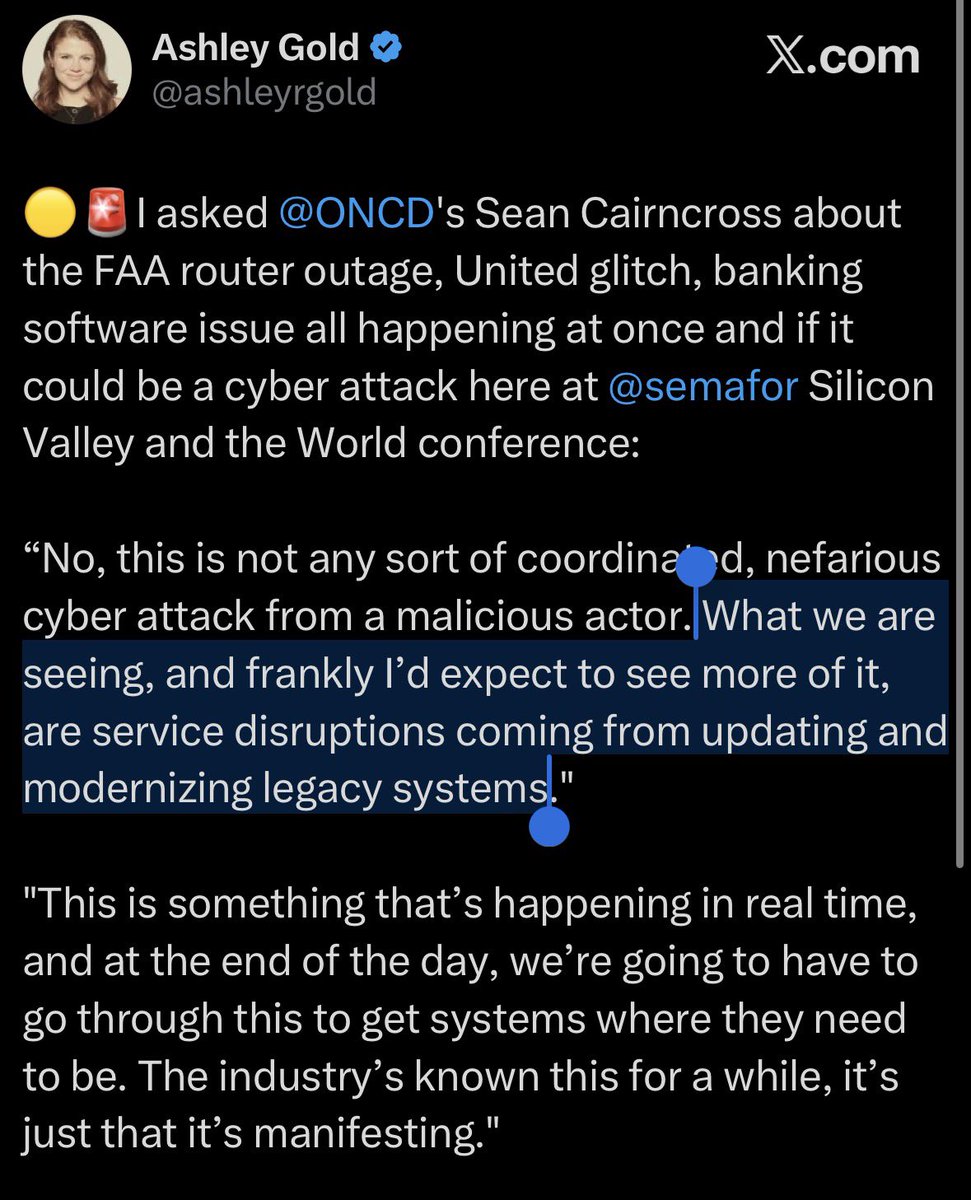
Coincidences Magnified - Are We Under Attack?
I will preface this with the humility that I might be totally wrong and all these recent events really are some type of coordinated cyber-attack, although I would say if it is it’s all rather pointless and unfocused. But, I doubt this is really an “attack” in any way. However, just because you’re paranoid doesn’t mean that they are not really out to get you.
No, the most likely explanation of what is going on is:
1. Fragility of increasingly large-scale and under-maintained, complex and brittle infrastructure.
2. Our increased digital dependence such that when these events happen we notice them more.
3. A few independent incidents coincidentally occurring together which causes the media and the rest of us to be more attuned to other outages that would normally go unreported, that we now bucket into some mythologized growing category.
4. Lack of resilience in the presence of failures so that their impact is longer-lasting and more impactful.
Let’s pick on a few of these. First, independent occurrences of events that seem to be connected. One example I remember was a day many years ago when the New York Stock Exchange was down for the day (software error), a US airline was ground stopped (hardware event), and on the same day a bunch of major bank CISOs, including me, were going into the White House Situation Room for a totally unrelated threat briefing (we had to hide from the White House Press Corp in case that was further coincidental evidence of “attack on America”.) After this I looked at what else happened that was unreported that day and there were dozens of other unrelated outages at hospitals, power plants, and so on. Perhaps even more happened that one day than has been happening this past week. It just went unreported.
Second, do we have any base rate data to understand if what of anything that has happened is actually so unusual or surprising? [Note: something being unsurprising doesn’t mean it’s acceptable, in fact we want such events to become ever more surprising of course].
- Microsoft outage: yes, this was unusually big, but a Microsoft outage isn’t a new occurrence. (Other large-scale tech providers have outages also, to be fair to Microsoft).
- FAA outage: maybe this was a minor change to one of 1000’s of cables that had previously been fine that had some weird accidental effect they’d not seen before hence this wasn’t the situation of “why do a production change on a Friday?” Organizations do changes all the time that they think are distant from impact risk. Perhaps this was like that. But it does seem their network should not have been so brittle in the face of this. I guess we will find out.
- NSA Net outage: do you know how many times NSA Net goes down per year? I don’t. But perhaps NSA Net isn’t a literally 100% available system (most things aren’t [literally], even stupendously critical things), so perhaps this was still within their four or five 9’s SLO. Perhaps it goes down several times a year but we just don’t normally hear about it. I don’t know, most of everyone else doesn’t either.
The list could go on.
The thing that should be disturbing to us though is the point on resilience.
I really worry when things like this happen together or in isolation and our response is: “This [bad thing] must never happen again.” and the organizations involved, sometimes when compelled to, make that system less likely to break. Then we build up more dependence on it, but again it will inevitably break in some new way for some other reason and the damage will be bigger because that increased confidence induced more dependence, because we all said “this must never happen again.”
The real lesson here is that we need to not just build resilience to failure in specific components but resilience in the overall “system”, like let’s always assume FAA comms may go down albeit at some increasingly low probability and have a true back-up emergency communications approach to at least sustain some operations. Maybe they’re working on this, I don’t know. And make sure that critical industrial systems don’t depend on alerts only being delivered by cloud-based email.
I’ll start where I began. It will be darkly funny if I’m wrong and this really is a set of related attacks. But when you look at how much breaks regularly everywhere all the time, I doubt it.
The actual need here is to reduce brittleness and increase resilience on the assumption that everything will always fail in some way at some time.
I haven’t lived here in awhile, but I see no other way to answer the hundreds of texts/DMs asking me if the world is, indeed, ending.
In the span of six days, we’ve experienced;
11/12 — Microsoft outage
11/13 — Nationwide FAA ground stop
11/16 — Major US banking disruptions
11/17 — NSA’s classified internal network goes down
We need far more analysis of why so much is breaking at once. I don’t want to get out over my skis here, and what I am hearing does not contradict the messaging that most of this is the result of screwy updates.
But stepping back, the dots are starting to form a collective picture. We are seeing:
• An explosion in severe and critical vulnerabilities, with AI accelerating discovery to 3X the number of vulnerabilities discovered in the same period last year. This is collectively being referred to as “vulnageddon” or “the vulnpocalypse.”
• Mean time to exploit those vulnerabilities has collapsed to NEGATIVE SEVEN DAYS. AI allows attackers to find/exploit vulns far faster than software makers have time to fix them.
• Powerful AI-enabled offensive tools like ARTEX have been thrown into the hands of every third tier nation state, cybercriminal and digital arsonist, which logically creates havoc.
• This creates enormous pressure to compress patching windows and accelerate software updates, increasing the likelihood these fixes break things in unexpected, cascading ways.
• Pressure to just “AI everything” means we are rolling out automated AI tooling on top of brittle infrastructure that can’t support it.
My generation grew up in an extraordinary period of technological stability. We worked our way up the software stack, abstracting away layer after layer, until we lost a fundamental understanding of how the underlying systems actually work.
We were told to “move fast and break things.” VCS told us to celebrate the idea that “software would eat the world.” Now we’re telling ourselves we can simply “roll out AI” across everything, as though nothing underneath will buckle.
We never stopped to ask: SHOULD WE?
Should we be digitizing every last nook and cranny of our companies, infrastructure, healthcare, homes, cars, bodies, lives? Especially when the complexity, interdependence, and fragility we were introducing overwhelmed our ability to understand/secure/maintain the systems we built?
Nobody every asked: What if, in the name of progress, we were creating the ripest attack surface in human history?
We are now entirely dependent on software systems that almost nobody understands end to end, that increasingly few people can repair, and that attackers can now probe at machine speed. We are hearing that incident response firms, the 911 for breach victims, are backlogged six months. Even those paid on retainer lack the bandwidth to triage every incident. The cavalry is disappearing.
We are entering a period of unprecedented technological instability.
“Software Beirut” is an incredibly apt analogy. We are in for a period of cascading failures, whether triggered by attackers, bad updates, or our own accumulated complexity.
This, I’m sorry to say, is just the opening chapter.
I meant to ride a river
down the banks of blue and green
like jazz begets a poem
my mouth begins to sing
i won't expect a day job
doing words and song and tune
I'll leave it in the riverbed
come wading with me soon
check out the full post coauthored with @raymondadouglas for more details, a big table of results, stories of our battles with WorkspaceBench, and more…
https://t.co/vuG6em7Sn7
Democrats will now control the House and Senate and be able to hold Trump accountable. That's great.
At a time of massive income and wealth inequality, we must do more. We must aggressively fight for working families.
No more excuses.
I wrote an essay about my experience hearing voices and the ways I've learned to work with them over the past two years. It's an ongoing process but this is where I am and where I've been
https://t.co/IA5qP69YVv
Kidly reminder about #Musk .
What Elon Musk has done since buying Twitter:
- he unblocked all anti-vaxxers, conspiracy theorists, Russian propagandists and Russian official media - all huge accounts of influential accounts with millions of subscribers;
- he canceled the labeling of profiles that work for foreign propaganda media (Russia, Iran, China) such as Russian Television and others;
- he destroyed the system of control and verification of fake information (Community notes work very selectively and in an extremely small part of the lies) and even if there is a community note, the lie still continues to be broadcast in the feed for millions;
- the official Twitter RULES work very rarely and selectively. Almost never work for Russian propagandists and MAGA.
- Elon systematically adds hundreds of thousands of views with his comments on the posts of the most popular liars and propagandists (for example, Tucker Carlson, Wall Street Silver, David Sachs ...), whom he called "citizen journalists";
- he provided a very easy opportunity for liars and propagandists to make money from lies, fakes and propaganda - in a system where there is no punishment for outright lies and propaganda, the false posts themselves get millions of views. That is, in such a system, the more and cynically you lie, the more money you make from views as a content creator.
He is not stupid. And it was a consistent and well-thought-out plan to help Russia and Trump from the very beginning.
🗞️🇺🇸 Finding a democracy-eroding "crisis of authenticity" fueled by the spread of AI-generated content and deepfakes, @ISDglobal have released an analysis of the role AI played in the recent US election:
🗣️ "The rapid increase of AI-generated content has created a fundamentally polluted information ecosystem where voters are struggling to assess content’s authenticity and increasingly beginning to assume authentic content to be AI generated, or question whether anything they see is real at all."
🗣️ "This deterioration of trust in political discourse posed significant risks during the election period, when time-sensitive events created fertile ground for the spread of AI-generated content, and voters had to make critical decisions based on increasingly unstable information foundations."
🔗Read the full report at the link in the replies.