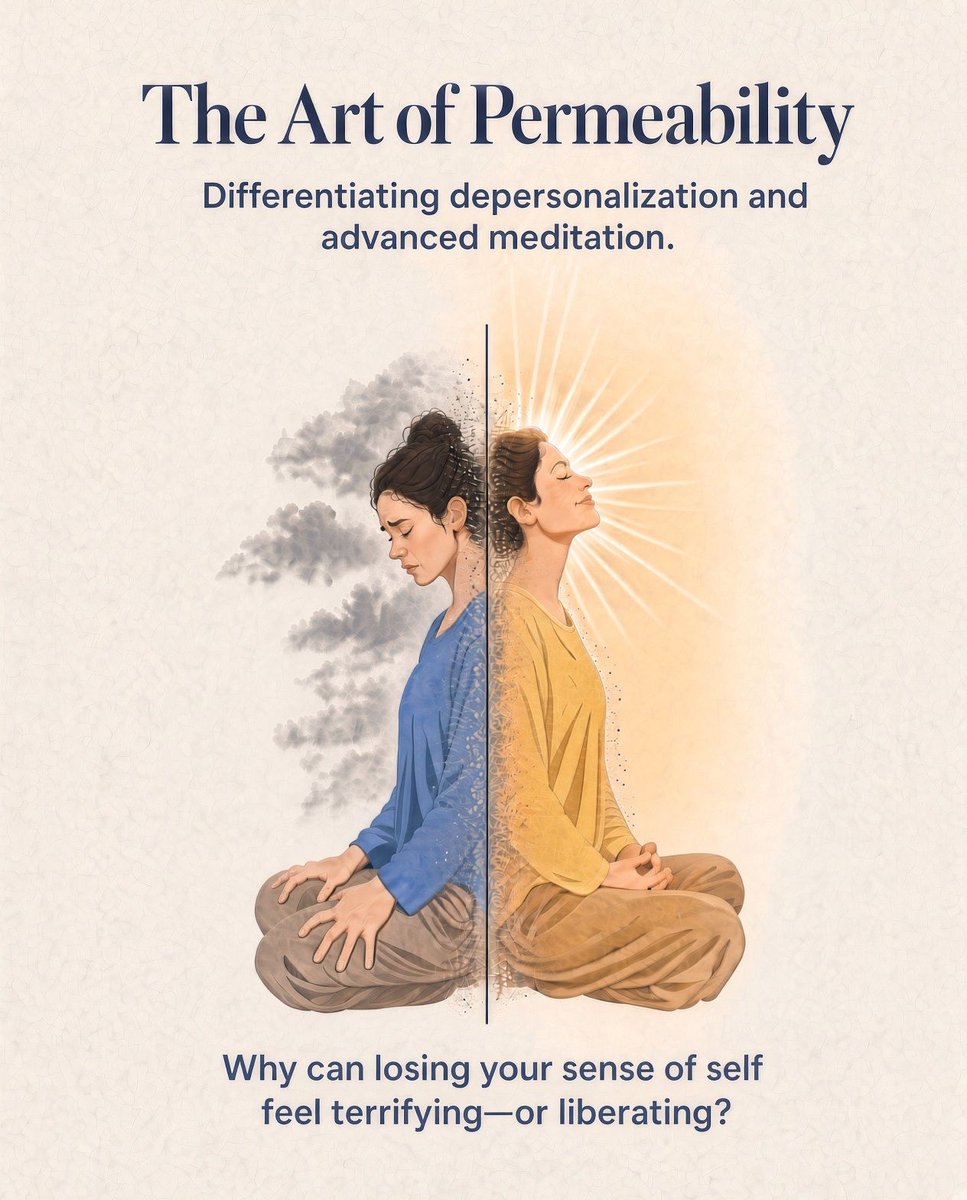
Why can losing your sense of self feel terrifying during depersonalization—but liberating in advanced meditation?
Although these experiences can appear similar, their underlying mechanisms may be quite different. Our research suggests the difference may lie in how the brain processes signals from the body.
I'm delighted to share our new preprint, ���The Art of Permeability: A Computational Distinction Between Depersonalisation and Advanced Meditation.”
We propose that the key is how open the mind is to bodily experiences reshaping its sense of self:
-- In depersonalization, the mind may defensively suppress bodily signals, leaving people feeling detached or estranged from themselves.
-- In advanced meditation, the mind may become more open to bodily sensations, allowing the sense of self to become more flexible without losing its connection to the body.
Importantly, greater openness isn't necessarily better on its own. The ability to safely tolerate and integrate bodily sensations may be what makes the difference.
Our theoretical framework offers a new way to understand these contrasting experiences, with implications for contemplative science and mental health research.
Congratulations to first author Fedal Saini @fedalsaini and our co-authors Hagar Tal and Ruben E. Laukkonen @RubenLaukkonen.
Preprint PDF: https://t.co/Z8xMaMzZkH
May this work benefit many 🙏
What do you think distinguishes a loss of self that is distressing from one that feels liberating?
#AdvancedMeditation #MeditationResearch #Depersonalization
Smart isn't the same as aware. And your brain's software is also its hardware.
Three reasons why AI is not conscious and perhaps never will be
https://t.co/tbYaap9uph
#neuroscience
@IAI_TV so wait, let me understand this logic. Because the relation between hippocampul processes and declarative memory is complex, that somehow justifies the leap to a dualist perspective? The absence of simplicity does not validate dualism
The ABCD Study at Yale is hiring a new post-baccalaureate research assistant! This is a great position to gain hands-on research experience in the field and to learn more about adolescent brain and behavioral development! 🧠 https://t.co/JD1UrJWJu8
I really enjoyed chatting with Christof Koch and @heather_berlin on their excellent Perception Box podcast - all about the nature of perception and self: listen here https://t.co/RgKqURfW6w & watch here: https://t.co/BnyvlYDXOZ
Launching https://t.co/lVqDcRQU0x: a living bibliography of placebo and nocebo research. New papers screened & tagged daily by design, population, outcome and findings, with a searchable database (currently about 5,000 papers), an interactive researcher map, events, news and discussion.
Like a stadium full of sports fans doing the wave, neurons coordinate their electrical signals in rhythmic patterns that sweep across the cortex, the brain’s outermost layer.
Recent studies in humans and animals have shown these patterns, called traveling waves, can take on complex shapes, among them a rotating spiral that has been observed during deep sleep, memory retrieval, and other brain processes.
Now, a study has captured the fast-spinning waves spanning whole brains, offering clues to how they’re organized and what they might do.
Learn more: https://t.co/gAK0mjsUyL
Northwestern Psychology is hiring an Assistant Professor in Clinical Psychology! Review of applications will begin on October 15, 2026!
Link: https://t.co/GTbxlli6XA
Please share widely & apply!
Excited to share the lab's latest on leveraging what we're learning from developmental neuroscience about the role of parents in children's anxiety to optimize treatments for youth! Led by @ElizabethRKitt & now out in @NatMentHealth 🧠 @YalePsychology https://t.co/FwqIhFQ2hN
My lab at Northwestern is hiring! We have openings for a Full-Time Research Assistant and a Full-Time MRI Data Analyst for studies examining neuroinflammation and mental and physical health. Please RT and share!! Click here for more information: https://t.co/JfB823M61H
Northwestern Medicine is launching the new Dauten Behavioral Health Institute, made possible by a transformative $25M gift from the Dauten Family Foundation. The Institute will advance coordinated, system‑wide #BehavioralHealth care and introduce the first #BipolarDisorder Center of Excellence, accelerating innovation in diagnosis, treatment, and outcomes. https://t.co/ezBEb8MoSu
Interested in research on depression in youth? New opening for a full-time research assistant in our lab (https://t.co/0lHKr5jZiM) to work on a range of projects focused on the causes & treatment of depression in teens. Please RT and share! Apply⬇���
https://t.co/QULG7pXCp2
@karlmehta I study the anterior cingulate (amongst other brain systems). To reduce all of will power down to a single brain region is an oversimplification of the complexity of how the brain works and is more click bait than anything
3-day #fMRI course live online Jan 7-9, 2026!
#SPM, #ICA, GLM, connectivity, mediation, MRI physics, #DataScience with @vdcalhoun and Kent Kiehl.
We love talking methods & connecting with colleagues! Come join us!
Register at:
https://t.co/JJuATJesyf
I'm recruiting a graduate student this year! If you’re interested in using MRI to study brain systems involved in emotion and how they link to mental and physical health, please apply! Check out our current projects here. Please share and retweet! https://t.co/3H5XRSvpIp
𝗖𝗼𝗴𝗻𝗶𝘁𝗶𝗼𝗻 𝗶𝘀 𝗲𝗺𝗲𝗿𝗴𝗲𝗻𝘁
Is neuroscience in need of a reboot??
Check presentation + discussion with Earl Miller (
@MillerLabMIT) on the Neuroscience and Philosophy Salon
https://t.co/r63pVEobIg
New paper by ACNL alumni Kate Damme in JAMA Pediatrics explains how the timing of stressful events relative to neurodevelopment can help identify risk factors (looking backward) and predict future psychopathology (looking forward) at the individual level! https://t.co/FRHNcBwqC4