@KordingLab@ylecun IMO engineers can be especially powerful in research. Deeply theoretical (cf. signal/image processing, control, and information theory) while bringing a bias toward pragmatic experiments that fail quickly, quantify precision/output, and narrow the solution space.
@bttyeo@tianchuzeng@kkli20111@ZShaoshi@ten_photos Suggestion for slightly more precise (but still promotional) title: “Statistical tests often ignore cross-validation dependence in biomedical ML.” or, if you want to go further out on the ledge: "“Almost Everything You Thought Was Significant in Biomedical ML May Be Wrong". ;-)
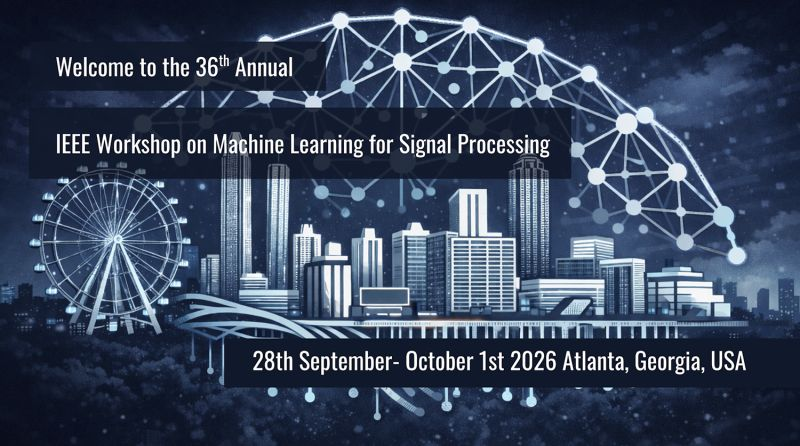
The next edition of the IEEE Machine Learning for Signal Processing (MLSP) Workshop will take place in Atlanta, USA, from September 28 to October 1, 2026! 🤩
Take a look at the website for further information and deadlines: https://t.co/iYOnuOYo57
See you soon Atlanta! 🚀
The Molecular Connectivity Working Group (MCWG) invites you to our upcoming Symposium “Molecular connectivity: Best practices for data analysis” in Bordeaux (France) on June 19th, 8:30 am - 1:00 pm CEST, in the same city and right after the #OHBM2026 Annual Meeting!
Moreover, using only phase information from thirteen identified flows, a linear classifier decoded 23 tasks at 89.9% accuracy, outperforming network activation amplitude. This suggests the brain's key control variable is when dynamics align, not where or how much it activates.
This addresses the stability–flexibility problem: how does flexible task activation arise from stable FC architecture? Assuming stable flows, our framework reconstructs 23 task activation maps (mean R = 0.73) while preserving FC topology across all task states.
Flows are identified by modeling coherence among intrinsic networks, referred to as intrinsic network flows (INFs). Remarkably, the flow sequence of the dominant flow (INF 1) — the one contributing most to dynamics — closely resembles the joint embedding of FC gradients 1 and 2.
Happy to share my first work as a postdoc!🎉 We show diverse cognition can emerge by retiming stable intrinsic flows. Such flows reconstruct FC, whole-brain gradients, and even 23 task activations via phase alone, unifying resting & task dynamics. #neuroscience#CenterTrends
@KordingLab@TroyASmithPhD That would be a very different paper. ;) I read this more as modest effects + lots of caveats, not ‘street layout explains everything'.
@KordingLab@TroyASmithPhD Like saying ‘the layout of a gym can’t affect fitness’…until you realize it changes how often and how hard people use it. I haven't read in detail, but given how strongly navigation demands are linked to hippocampus, it doesn’t seem that far-fetched.
@KordingLab@TroyASmithPhD I’d frame it less as ‘obvious confounds’ and more as ‘important residual confounds.’ They did include area-level SES and several other adjustments. The tougher issue is selection and behavior, which is harder to nail down.
@AndrewZalesky@shansiddiqi Totally agree with open sharing, but what's allowed depends on the IRB, some take the view that *anything* at the subject level comes with risk of re-identification. But even if not allowed, one can consider a federated analysis vault (https://t.co/KSrAnvZCXY)